Why Protesters Want CEC Gyanesh Kumar to Resign – Introduction
Protests demanding the resignation of Chief Election Commissioner (CEC) Gyanesh Kumar have intensified across India, bringing questions about voter rights, electoral transparency, and the independence of democratic institutions into the national spotlight. Demonstrations involving student groups, opposition parties, and civil society activists have taken place in Delhi, Mumbai, and other locations, with protesters accusing the Election Commission of India (ECI) of mishandling changes to electoral rolls.
At the centre of the controversy is the Special Intensive Revision (SIR) of voter lists, an exercise intended to verify electoral records and identify entries that require correction or removal. Critics argue that the process has created serious concerns about the possible exclusion of eligible voters, while the Election Commission maintains that the revision is necessary to keep voter lists accurate.
The demand for Gyanesh Kumar’s resignation has therefore become part of a wider debate about democratic accountability and public confidence in India’s electoral system. Here is why protesters are calling for his removal and what the controversy means for Indian democracy.
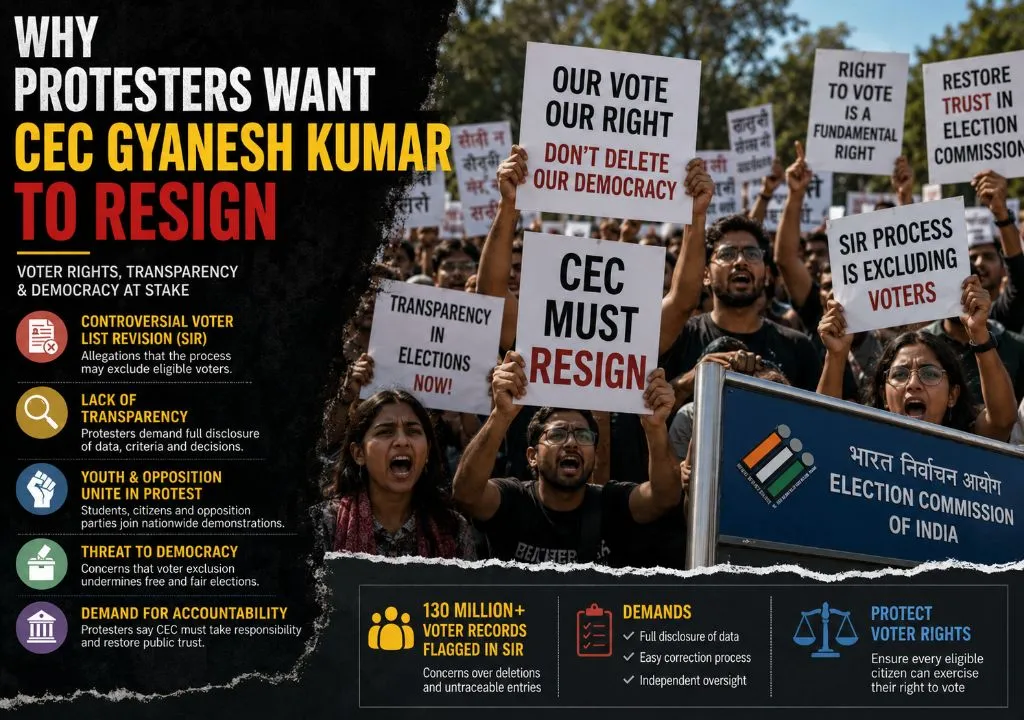
1. What Is the Main Reason Behind the Protests? (Why Protesters Want CEC Gyanesh Kumar to Resign)
The primary reason behind the protests (Why Protesters Want CEC Gyanesh Kumar to Resign) is the controversy surrounding the Special Intensive Revision of electoral rolls. Voter lists determine who can participate in elections, making their accuracy essential for a fair democratic process. The revision aims to identify duplicate entries, deceased voters, people who have moved, and other records that may no longer be valid.
However, protesters argue that the exercise has raised concerns about eligible citizens being incorrectly excluded from electoral rolls. Reports about the large number of voter records being examined or flagged have increased public concern, particularly among groups that fear the process could make voting more difficult for ordinary citizens.
Critics have questioned whether sufficient safeguards exist to prevent genuine voters from losing their registration because of administrative errors or difficulties in providing documents. They also want clearer information about how decisions are made and how affected citizens can correct mistakes.
The Election Commission, however, says that the purpose of the exercise is to improve the accuracy of voter lists rather than deny eligible citizens their voting rights. The disagreement over implementation, transparency, and accountability has become the main reason protesters are demanding Kumar’s resignation.
2. Concerns Over the Exclusion of Eligible Voters
One of the strongest concerns (Why Protesters Want CEC Gyanesh Kumar to Resign) raised by protesters is the possibility that eligible citizens could lose their right to vote because their names are missing from electoral rolls. Reports in October 2026 have drawn attention to approximately 130 million voter records reportedly classified for reasons such as death, relocation, or being untraceable during the revision process.
It is important to distinguish between records identified for verification and confirmed deletions of eligible voters. The reported figure does not automatically mean that 130 million eligible citizens have been removed from the final voter lists. Nevertheless, the scale of the exercise has raised questions about how effectively the authorities can identify genuine voters and correct errors.
Protesters argue that even a smaller number of incorrect exclusions could have serious consequences, particularly for people who face difficulties accessing official documents, updating their addresses, or completing administrative procedures. If an eligible citizen discovers that their name is missing when an election takes place, correcting the problem may become difficult within the available time.
For this reason, demonstrators want the Election Commission to explain the verification process, provide accessible correction procedures, and establish stronger safeguards against wrongful exclusion. Their demand for Kumar’s resignation reflects the belief that the leadership must accept responsibility when a process of this scale raises questions about voting rights.
3. Why Is Chief Election Commissioner Gyanesh Kumar Being Targeted?
The Election Commission is responsible for supervising elections and maintaining public confidence in the electoral process. As its chief, Gyanesh Kumar has become the main focus of criticism from groups that believe the institution has not adequately addressed their concerns about the voter-list revision.
Opposition leaders and protest groups have questioned the Commission’s decision-making procedures and called for greater transparency regarding the implementation of the SIR exercise. Reports about disagreements within the Commission over certain procedures have added to demands for explanations.
Protesters (Why Protesters Want CEC Gyanesh Kumar to Resign) argue that the head of an independent constitutional institution should be accountable for decisions that may affect citizens’ voting rights. They believe that a resignation would demonstrate responsibility and create an opportunity to rebuild public confidence.
However, demands for Kumar to step down are political and civic demands, not proof that he has personally manipulated electoral rolls. The allegations of wrongdoing and the Commission’s response must be assessed through evidence, official records, and appropriate legal processes.
Kumar’s position has consequently become central to a larger dispute over whether the Election Commission is providing sufficient answers to concerns about the revision process.
4. Role of Youth Groups and Opposition Parties
The protests (Why Protesters Want CEC Gyanesh Kumar to Resign) have attracted attention because they bring together different sections of Indian society, including student organisations, opposition politicians, activists, and youth-led movements. The Cockroach Janta Party (CJP), a youth-led movement, has been among the prominent groups calling for Kumar’s resignation.
Opposition parties have also supported demonstrations and criticised the handling of electoral revisions. Their participation has helped turn an administrative dispute into a broader political debate about electoral fairness, government accountability, and democratic institutions.
For younger protesters, the controversy is connected to a fundamental question: whether every eligible citizen can exercise the right to vote without facing unnecessary administrative barriers. Student groups and civil society activists have argued that electoral transparency is not simply a concern for political parties but an issue affecting the future of democracy.
At the same time, political participation means that the protests include different objectives. Some groups want Kumar to resign, while others have called for changes to the SIR process, stronger protections for voters, and wider electoral reforms.
The movement therefore reflects both immediate concerns about voter registration and broader dissatisfaction with the way important democratic institutions respond to public criticism.
5. Why the Election Commission’s Response Matters
The Election Commission has defended the revision process, stating that its purpose is to maintain accurate electoral rolls by identifying deceased, duplicate, relocated, or otherwise ineligible entries. It has also maintained that eligible citizens who have been left out can seek inclusion through the prescribed procedures.
The Commission’s position highlights a legitimate administrative responsibility: inaccurate voter lists can create problems for election management and undermine the reliability of electoral records. Regular verification can therefore be an important part of maintaining a credible electoral system.
However, the effectiveness of such an exercise depends on how it is implemented. Authorities must ensure that genuine voters are not unfairly excluded, that the reasons for changes are clearly communicated, and that correction procedures are accessible to people across different social and economic backgrounds.
Protesters want more than general assurances that the process is lawful. They are calling for detailed explanations, greater transparency, and effective mechanisms through which citizens can challenge mistakes.
A clear response from the Election Commission could help reduce confusion and restore confidence among voters. On the other hand, continued disagreement without satisfactory answers may deepen public distrust and prolong the controversy.
6. Police Action and the Right to Protest
The controversy (Why Protesters Want CEC Gyanesh Kumar to Resign) has also raised questions about the right to peaceful protest. Demonstrations in Delhi have involved heavy police deployment, restrictions on gatherings, and detentions of protesters. It had been reported that more than 2,000 people were detained during a crackdown ahead of a planned demonstration on October 10, 2026.
The authorities have imposed restrictions on some gatherings, while protest organisers have continued to call for demonstrations against the Election Commission’s handling of voter lists. These developments have added another dimension to the controversy, with activists and opposition leaders raising concerns about the space available for public dissent.
Peaceful protest is an important means through which citizens can express disagreement, demand accountability, and bring public attention to issues that they believe require urgent action. At the same time, authorities have responsibilities relating to public order and safety.
The challenge is to manage demonstrations lawfully while respecting fundamental rights. How the government and law enforcement agencies respond to these protests may influence public perceptions of democratic freedoms and institutional accountability.
7. What Could the Controversy Mean for Indian Democracy?
The dispute surrounding (Why Protesters Want CEC Gyanesh Kumar to Resign) is significant because public confidence in elections depends on more than the announcement of results. Citizens must also believe that voter registration is fair, electoral procedures are transparent, and complaints can be addressed through reliable mechanisms.
If eligible voters are incorrectly excluded and their complaints are not resolved effectively, confidence in the electoral system could weaken. Even when administrative errors are unintentional, a lack of clear communication can create suspicion and increase political tensions.
The controversy also highlights the importance of institutional independence. The Election Commission must be able to carry out its responsibilities impartially while explaining its decisions to the public. Similarly, allegations against the institution should be examined through evidence rather than treated as established facts simply because they have become politically prominent.
Whether Kumar resigns or remains in office, the central questions will continue to concern the accuracy of voter lists, the protection of voting rights, and the credibility of the institutions responsible for conducting elections.
Conclusion
The demand for Chief Election Commissioner Gyanesh Kumar’s resignation has grown out of concerns surrounding the Special Intensive Revision of electoral rolls, the possible exclusion of eligible voters, and questions about transparency within the Election Commission. Protesters believe the institution’s leadership must take responsibility for addressing these concerns, while the Commission maintains that the exercise is intended to improve electoral accuracy.
The controversy (Why Protesters Want CEC Gyanesh Kumar to Resign) has expanded beyond one official, becoming a wider debate about voter rights, institutional accountability, and the right to peaceful protest. For India’s democracy, the priority should be ensuring that electoral records remain accurate without denying eligible citizens their opportunity to vote.
Clear explanations, accessible correction procedures, and transparent decision-making will be essential to rebuilding trust. Ultimately, the credibility of India’s electoral system will depend on whether citizens can participate confidently and whether their concerns receive fair and effective consideration.
If you find this article worth reading, then you will be interested in what the globaltides had posted in Indian Politics section
