Super El Niño Sets Records: 2026 May Be the Hottest Year
The world is facing another major climate challenge as a powerful El Niño event develops in the Pacific Ocean, raising concerns about rising global temperatures and extreme weather. Scientists are closely monitoring the phenomenon because it could influence weather conditions across several continents, increase the risk of heatwaves and droughts, and contribute to further global temperature records. With 2026 already experiencing unusually warm conditions, the strengthening El Niño has brought renewed attention to the connection between ocean temperatures and climate change.
According to the World Meteorological Organization (WMO), the current El Niño is expected to intensify towards the end of 2026 and could become one of the strongest events observed since at least 1950. Forecasts indicate that unusually warm waters in the central and eastern tropical Pacific could reach exceptional levels during October, November and December. These conditions are expected to influence temperatures and rainfall patterns in many parts of the world.
However, scientists caution that the final global temperature ranking for 2026 cannot be confirmed before the complete year’s observations are available. The growing concern is that a powerful “El Niño Sets Records: 2026 May Be the Hottest Year”, combined with long-term human-caused global warming, could push temperatures even higher and increase climate risks into 2027.
What Is El Niño and Why Is It Important?
El Niño is a natural climate phenomenon that develops when surface waters in the central and eastern tropical Pacific Ocean become warmer than usual. This warming changes the interaction between the ocean and the atmosphere, influencing wind patterns, rainfall and temperatures across different parts of the world.
Under normal conditions, trade winds generally push warm surface water towards the western Pacific, allowing cooler water to rise in parts of the eastern Pacific. During El Niño, these winds weaken or change, allowing warm water to spread eastward and altering the movement of heat and moisture through the atmosphere.
These changes (El Niño Sets Records: 2026 May Be the Hottest Year) can affect weather thousands of kilometres away from the Pacific Ocean. Some regions may experience unusually high temperatures and dry conditions, while others may receive heavier rainfall and face an increased risk of flooding. The exact effects depend on the strength of the event, the season and other climate patterns operating at the same time.
El Niño is part of a natural cycle known as the El Niño–Southern Oscillation, or ENSO. Its cooler counterpart is La Niña, which is associated with cooler-than-average sea-surface temperatures in the central and eastern tropical Pacific.
El Niño events occur periodically, often every two to seven years, but their strength and effects vary. The current event is attracting particular attention because forecasts suggest that Pacific Ocean temperatures could rise beyond levels recorded during previous major events.
The WMO has also clarified that the expression “super El Niño” is an informal term rather than an official category in its operational climate classification. Nevertheless, it is commonly used to describe an exceptionally strong event.
Why El Niño Sets Records: 2026 May Be the Hottest Year?
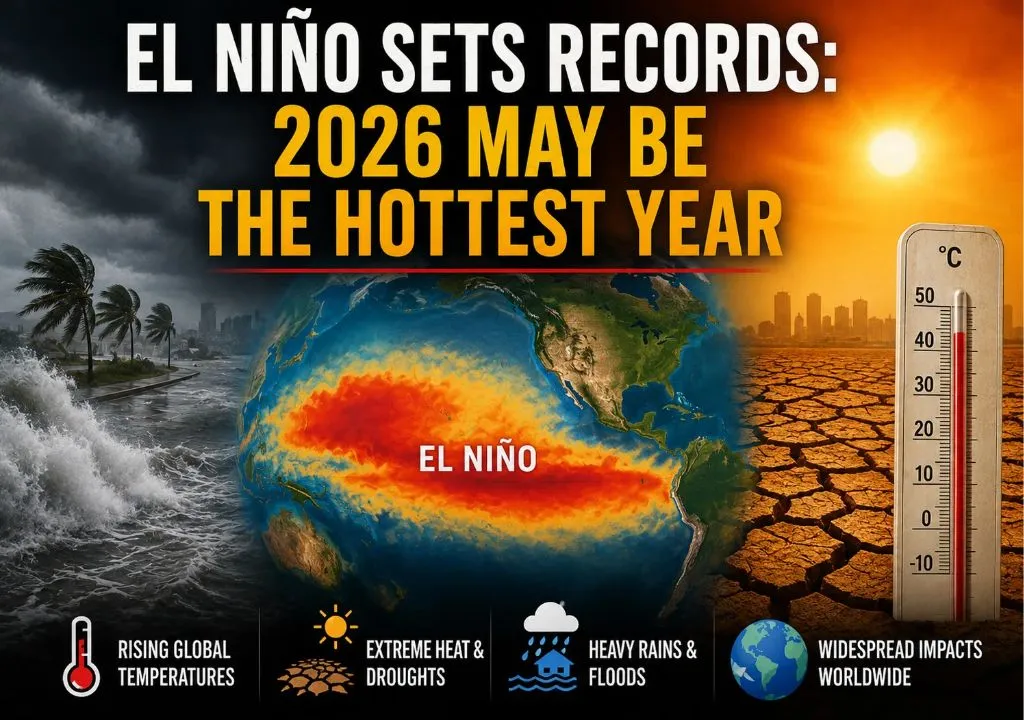
The possibility of another record-breaking year comes at a time when global temperatures are already elevated because of human-caused climate change. Greenhouse gases released through the burning of coal, oil and natural gas trap heat in the Earth’s climate system, raising average temperatures over time.
“El Niño Sets Records: 2026 May Be the Hottest Year” can add to this existing warming by changing how heat is distributed between the ocean and the atmosphere. During a strong event, the tropical Pacific releases more heat into the atmosphere, which can temporarily increase global average surface temperatures.
This does not mean El Niño is the main cause of long-term global warming. Instead, it acts as a natural influence on top of a climate system that has already become warmer because of human activity.
The distinction is important because global temperatures can vary from one year to another, even while the long-term warming trend continues. A strong El Niño may push temperatures higher, while La Niña can temporarily moderate some of the warming without reversing climate change.
The WMO‘s October 2026 seasonal outlook forecasts that the central and eastern tropical Pacific could experience a sea-surface temperature anomaly of approximately 3.7°C above the relevant long-term average during October–December. This is a forecast for a specific part of the Pacific Ocean, not a prediction that the entire planet will warm by 3.7°C.
If the event (El Niño Sets Records: 2026 May Be the Hottest Year) develops as expected, it could contribute to unusually high global temperatures in late 2026 and into 2027. However, whether 2026 becomes the hottest year ever recorded will depend on the temperatures observed across the entire planet, not on the Pacific Ocean alone.
How Could a Strong El Niño Affect the World’s Weather?
One of the main concerns surrounding the developing El Niño Sets Records: 2026 May Be the Hottest Year is its potential to change rainfall patterns and increase the likelihood of certain extreme weather events. Although the effects vary between regions, several areas could face significant challenges.
1. Rising Temperatures and Heatwaves
A powerful El Niño can increase the likelihood of above-average temperatures across many parts of the world. When this influence combines with long-term global warming, already hot regions may experience more intense heat, placing pressure on public health, electricity supplies and water resources.
Extended periods of extreme heat can be particularly dangerous for older people, outdoor workers, children and those without access to cooling. Heat can also reduce labour productivity, increase the demand for electricity and place additional pressure on healthcare services.
2. Drought and Water Shortages
El Niño can reduce rainfall in certain regions, increasing the risk of drought and water shortages. Parts of Southeast Asia, Australia and Central America are among the areas that can experience drier conditions during some El Niño events, although local outcomes are never guaranteed.
Prolonged dry weather can reduce reservoir levels, damage crops and increase the risk of wildfires. Communities that depend heavily on seasonal rainfall may face additional difficulties when water supplies decline.
3. Heavy Rainfall and Flooding
While some regions may experience drought, others could receive unusually heavy rainfall. Changes in atmospheric circulation can increase the likelihood of intense rain in parts of South America and other areas affected by El Niño-related weather patterns.
Heavy rainfall can overwhelm drainage systems, damage roads and homes, disrupt transport networks and threaten agricultural land. The consequences can be particularly serious in places where infrastructure is not designed to manage extreme weather.
4. Pressure on Agriculture and Food Prices
Agriculture depends heavily on predictable rainfall, suitable temperatures and reliable water supplies. When these conditions change, farmers may experience lower yields, crop failures or higher production costs.
If several agricultural regions experience unfavourable weather at the same time, food supply chains can face additional pressure. Reduced harvests may contribute to higher food prices, especially for households that already spend a large share of their income on essential goods.
These risks make El Niño more than a climate issue. Its effects can spread into food security, public health, employment and the wider global economy.
What Does the Developing El Niño Mean for India?
India is among the countries where “El Niño Sets Records: 2026 May Be the Hottest Year” deserves close attention because the phenomenon can influence the summer monsoon, which supplies a large share of the country’s annual rainfall.
Historically, El Niño has often been associated with weaker Indian monsoon rainfall, increasing the possibility of dry conditions in some regions. However, the relationship is not automatic. Other factors, including the Indian Ocean Dipole, ocean temperatures and regional atmospheric conditions, can strengthen or weaken its influence.
The Indian Ocean Dipole is particularly important because it describes differences in sea-surface temperatures between the western and eastern tropical Indian Ocean. A positive phase can sometimes help support Indian monsoon rainfall even when El Niño conditions are present.
The impact of the current event (El Niño Sets Records: 2026 May Be the Hottest Year) on India will depend on how these climate drivers interact. It would therefore be inaccurate to conclude that a strong El Niño will automatically cause a drought across the entire country.
Nevertheless, the developing event raises important questions about water management, agricultural planning and preparedness for extreme temperatures. Farmers may need reliable seasonal forecasts to make decisions about sowing, irrigation and crop selection. State governments and local authorities may also need to prepare for heat stress, changing rainfall patterns and pressure on drinking-water supplies.
For a country with a large agricultural sector and significant regional differences in rainfall, early warnings and accurate local forecasts are especially valuable. Understanding the risks in advance can help reduce potential losses and protect vulnerable communities.
Economic and Human Consequences of Extreme Weather
The consequences of a strong El Niño may extend far beyond temperature records. Extreme heat, droughts and floods can interrupt transport, damage infrastructure and increase the costs of producing food and electricity.
For businesses, unpredictable weather can affect supply chains, agricultural production, construction and outdoor work. Governments may need to spend more on disaster response, healthcare, water supply and emergency assistance, while households could face higher food bills and additional costs associated with cooling their homes.
The impact is often unequal. Wealthier communities may have better access to air conditioning, insurance and emergency services, while low-income households can find it harder to recover from crop losses, flooding or prolonged heat.
Climate-related risks can also contribute to food insecurity in regions already affected by conflict, poverty or weak infrastructure. When harvests decline and essential goods become more expensive, vulnerable families may struggle to obtain sufficient food and clean water.
These risks highlight the importance of treating climate preparedness as part of economic and social planning rather than as an issue limited to environmental policy.
What Can Governments and Individuals Do to Prepare ?
Although countries cannot prevent a natural El Niño event from developing, they can take steps to reduce its potential damage. Early-warning systems, reliable weather forecasts and effective communication can help communities prepare for heatwaves, floods and droughts before conditions become dangerous.
Governments can improve water-storage systems, strengthen drainage infrastructure, protect electricity networks and support farmers with climate information. Public health authorities can issue heat advisories, establish cooling facilities and ensure that vulnerable populations receive timely assistance.
Businesses can review emergency plans and assess whether extreme weather could disrupt their operations. Farmers can use seasonal forecasts to make informed decisions about planting, irrigation and crop management, while cities can expand green spaces and improve their ability to manage heat.
Individuals can also take practical precautions by following official weather warnings, conserving water during shortages and avoiding strenuous outdoor activity during dangerous heat. However, responsibility should not fall only on individuals, because large-scale climate risks require coordinated action and investment.
The longer-term response must also address the main cause of global warming by reducing greenhouse gas emissions and accelerating the transition towards cleaner energy. Preparing for El Niño can limit immediate harm, but reducing emissions remains essential to slowing the underlying rise in global temperatures.
Conclusion: A Warning Sign for the World’s Climate
The developing super El Niño Sets Records: 2026 May Be the Hottest Year has increased concerns that global temperatures could reach new highs as 2026 draws to a close and 2027 approaches. Forecasts from the WMO point to an exceptionally strong event, with the potential to influence heat, rainfall and extreme weather across multiple regions.
However, the event should be understood in the context of long-term climate change. El Niño is a natural phenomenon, while the persistent rise in global temperatures is largely driven by human-caused greenhouse gas emissions. When these two influences combine, the consequences can become more severe.
For India and the rest of the world, the priority is to prepare for changing weather conditions, strengthen early-warning systems and protect communities that are most vulnerable to climate-related disasters. Governments, businesses and individuals all have a role to play, although effective public planning and international cooperation are essential.
The coming months will provide a clearer picture of the event’s strength and its effects on global temperatures. Whatever the final ranking of 2026, the developing El Niño Sets Records: 2026 May Be the Hottest Year is a reminder that climate preparedness cannot wait until records are broken or disasters occur. Understanding the risks early and responding with practical measures can help protect lives, livelihoods and the environment.
