Introduction (Europe Protests Over Rising Living Costs)
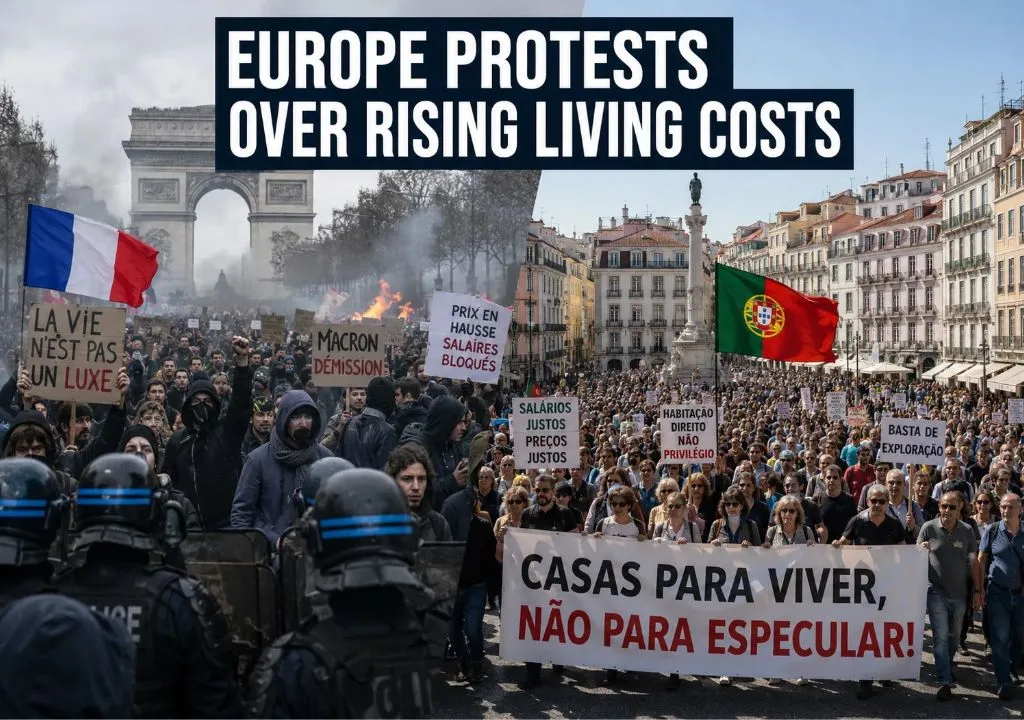
Europe is facing a fresh wave of public anger as rising living costs, expensive housing and concerns about public services push people onto the streets. On October 17, 2026, demonstrations took place in several European countries, including France, Portugal, Italy and Belgium. While many people joined peaceful marches to demand economic relief, protests in France turned violent in several cities, bringing renewed attention to the growing gap between household incomes and everyday expenses.
In Lisbon, thousands of people gathered to protest against rising rents, low wages and the difficulty of finding affordable homes. Meanwhile, demonstrations in France grew beyond student grievances and developed into a wider expression of dissatisfaction with living standards and government policies. The unrest highlights a common concern across Europe: many people feel that earning a living is becoming increasingly difficult, even when they are employed or have spent years building their careers.
The latest demonstrations (Europe Protests Over Rising Living Costs) are not simply about higher prices at supermarkets or petrol stations. They also reflect concerns about economic inequality, housing security, access to education and the quality of public services. As pressure builds on governments, the protests raise important questions about how European countries can protect household incomes while managing their wider economic challenges.
Europe Protests Over Rising Living Costs Is Growing Public Frustration
France has become one of the main centres of the latest wave of demonstrations. On October 17, large crowds gathered across the country to protest against the rising cost of living and declining public services. According to reports, the demonstrations involved hundreds of thousands of people, with estimates varying between official figures and trade union assessments.
Although many participants marched peacefully, some gatherings developed into violent confrontations. Clashes between protesters and police were reported in several cities, including Paris, Lyon and Marseille. Incidents included fires, damage to property, looting and the use of tear gas and water cannon by police to disperse crowds.
The protests brought together people with different concerns. Students raised issues related to school conditions, staff shortages and university admissions, while workers and trade union members called for better wages, improved pensions and action to address rising prices. These overlapping demands helped turn separate complaints into a broader expression of economic and social frustration.
France has a long history of public demonstrations against economic reforms and government decisions. The earlier Yellow Vest movement, which began in 2018, showed how concerns about fuel costs and purchasing power could develop into a much wider political movement. The latest unrest has revived some of those concerns, particularly the feeling that ordinary households are carrying too much of the economic burden.
However, it is important to distinguish between peaceful demonstrators and those involved in violence. Not everyone participating in the marches supports property damage or clashes with law enforcement. For many citizens, protesting remains a way to demand that political leaders respond to problems affecting their daily lives.
Lisbon Marches Highlight Portugal’s Housing Crisis
While (Europe Protests Over Rising Living Costs) France experienced violent unrest in several locations, Lisbon witnessed large demonstrations focused on the cost of living and the country’s worsening housing affordability problem. On October 17, tens of thousands of people marched through the Portuguese capital.
The demonstrations were called by Portugal’s main trade union confederation, the CGTP, and focused on demands for higher wages, better pensions and stronger public services. Housing rights campaigners also joined the protests, highlighting the difficulties faced by people trying to find affordable accommodation in major cities.
Housing has become a particularly serious concern in Portugal. House prices have more than doubled since 2017, while rents for new leases have risen sharply. These increases have placed considerable pressure on people whose salaries have not kept pace with the cost of accommodation.
For young professionals, students and families, finding a suitable home can require spending a large share of monthly income on rent or mortgage payments. When housing costs rise faster than earnings, households have less money available for food, transport, healthcare and savings. This can make even routine financial decisions difficult.
The situation is especially challenging for people who work in cities but cannot afford to live close to their workplaces. Some may be forced to move farther away, accept smaller homes or depend on financial support from family members. Others face uncertainty when rental agreements end and landlords demand higher payments.
The protests in Lisbon therefore reflect more than a temporary increase in household expenses. They point to a deeper problem involving housing supply, affordability and the relationship between wages and property prices.
Portugal’s government has stated that measures are being introduced to address public concerns, but protesters want solutions that make a visible difference to their lives. Their central demand is straightforward: people who work and contribute to society should have a realistic chance of securing a home and maintaining a reasonable standard of living.
Why Is the Cost of Living Becoming Such a Serious Issue?
The cost-of-living crisis (Europe Protests Over Rising Living Costs) develops when the price of essential goods and services rises faster than household incomes. Inflation is one important factor, but the experience of families depends on more than the overall inflation rate.
A household may face higher grocery bills, increased electricity charges, more expensive transport and rising rent at the same time. Even if inflation begins to slow, prices generally do not return to their previous levels. This means people may continue to struggle long after the pace of price increases has declined.
Energy prices can also influence the cost of other goods. When fuel becomes more expensive, transporting food, delivering products and operating businesses can cost more. Companies may pass some of these expenses on to consumers, increasing pressure on household budgets.
Recent tensions in the Middle East have added to concerns about energy markets and fuel prices. Disruptions affecting important shipping routes, including the Strait of Hormuz, can create uncertainty about global energy supplies. If these pressures continue, European households and businesses could face additional costs.
Wages are another important part of the problem. When salaries rise more slowly than essential expenses, people lose purchasing power. A worker may receive the same monthly salary as before but find that it covers fewer groceries, less transport and a smaller share of housing costs.
This creates frustration because economic progress is often measured through national growth figures, employment rates and financial market performance. However, ordinary citizens judge economic conditions through their own experiences. If people are employed but cannot save money, afford rent or plan for the future, they may feel that economic growth is not improving their lives.
Cost-of-Living Anger Spreads Beyond France and Portugal
The latest demonstrations were not limited to France and Portugal. Protests also took place in Italy and Belgium, reflecting concerns about living expenses, public spending and access to essential services.
In Italy, demonstrations in cities such as Milan and Bologna included clashes between some protesters and police. In Belgium, rallies added to existing tensions surrounding education costs and public policy. Although the demands differed between countries, the wider concerns showed considerable similarities.
These demonstrations should not be treated as one centrally organised European movement (Europe Protests Over Rising Living Costs). They emerged from different national circumstances, political debates and social pressures. Nevertheless, the timing suggests that many European societies are dealing with related economic challenges.
Housing affordability is a particularly visible example. In cities across “Europe Protests Over Rising Living Costs” demand for accommodation, investment activity, limited affordable housing and changes in rental markets have contributed to pressure on residents. The impact is often strongest on younger people, who may be entering the job market with limited savings while facing high rents and uncertain employment prospects.
Public services also play an important role. When people experience shortages in schools, difficulties accessing healthcare or declining confidence in public institutions, economic concerns can become more serious. Citizens may begin to question whether their taxes and contributions are delivering the services they need.
This combination of pressures can make public frustration more intense. People may tolerate higher prices for a limited period, but their patience can weaken when they believe that their living standards are declining without a clear path to improvement.
What Do the Protests Mean for European Governments?
The demonstrations (Europe Protests Over Rising Living Costs) present a political challenge for governments across Europe. Leaders must respond to public demands while dealing with budget limitations, economic uncertainty and competing policy priorities.
One possible response is to provide targeted financial support to households most affected by rising prices. Assistance with energy bills, housing costs and essential expenses can help vulnerable groups manage short-term pressure. However, such programmes require public funding and may not address the deeper causes of high living costs.
Governments can also consider policies that support wage growth, strengthen worker protections and improve access to affordable housing. In cities where rents have become difficult to manage, increasing the supply of suitable homes and improving rental protections may be important parts of a longer-term response.
Public services are another key area. Investment in education, transport and healthcare can help reduce the financial burden on households, particularly those that cannot afford private alternatives. At the same time, governments must consider how to fund these improvements without creating additional economic pressures.
The challenge is that different groups often expect different solutions. Workers may prioritise higher salaries, businesses may worry about rising operating costs, and governments may focus on controlling public spending. Finding a balance between these interests requires careful planning and clear communication.
Political leaders must also recognise that public confidence depends on whether people believe their concerns are being taken seriously. Announcements alone may not be enough if households continue to face unaffordable rents and rising essential expenses.
Could the Unrest Become a Wider European Political Issue? (Europe Protests Over Rising Living Costs)
The protests could influence political debates well beyond the streets where they began. Cost-of-living concerns often affect how citizens judge governments, economic policies and the distribution of public resources.
When people feel financially insecure, they may become more receptive to political movements promising significant economic changes. This can reshape debates about taxation, welfare spending, labour rights, housing regulation and the role of government in the economy.
France’s unrest (Europe Protests Over Rising Living Costs) is particularly significant because economic dissatisfaction has repeatedly played an important role in its political life. Portugal’s housing crisis also presents a serious challenge because affordability affects young adults, working families and people in professions that are essential to urban communities.
However, the long-term direction of these protests remains uncertain. Demonstrations may lead to policy changes, further public mobilisation or a gradual decline in participation. Their impact will depend partly on how governments respond and whether proposed measures produce practical improvements.
It would also be premature to assume that protests in several countries will automatically develop into a single movement. National economic conditions and political systems differ, and protesters do not necessarily share the same priorities. What connects them is a growing concern about whether ordinary people can maintain a secure and dignified standard of living.
Conclusion: Europe’s Living-Cost Crisis Demands Practical Solutions
The violent protests in France and mass marches in Lisbon have brought Europe’s cost-of-living pressures back into the spotlight. From rising rents and fuel costs to concerns about wages, education and public services, the demonstrations reflect widespread anxiety about household financial security.
Although the protests have different causes in each country, they reveal a shared challenge for European governments: economic stability means little to citizens if their incomes cannot cover essential needs. People want more than promises of future growth; they want to see improvements in their everyday lives.
The coming weeks will be important in determining whether governments can turn public frustration into meaningful policy action. Measures that improve housing affordability, protect purchasing power and strengthen public services could help rebuild confidence. Ignoring these concerns, however, risks deepening the distance between political institutions and the people they serve.
For “Europe Protests Over Rising Living Costs” the central issue is no longer simply how much prices have increased. It is whether ordinary households can afford to live, work and plan for the future with confidence. The answer will shape not only economic policy but also public trust and political stability across the continent.
