UN Pushes for Global AI Safety Rules
Artificial intelligence is developing faster than many governments can regulate it. New AI systems are changing how people work, communicate, create content and make decisions. At the same time, countries are competing for greater control over advanced technology.
This growing competition has raised questions about who should set the rules for artificial intelligence and how countries can manage its risks.
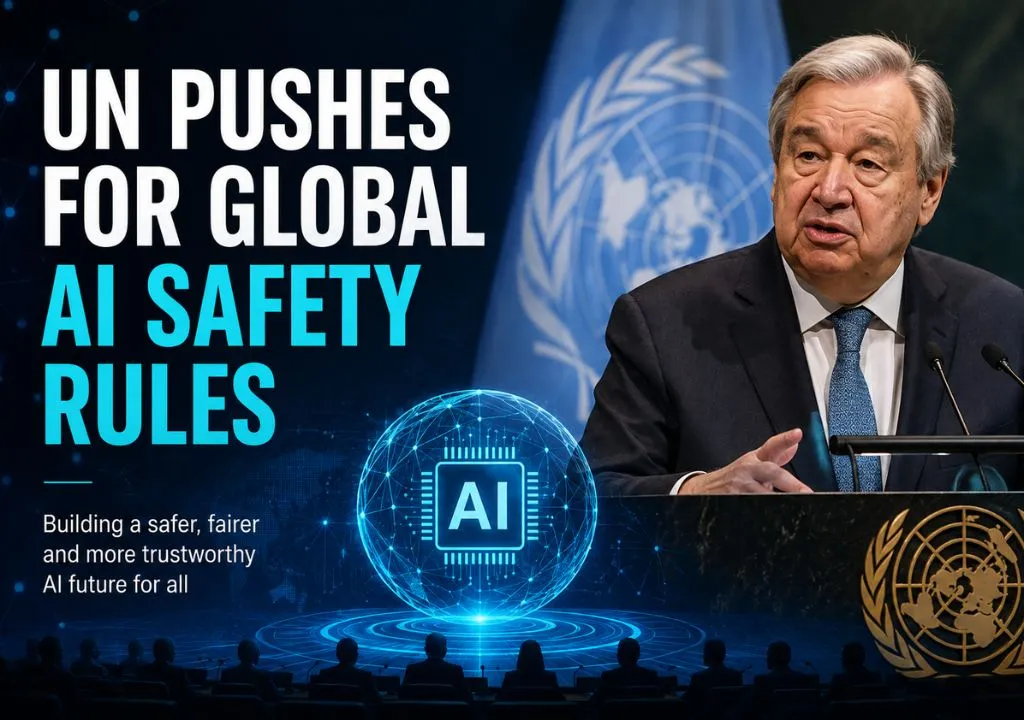
United Nations Secretary-General António Guterres has again called for stronger global cooperation on AI. Speaking during the opening of the 81st United Nations General Assembly in New York on September 22, 2026, Guterres warned that geopolitical divisions are making international cooperation harder at a time when shared rules are becoming more important.
His comments placed artificial intelligence alongside war, inequality and climate change as major challenges facing the international system.
Why AI Has Become a Global Issue (UN Pushes for Global AI Safety Rules)
AI is no longer only a technology issue. Its impact now reaches international security, economies, education, information and government.
Countries are investing heavily in advanced AI systems because the technology can provide economic and strategic advantages. Governments also want access to computing power, data and advanced research.
This has created a growing competition between major technology powers.
However, AI does not operate within national borders. A system developed in one country can be used by people in another country within seconds. AI-generated information can also spread across borders almost instantly.
This makes national regulation alone difficult.
The United Nations has therefore argued that countries need to work together on common principles and safeguards. Earlier in September, the UN said that national action on AI was important, but global coordination was also necessary because many AI risks cross national borders.
What Did Guterres Ask Countries to Do?
In his UNGA address (UN Pushes for Global AI Safety Rules), Guterres called for a multilateral AI risk management framework supported by credible and independent oversight.
In simple terms, this would mean countries working together to identify major AI risks and create common safeguards instead of developing completely separate approaches.
He also called on countries leading the AI sector to share information about emerging safety risks and cooperate on testing and evaluation.
The proposal is important because advanced AI development is taking place across several countries and companies. Without some level of international cooperation, different rules could develop in different parts of the world.
That could make it harder to deal with risks that affect several countries at once.
AI and Geopolitical Competition
The debate over AI is closely connected to geopolitics.
The United States, China and other major economies are competing for leadership in artificial intelligence. The competition involves research, computer chips, data centres, advanced models and other forms of digital infrastructure.
AI is also becoming connected to national security.
Governments are studying how AI can be used in defence, intelligence and cyber operations. At the same time, there are concerns about the use of autonomous systems in warfare.
Guterres has previously warned about the risks of allowing machines to make life-and-death decisions. In his latest UNGA speech, he again linked AI with the wider question of how power is being distributed between governments, technology companies and other actors.
This creates a difficult international problem. Countries may want stronger global rules, but they may also worry that strict rules could reduce their technological or economic advantage.
Why Geopolitical Divisions Matter
Guterres’ call (UN Pushes for Global AI Safety Rules) comes at a time when cooperation between major powers is facing pressure.
In his speech, the UN chief said that geopolitical divisions have deepened and warned against a world divided into rival blocs. He argued that military, economic or technological power alone cannot solve global problems.
This matters for AI because effective global rules require cooperation.
If countries follow completely different standards, AI regulation could become another area of geopolitical competition.
One group of countries may focus on national security. Another may focus on innovation and economic growth. Others may place greater attention on privacy, human rights or public safety.
Finding common ground between these interests will be difficult.
The Role of the United Nations (UN Pushes for Global AI Safety Rules)
The UN is trying to position itself as a platform where countries can discuss AI governance.
The organisation has already created international processes focused on AI. In 2023, the UN established a 39-member advisory body on artificial intelligence, bringing together experts from governments, academia and the technology sector.
The UN has also been encouraging countries to develop shared principles for responsible AI.
The main challenge is turning broad principles into practical international rules.
Countries must decide what should be regulated, who should monitor compliance and what happens when an AI system creates serious harm.
These questions become even more difficult when governments disagree about national security, data, technology access and digital sovereignty.
AI Safety Is Also a Security Issue (UN Pushes for Global AI Safety Rules)
One of the biggest concerns is the use of AI in military systems.
AI can help analyse large amounts of information, identify patterns and support decision-making. However, greater automation in military systems also creates questions about human control.
The concern becomes particularly serious when AI is connected to weapons.
Guterres has repeatedly argued that human beings should remain responsible for critical decisions involving life and death. His latest call for international AI governance reflects this wider concern about keeping meaningful human oversight over powerful technologies.
AI safety is therefore not only about protecting consumers or preventing misinformation. It can also become an issue of international peace and security.
Why Developing Countries Are Part of the Debate (UN Pushes for Global AI Safety Rules)
Global AI governance cannot only be decided by the countries and companies that currently lead the technology sector.
Many developing countries are still building their digital infrastructure. They may not have the same computing resources, research capacity or investment available to major technology powers.
At the same time, these countries will also experience the effects of AI.
AI could create opportunities in areas such as education, healthcare, agriculture and public services. But unequal access could also increase the gap between countries with advanced technology and those without it.
This makes access an important part of the global AI discussion.
International cooperation could help countries share knowledge, develop skills and build safer digital systems.
The Bigger Question: Who Controls AI?
The debate (UN Pushes for Global AI Safety Rules) around AI regulation is ultimately connected to a larger question about power.
Technology companies now control significant amounts of computing infrastructure, data and research capacity. Governments are also competing to maintain influence over the technology.
Guterres warned in his UNGA address about a transfer of power from governments towards a small number of private corporations and individuals with influence over technology, information and economic activity.
This raises questions about accountability.
If an AI system causes serious harm, who should be responsible? Should responsibility rest with the company that developed it, the organisation using it, the government that approved it, or several actors?
International rules could help establish clearer expectations.
However, reaching agreement between countries with different political and economic interests will remain a major challenge.
What Could Happen Next?
The debate over global AI rules is likely to continue through international organisations, governments and technology companies.
A global framework would not necessarily mean that every country follows exactly the same AI laws. Instead, countries could work towards shared principles covering areas such as safety testing, risk management, transparency and human oversight.
The Council of Europe is also developing international cooperation around AI through its Framework Convention on Artificial Intelligence and human rights, democracy and the rule of law. The convention is open to countries beyond Europe, showing that AI governance is already becoming a wider international issue.
The key question is whether countries can cooperate before technological competition becomes even more divided.
What This Means for Global Diplomacy
Guterres’ latest warning shows how closely technology is now connected to international relations.
AI is no longer simply a subject for technology companies or computer scientists. It is becoming part of diplomacy, national security, economic competition and global governance.
The challenge for diplomats will be finding areas where countries can cooperate even when they disagree on wider geopolitical issues.
That will not be easy.
The current international system is already facing wars, climate pressure, economic inequality and growing competition between major powers. Adding AI competition to these tensions could make international cooperation even more complex.
At the same time, AI could also create new opportunities for countries to work together.
Shared safety research, common standards and international discussions could reduce some risks and create greater trust.
Conclusion
The UN chief’s call for global AI rules comes at a time when geopolitical divisions are making international cooperation more difficult.
António Guterres has urged countries to develop a multilateral approach to AI risk, supported by independent oversight and greater cooperation on safety. His message reflects a growing concern that technology is advancing faster than international systems can respond.
The future of AI governance will depend on whether countries can find common ground.
The central issue is not simply how quickly AI develops. It is how governments, international institutions and technology companies decide to manage that development.
As AI becomes more powerful, global diplomacy will have an increasingly important role in deciding how the technology affects security, economies and societies around the world.
