World War II’s Lasting Impact on Asian Geopolitics
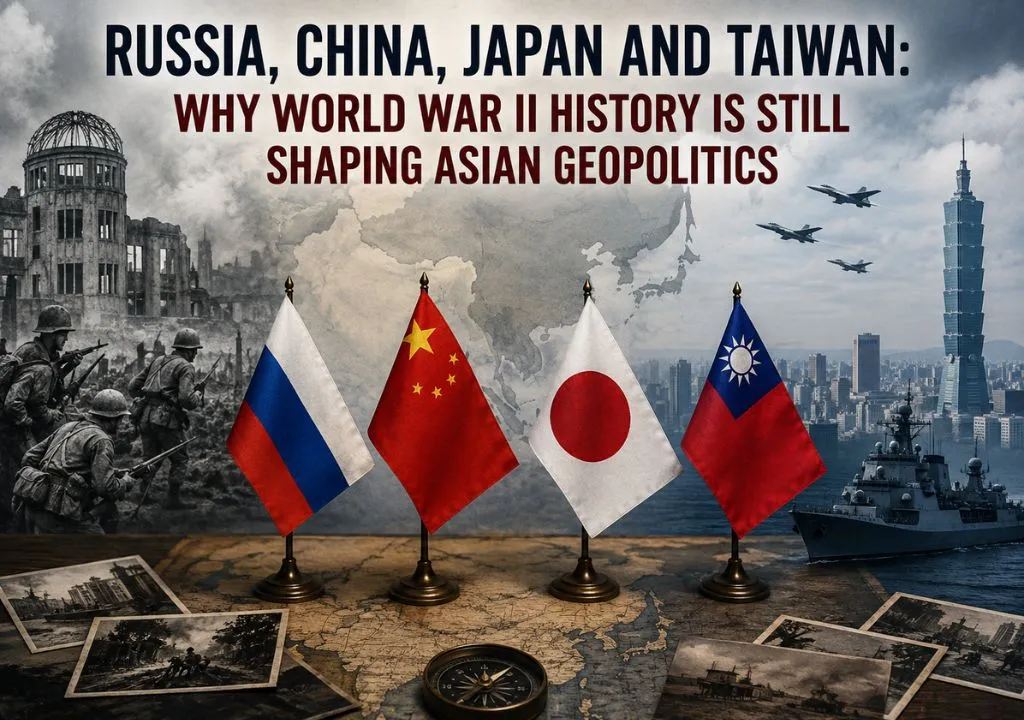
World War II ended more than 80 years ago, but its political and military legacy continues to influence relations between Russia, China, Japan and Taiwan. Historical memories of war, occupation and territorial change still shape how these countries understand security and national identity.
The issue has gained fresh attention in September 2026 after Russia screened a Soviet-era film about Japanese militarism in Taipei. The event was small, but it created concern in Taiwan because of the wider relationship between Russia and China and their shared criticism of Japan’s growing security role in Asia.
This shows why World War II is not simply a subject for history books in East Asia. Its legacy continues to influence diplomacy, military policy, territorial disputes and political narratives.
How World War II Changed East Asia (World War II’s Lasting Impact on Asian Geopolitics)
The Second World War (World War II’s Lasting Impact on Asian Geopolitics) transformed the political map of Asia. Japan had expanded its military presence across East Asia before and during the war, including its occupation of parts of China and control over Taiwan.
The conflict between China and Japan became one of the most important parts of the Asian war. China suffered enormous human and economic losses during the conflict, while Japanese military expansion created memories that remain politically important today.
The Soviet Union also became involved in the final stage of the war in Asia. In 1945, Soviet forces entered northeastern China and fought Japanese forces in the region. The Soviet military advance helped change the balance of power in the final months of the war.
The end of the war did not create a simple political settlement. Instead, it was followed by the Chinese Civil War, the division between mainland China and Taiwan, and new disputes between Russia and Japan.
These developments created several political questions that remain important today.
China and Japan: History as a Political Issue (World War II’s Lasting Impact on Asian Geopolitics)
The relationship between China and Japan is one of the clearest examples of how wartime history continues to influence modern diplomacy.
China places strong importance on remembering Japanese aggression during the war. The Chinese government presents the resistance against Japan as an important part of the country’s modern national story. This historical memory is connected to China’s wider argument that Japan must remember the consequences of militarism.
Japan, meanwhile, has developed into a democratic country with a strong economy and close security relationships with the United States and other regional partners. However, debates about Japan’s wartime past continue to create tensions with China.
The disagreement becomes more serious when Japan increases its defence capabilities or discusses a larger security role in the Indo-Pacific. Beijing can view such developments through the historical experience of Japanese militarism, while Tokyo argues that its security policies are responses to present-day threats.
This difference in perspective makes historical memory part of modern security politics.
Taiwan’s Different View of the War
Taiwan adds another important dimension to the historical debate.
During World War II (World War II still shapes Asian geopolitics), Taiwan was under Japanese colonial rule. The Republic of China, which was then based in mainland China, fought Japan during the war. After Japan’s defeat, Taiwan came under the administration of the Republic of China.
The situation changed dramatically after the Chinese Civil War. In 1949, the Chinese Communist Party established the People’s Republic of China on the mainland, while the Republic of China government moved to Taiwan.
This created two competing political systems that both developed different interpretations of Chinese history.
Beijing argues that Taiwan is part of China and that national reunification is an important historical objective. Taiwan, however, has developed its own democratic political identity and does not accept Beijing’s authority over the island.
This means that even discussions about World War II can become connected to the modern Taiwan question.
Why Russia Matters?
Russia’s role in this historical debate (World War II’s Lasting Impact on Asian Geopolitics) is also important.
The Soviet Union entered the war against Japan in 1945 and occupied areas in northeastern China. After the war, Soviet influence became closely connected with the rise of Communist forces in China.
The Soviet Union later became one of the first countries to recognize the People’s Republic of China after its creation in 1949. This created a historical connection between Moscow and Beijing that continues to influence their relationship today.
Russia also has a long-running territorial dispute with Japan over islands in the Kuril chain. The Soviet Union took control of the disputed islands at the end of World War II, and the disagreement has remained unresolved.
The territorial dispute has prevented Russia and Japan from establishing a formal peace treaty ending the state of war created by World War II.
Therefore, Russia’s relationship with Japan is also partly connected to the unresolved consequences of the war.
Why the Recent Film Screening Matters? (World War II’s Lasting Impact on Asian Geopolitics)
The recent Russian screening in Taipei illustrates how historical narratives can become part of modern geopolitical competition.
The film, made during the Soviet period, portrayed Japanese militarism during World War II. Taiwan viewed the event with concern because it came at a time when China and Russia have been developing closer strategic relations.
Taiwanese officials have suggested that the screening could support a wider Chinese and Russian narrative about the return of Japanese militarism. China has rejected Taiwan’s concerns, while Russia has not officially commented on the event.
The importance of the event is therefore not the film itself. The larger issue is how countries use historical memory to influence public opinion and explain present-day security policies.
History can become a diplomatic tool when governments use particular parts of the past to support their current political arguments.
Japan’s Growing Security Role
Japan’s security policy has changed significantly compared with the decades immediately after World War II.
For much of the post-war period, Japan maintained a relatively restrained defence policy. Its Constitution, especially Article 9, became closely associated with Japan’s post-war identity.
Today, Japan faces a more complicated security environment. China’s growing military power, tensions around Taiwan, North Korea’s missile programme and Russia’s activities in the region have encouraged Tokyo to strengthen its defence capabilities.
Japan has also increased security cooperation with countries such as the United States, Australia, India and the Philippines.
China views some of these developments with suspicion. Beijing frequently warns against what it describes as a return of Japanese militarism.
Japan, on the other hand, argues that its defence policies are designed to respond to current security risks rather than revive the military policies of the past.
This disagreement shows how the same historical period can produce very different political interpretations.
Taiwan and Japan’s Changing Relationship (World War II’s Lasting Impact on Asian Geopolitics)
Japan and Taiwan have also developed closer practical relations in recent years.
Although Japan does not have formal diplomatic relations with Taiwan, the two sides maintain important economic and unofficial political connections. They also share concerns about regional security.
Japan is geographically close to Taiwan, and any major conflict around the Taiwan Strait could have direct consequences for Japanese territory, trade and regional security.
This explains why Japanese political statements about Taiwan receive strong attention in Beijing.
China considers Taiwan an internal matter and opposes foreign military involvement in the Taiwan Strait. Japan sees stability in the surrounding region as important to its own national security.
The history of World War II adds another layer to this disagreement because China often links discussions about Taiwan and Japan’s security role to Japan’s wartime past.
The Battle Over Historical Narratives (World War II’s Lasting Impact on Asian Geopolitics)
The continuing debate is not only about territory or military power. It is also about historical narratives.
China emphasizes its resistance against Japanese aggression and the enormous suffering caused by the war. Taiwan emphasizes the role of the Republic of China in the war and rejects Beijing’s attempt to represent itself as the sole political representative of the Chinese people during that period.
Japan has its own debates about how its wartime history should be remembered and taught.
Russia also uses the Soviet victory over Japan as part of its broader historical narrative about the Second World War.
These different narratives matter because national identity and foreign policy are often connected. Governments use historical events to explain who their country is, who its past enemies were and what lessons should be learned for the future.
What This Means for Asian Geopolitics?
The influence of World War II on Asian geopolitics is unlikely to disappear soon.
The region is experiencing major changes in military power, economic competition and diplomatic partnerships. China is becoming more influential, Japan is taking a more active role in regional security, Russia is strengthening its relationship with China, and Taiwan remains one of Asia’s most sensitive political issues.
These developments are creating new strategic relationships, but old historical disputes continue to influence how governments view one another.
The Russia-China relationship is particularly important because both countries often criticize what they describe as the return of Japanese militarism. At the same time, Japan is strengthening its security partnerships as concerns about China and regional instability grow.
This creates a situation where historical memory and present-day security concerns reinforce each other.
Conclusion (World War II’s Lasting Impact on Asian Geopolitics)
World War II may have ended in 1945, but its political consequences are still visible across East Asia.
The disputes between Russia and Japan over territory, China’s relationship with Japan, Taiwan’s separate political identity and Japan’s changing defence policy are all connected, in different ways, to the political changes that followed the war.
The recent controversy surrounding Russia’s screening of a wartime film in Taiwan demonstrates that historical memory remains politically powerful.
For Asia, the challenge is to prevent historical disagreements from becoming permanent barriers to diplomacy. Understanding the past is important, but using history only to strengthen rivalry can make present-day tensions more difficult to manage.
As competition grows between China, Japan, Russia and Taiwan, World War II will continue to influence the region. The key question is whether these countries can learn from their shared history while building a more stable future for Asia.
For more articles related to geopolitics visit Globaltides.
