India-Vietnam Defence Cooperation in the Indo-Pacific
India-Vietnam relations are entering a more important strategic phase as both countries strengthen defence cooperation, maritime security, and defence-industrial ties. Their growing partnership reflects the changing security environment in the Indo-Pacific, where maintaining regional stability, protecting sea routes, and supporting international law have become major priorities.
India and Vietnam have shared close political and strategic relations for decades, but their defence partnership has gained greater importance in recent years. In 2026, the two countries agreed to deepen defence cooperation, including efforts toward the joint production of military equipment. The two sides are also working to strengthen supply chains, trade, maritime cooperation, space cooperation, and other strategic areas.
The latest developments show that India-Vietnam relations are no longer limited to diplomatic exchanges or traditional defence cooperation. Both countries are increasingly looking at how their partnership can contribute to a more stable and balanced Indo-Pacific.
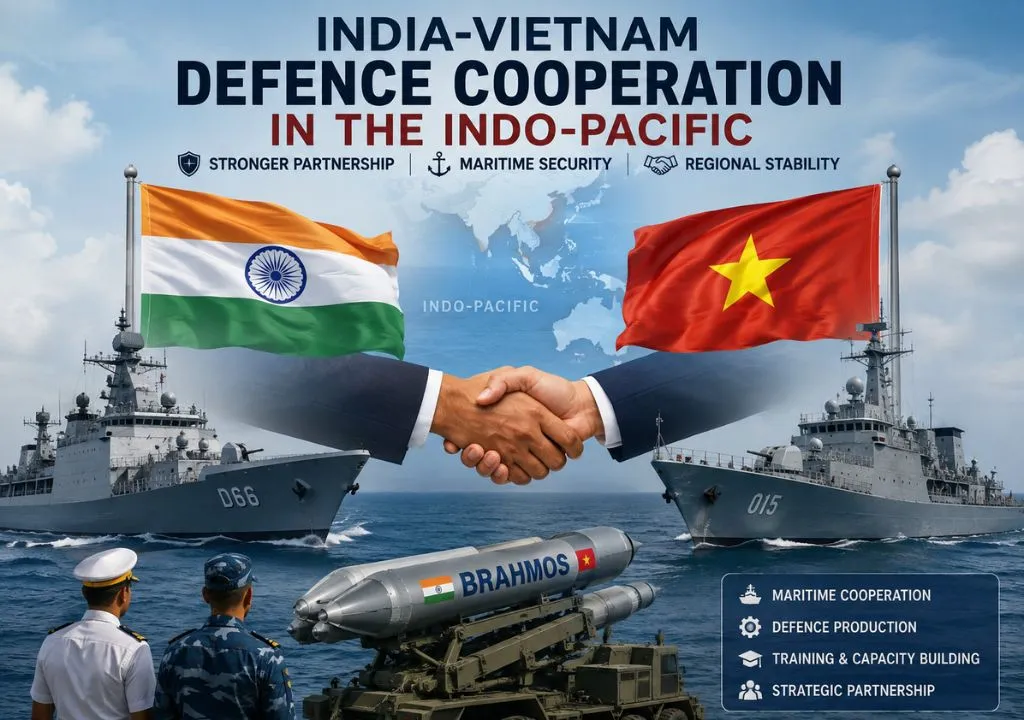
India and Vietnam Strengthen Their Strategic Partnership
India and Vietnam upgraded their relationship to an Enhanced Comprehensive Strategic Partnership in May 2026, creating a stronger framework for cooperation across defence, trade, technology, connectivity, and other areas. Defence cooperation and military training remain important parts of this relationship.
During recent high-level discussions, the two countries reviewed cooperation across several sectors, including defence and security. They also identified further opportunities for defence-industrial cooperation and greater economic engagement.
This development (India-Vietnam Defence Cooperation in the Indo-Pacific) is important because Vietnam occupies a strategically significant position in Southeast Asia. Its location along the South China Sea gives it an important role in the wider Indo-Pacific security environment, while India sees Vietnam as a key partner in its Act East Policy and broader Indo-Pacific approach.
Why Defence Cooperation Is Becoming More Important (India-Vietnam Defence Cooperation in the Indo-Pacific)
The Indo-Pacific has become one of the most strategically important regions in the world because it connects major economic centres, trade routes, energy supplies, and maritime corridors. At the same time, territorial disputes, military competition, and growing strategic rivalry have created new security challenges.
For India and Vietnam, maritime security is particularly important because both countries depend heavily on stable sea routes for trade and economic growth. Any major disruption in the region could affect supply chains and commercial activity far beyond Southeast Asia.
This is why defence cooperation between New Delhi and Hanoi has gradually expanded beyond military training. It now includes (India-Vietnam Defence Cooperation in the Indo-Pacific) defence technology, maritime security, military exchanges, equipment, capacity building, and discussions on defence production.
The South China Sea Factor (India-Vietnam Defence Cooperation in the Indo-Pacific)
One of the most important reasons behind the strategic value of India-Vietnam defence cooperation is the South China Sea.
The South China Sea is a major maritime region through which a large volume of international trade passes. It is also an area where several countries have overlapping territorial and maritime claims.
Vietnam has long been involved in disputes over maritime claims in the region. India, while not a claimant in these disputes, has consistently supported freedom of navigation, respect for international law, and peaceful settlement of disputes.
For New Delhi, a stronger relationship with Vietnam therefore supports a broader objective: maintaining a free, open, inclusive, and rules-based Indo-Pacific.
The partnership (India-Vietnam Defence Cooperation in the Indo-Pacific) does not necessarily mean that India and Vietnam are creating a formal military alliance against another country. Instead, their cooperation can be understood as an effort to improve their own defence capabilities and contribute to regional stability.
Defence Production Could Change the Relationship
A major development in 2026 is the growing focus on joint production of defence equipment.
India has been attempting to increase its defence manufacturing capabilities and expand defence exports to friendly countries. Vietnam, meanwhile, has an interest in strengthening its own defence capabilities and reducing excessive dependence on a limited number of suppliers.
Joint production (India-Vietnam Defence Cooperation in the Indo-Pacific) could therefore provide advantages to both countries.
For India, Vietnam could become an important defence partner in Southeast Asia and a potential destination for Indian defence technologies. For Vietnam, cooperation with India could provide access to additional defence technologies, training, and equipment while diversifying its defence relationships.
The two countries have already been expanding defence-industrial cooperation, and the latest discussions indicate that this area could become more important in the coming years.
This is also connected to India’s broader ambition to become a stronger defence manufacturing and export hub.
BrahMos and India’s Growing Defence Role
The BrahMos missile system has become an important symbol of India’s growing defence-industrial capabilities and its expanding security partnerships in Southeast Asia.
India and Vietnam have moved forward with a major BrahMos coastal-defence agreement, with recent reporting placing the contract at roughly $629 million. The agreement represents a significant development in bilateral defence-equipment cooperation and could create opportunities for broader defence-technology engagement.
For Vietnam, coastal defence is particularly important because of its long coastline and strategic location in the South China Sea.
For India, defence exports such as BrahMos also demonstrate that its defence industry is becoming an increasingly important part of its foreign policy.
This makes defence cooperation more than a military issue. It is becoming a tool of strategic diplomacy, industrial development, and regional engagement.
Maritime Security at the Centre of the Partnership (India-Vietnam Defence Cooperation in the Indo-Pacific)
India and Vietnam have also been increasing their cooperation in maritime security.
The Indian Navy and Vietnamese Navy have developed defence exchanges, training programmes, port interactions, and other forms of cooperation over the years. India has also supported Vietnam through training and defence capacity-building initiatives.
Maritime cooperation is important because many of the Indo-Pacific’s biggest challenges are connected to the sea.
These include illegal fishing, maritime disputes, piracy, humanitarian emergencies, natural disasters, and threats to commercial shipping. Greater cooperation between regional countries can improve their ability to respond to these challenges while building trust between their armed forces.
India’s Act East Policy and Vietnam
Vietnam has a special place in India’s Act East Policy, which aims to strengthen India’s economic, political, cultural, and strategic relationships with Southeast Asia and the wider Indo-Pacific.
India’s relationship with Vietnam therefore supports more than bilateral interests. It also helps India develop stronger connections with ASEAN and Southeast Asian countries.
Indian officials have described Vietnam as an important partner for India’s Act East Policy and Indo-Pacific vision. The two countries have also discussed cooperation in areas such as connectivity, supply chains, energy, space, and nuclear cooperation.
This wider approach is important because modern strategic partnerships are no longer based only on military cooperation. Defence, technology, trade, energy, connectivity, and supply chains increasingly influence national security.
A Partnership Beyond China
China’s growing influence in the Indo-Pacific is an important part of the region’s strategic environment, and both India and Vietnam have their own complicated relationships with Beijing.
However, it would be too simplistic to describe India-Vietnam cooperation only as an attempt to counter China.
Both countries have repeatedly emphasized regional peace, stability, international law, and ASEAN-led mechanisms. Their growing defence relationship is better understood as part of their effort to protect national interests while maintaining strategic flexibility.
For India, Vietnam provides an important connection to Southeast Asia and the South China Sea. For Vietnam, India offers another major Asian partner with growing defence-industrial capabilities and a long history of strategic engagement.
Their interests therefore overlap without requiring the two countries to form a formal alliance.
Economic and Strategic Cooperation Are Becoming Connected
Another important feature of India-Vietnam relations is the increasing connection between security and economics.
Both countries are working toward stronger supply chains, greater investment, wider market access, and improved connectivity alongside defence cooperation. They have also discussed cooperation in nuclear energy and space.
This approach reflects a broader change in international relations.
Countries increasingly view resilient supply chains, access to critical technologies, energy security, and infrastructure as national security issues. India and Vietnam can potentially benefit from working together in these areas, particularly as companies and governments look to diversify supply chains across Asia.
A stronger economic relationship could therefore support the long-term foundation of their strategic partnership.
What Does This Mean for the Indo-Pacific?
The strengthening of India-Vietnam defence cooperation sends an important message about the changing security structure of the Indo-Pacific.
Rather than relying entirely on major powers, regional countries are increasingly developing their own partnerships and defence capabilities. India and Vietnam are part of this wider trend.
Their cooperation can contribute to the Indo-Pacific in several ways. It can improve maritime security, strengthen defence capabilities, encourage defence-industry partnerships, support freedom of navigation, and create additional channels for strategic dialogue.
Their cooperation through regional and multilateral platforms is also important because ASEAN-led mechanisms remain central to the security architecture of Southeast Asia.
Challenges Ahead (India-Vietnam Defence Cooperation in the Indo-Pacific)
Despite the positive direction of India-Vietnam relations, several challenges remain.
Defence production requires long-term investment, technology coordination, financial resources, and strong institutional mechanisms. Turning agreements into actual projects can therefore take considerable time.
The two countries must also manage their relationships with other major powers carefully. Both India and Vietnam have important economic and diplomatic relationships with China, while India also maintains major strategic partnerships with countries such as the United States, Japan, Australia, and Russia.
Another challenge is ensuring that increased defence cooperation contributes to stability rather than creating additional tensions in an already competitive region.
For this reason, transparency, communication, international law, and regional dialogue will remain important as India and Vietnam expand their strategic partnership.
Conclusion
India-Vietnam defence cooperation is becoming an important pillar of the Indo-Pacific security landscape. The partnership has moved beyond traditional military exchanges and now includes defence production, technology cooperation, maritime security, training, and broader strategic coordination.
The latest push for joint production and stronger defence ties shows that both countries see long-term value in working more closely together.
For India, Vietnam is an important partner for the Act East Policy and its wider Indo-Pacific vision. For Vietnam, India provides a significant strategic relationship with growing defence capabilities and an expanding role in Southeast Asia.
The future of India-Vietnam relations will therefore depend not only on defence agreements but also on how effectively both countries connect security, trade, technology, connectivity, and diplomacy.
As competition in the Indo-Pacific continues to grow, stronger partnerships between regional countries could become increasingly important for maintaining a stable, open, and rules-based regional order.
