India’s Rape Crisis: Why Laws Are Not Enough
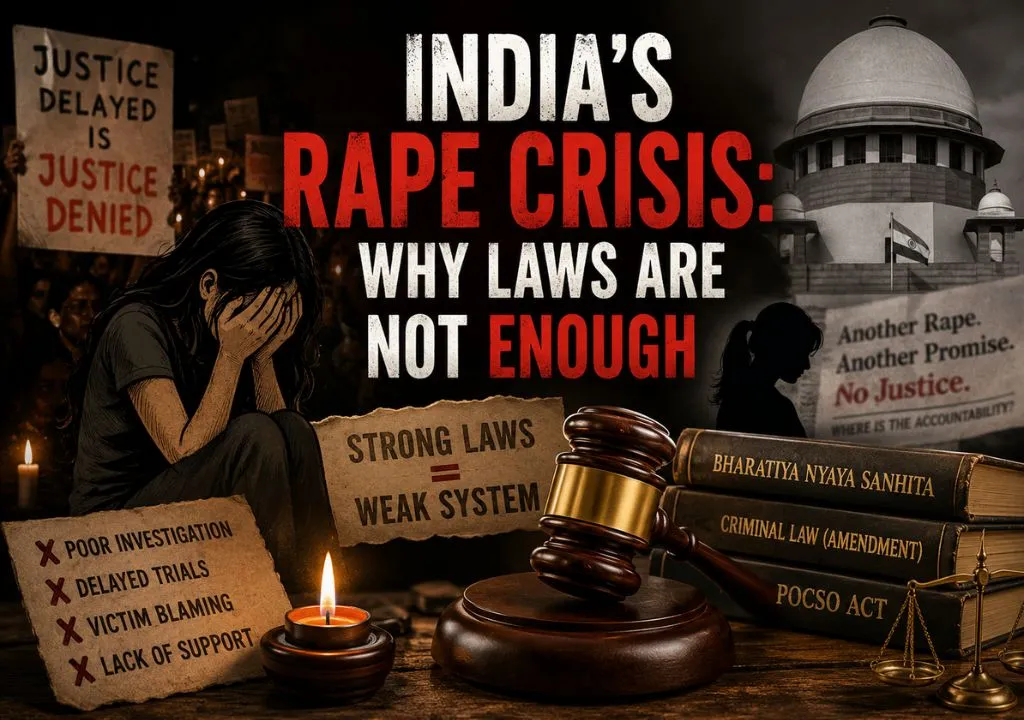
India has some of the strongest criminal provisions dealing with rape and sexual violence, with severe punishments for serious offences and additional protections for children and survivors. Yet a series of recent cases has once again raised a difficult question for governments across the country: Are strong laws enough if victims still have to wait for justice?
The question (India’s Rape Crisis: Why Laws Are Not Enough) has become particularly important after several cases reported in recent weeks. In Delhi, a 17-year-old girl was allegedly gang-raped inside Aastha Kunj Park on September 21 by three men who allegedly posed as police officers. The case led to student protests and renewed concerns about women’s safety in the capital. By September 25, Delhi Police had recorded statements from 12 witnesses and sent the three accused to judicial custody.
In another case, the National Human Rights Commission took suo motu cognizance of the alleged gang rape of a 16-year-old girl involving a bus driver and conductor after she reportedly travelled from Greater Noida toward Noida. The NHRC sought reports from senior police authorities concerning the investigation and compensation.
Meanwhile, the Supreme Court has ordered a fresh investigation into the 2012 rape and murder of a 17-year-old girl in Karnataka, nearly 14 years after the crime. The decision has again brought attention to what happens when an investigation fails to provide a satisfactory path to justice for a victim and her family.
These cases are different in their circumstances and legal stages. But together, they raise a broader public-policy question: Can India ensure that justice does not depend on how much public attention a case receives?
Delhi Gang Rape Case Raises Questions About Women’s Safety (India’s Rape Crisis: Why Laws Are Not Enough)
The latest case (INDIA’S RAPE CRISIS: Why Laws Are Not Enough) to trigger widespread public concern is the alleged gang rape of a 17-year-old girl at Aastha Kunj Park in southeast Delhi.
According to police and media reports, the teenager was visiting the area with a friend after visiting Kalkaji Temple when three men allegedly approached them while claiming to be police officers. The girl has alleged that she was subsequently sexually assaulted inside the park. The three accused have been arrested and sent to judicial custody.
The investigation is continuing. Police have recorded statements from 12 witnesses and are reportedly checking those accounts against call-detail records and CCTV footage from the surrounding area.
The case has also raised questions about security at the park. Reporting has indicated that one of the accused had allegedly been seen previously harassing couples and carrying a knife, although no formal complaint had reportedly been filed against him at the time.
Students subsequently protested in Delhi, demanding stronger measures for women’s safety.
This creates a question for the Delhi government and law-enforcement authorities: Could better surveillance, patrolling and security infrastructure have reduced the risk in such a large public park?
More importantly, now that the accused have been arrested, another question remains: Will the investigation be completed efficiently, evidence be properly presented and the victim receive justice through the courts?
At this stage, it would be premature to predict the outcome. The accused remain entitled to due process, while the allegations must be established through the legal system.
Another Case Raises Questions About Public Transport Safety (India’s Rape Crisis: Why Laws Are Not Enough)
The Delhi case is not an isolated example of concerns surrounding women’s safety.
In August, a 16-year-old girl was reportedly sexually assaulted by a bus driver and conductor after she boarded a bus while travelling from Greater Noida. According to the National Human Rights Commission, the girl was allegedly threatened and later left at the Kashmere Gate Bus Terminal in Delhi.
The NHRC took suo motu cognizance of the reported incident on September 1 and sought detailed reports from the Police Commissioners of Delhi and Gautam Budh Nagar and the Superintendent of Police in Mainpuri. The Commission specifically sought information about the investigation and any compensation provided to the victim.
The case raises another important governance issue: How effectively are authorities monitoring public transport and protecting minors who use it?
Public safety does not begin when a crime is reported. It begins with prevention.
Transport operators, police authorities and local administrations all have responsibilities in creating safer public spaces. If those systems fail, the government must examine where the failure occurred rather than treating every case only as an individual criminal act.
When Justice Takes Years: The Karnataka Case
Perhaps the strongest reminder (India’s Rape Crisis: Why Laws Are Not Enough) that laws alone are not enough comes from Karnataka.
The Supreme Court recently ordered a fresh investigation into the 2012 rape and murder of a 17-year-old girl in Dakshina Kannada. The order came nearly 14 years after the crime and followed concerns about the earlier investigation.
The case demonstrates one of the biggest challenges within India’s criminal-justice system: justice delayed can become a second burden for victims’ families.
A case that remains unresolved for years can mean repeated investigations, court proceedings, uncertainty and emotional distress for those seeking accountability.
The Supreme Court’s decision to order a fresh probe also raises a broader institutional question: What safeguards are in place to ensure that serious criminal investigations are conducted properly from the beginning?
If an investigation needs to be substantially revisited more than a decade later, policymakers must ask whether existing mechanisms for monitoring investigations are sufficient.
India Has Toughened Its Laws
India’s criminal-law framework has undergone significant changes.
The Bharatiya Nyaya Sanhita, Bharatiya Nagarik Suraksha Sanhita and Bharatiya Sakshya Adhiniyam replaced the earlier criminal-law framework from July 1, 2024.
The Bharatiya Nyaya Sanhita contains stringent punishments for rape and other offences against women. Gang rape of a woman below 18 can attract imprisonment for the remainder of the offender’s natural life or the death penalty under specified circumstances.
The procedural framework also contains provisions intended to make the reporting and investigation of sexual offences more responsive to survivors.
For example, provisions of the Bharatiya Nagarik Suraksha Sanhita deal with recording information about sexual offences, recording statements of women survivors and investigation procedures. The government has also highlighted the increased use of technology and forensic methods under the new criminal laws.
But this brings India back to the central problem.
If the law is strong, why do questions about justice continue to arise? (India’s Rape Crisis: Why Laws Are Not Enough)
The Problem Is Bigger Than Punishment
Punishment is only one part of the criminal-justice process.
For a rape case to reach a conviction, several stages must work effectively. The victim must be able to report the crime. Police must register and investigate the case properly. Evidence must be collected and preserved. Forensic examinations must be conducted efficiently. Prosecutors must present the evidence effectively. Courts must hear the case and reach a decision based on the evidence and law.
A weakness at any stage can affect the final outcome.
Recent reporting has again highlighted this implementation problem. India recorded an average of around 80 reported rape cases a day in 2024, according to the latest official crime data discussed in recent analysis. The figure has renewed debate about whether legal reforms and tougher punishments have been sufficient to reduce sexual violence.
However, reported crime figures should also be interpreted carefully. An increase in reported cases does not by itself prove that sexual violence has increased by the same proportion, because reporting practices, awareness and willingness to approach authorities can also change.
That is why policymakers (India’s Rape Crisis: Why Laws Are Not Enough) need to examine several indicators together rather than relying on one number.
So, Will Justice Be Served? (India’s Rape Crisis: Why Laws Are Not Enough)
This is perhaps the most important question raised by the recent cases.
In the Delhi case, the accused have been arrested and the investigation is continuing. Police have already recorded witness statements and are examining CCTV footage and other evidence.
In the Greater Noida case, the NHRC has sought an official report regarding the investigation and compensation.
In Karnataka, the Supreme Court has ordered a fresh investigation after nearly 14 years, showing that the judicial system can intervene when serious concerns arise about an earlier investigation.
But none of these developments allows anyone to guarantee what the final judicial outcome will be.
That is precisely why the government should be questioned about process and accountability, rather than being asked to promise a particular verdict.
Will investigations be completed properly?
Will forensic evidence be collected and examined without unnecessary delays?
Will prosecutors receive the resources they need?
Will victims and their families receive appropriate support?
Will cases be monitored until their conclusion?
And if an investigation is found to have serious shortcomings, who will be held institutionally accountable?
These are questions that governments can answer through measurable action.
Government Accountability Should Go Beyond Political Statements (India’s Rape Crisis: Why Laws Are Not Enough)
Whenever a high-profile rape case occurs, political reactions often follow. Governments highlight measures taken for women’s safety, while opposition parties frequently question law-and-order arrangements.
Political debate is part of democratic accountability. But public discussion should not end with statements made after a crime.
Governments should be assessed through concrete measures: police response times, investigation quality, forensic capacity, court pendency, victim-support services and implementation of safety programmes.
The Delhi case, for example, raises questions about security in large public parks. The Greater Noida case raises questions about safety in public transportation. The Karnataka case raises questions about the quality and oversight of long-running investigations.
Each case therefore points toward a different policy challenge.
Laws Alone Cannot Deliver Justice
India’s rape laws have become considerably stronger over the years. Yet recent cases show that the existence of strict laws is only the beginning.
Justice requires functioning institutions.
It requires police officers who can investigate without delay, forensic laboratories capable of processing evidence, prosecutors who can effectively present cases, courts with enough capacity to prevent excessive delays and support systems that protect survivors throughout the process.
The recent cases also show why prevention deserves as much attention as punishment. Safer public spaces, better transport security, adequate policing, effective surveillance and quicker responses can reduce risks before crimes occur.
For the victims and their families, however, the most immediate concern is simpler: Will the justice system work when they need it most?
That answer cannot be provided through a political promise. It has to come through a transparent investigation, a fair judicial process and an outcome based on evidence and law.
India has strengthened its laws. The next challenge is making sure that those laws work effectively in practice.
Until that happens, the question will continue to remain before governments, courts and society: Are India’s institutions doing enough to ensure that victims of sexual violence receive timely and meaningful justice?
If you find this article valid, you can check out other articles that are posted on the website Globaltides.
