Houthis Seize Mocha Port
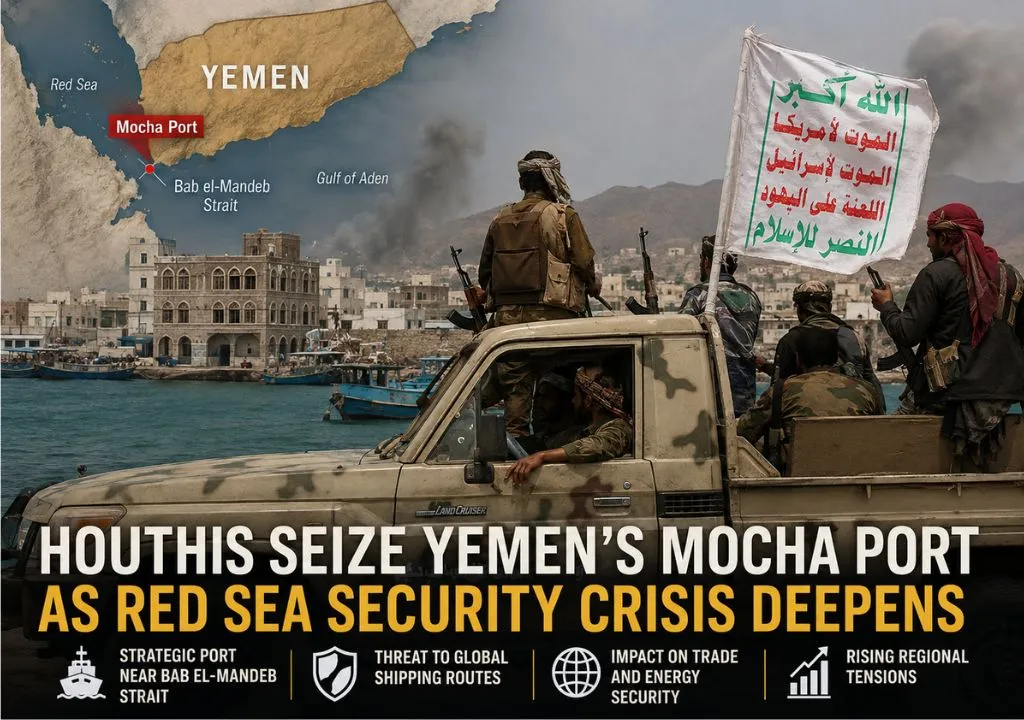
The reported Houthi takeover of Yemen’s Mocha Port has added a new layer of uncertainty to the already fragile security situation around the Red Sea. Mocha, also called Mokha, sits on Yemen’s western shoreline near the Bab el-Mandeb Strait, a narrow passage linking the Red Sea with the Gulf of Aden.
The port’s location gives the development importance beyond Yemen’s internal conflict. Any change in control along this stretch of coast could affect the safety of commercial vessels travelling between the Indian Ocean, the Suez Canal and the Mediterranean.
The reported advance comes as fighting between Houthi forces and groups aligned with Yemen’s internationally recognised government has intensified. It also coincides with broader tensions involving Iran, Saudi Arabia, the United States and other regional actors.
Why Mocha Matters (Houthis Seize Mocha Port)
Mocha has a long history as a trading port and is closely associated with the international coffee trade. Its modern strategic value, however, comes mainly from its position on the Red Sea coast.
The city is situated near the Bab el-Mandeb Strait, one of the world’s key maritime bottlenecks. Ships using the passage can travel between Europe and Asia without making the much longer journey around Africa’s southern tip.
The waterway is important for container shipping, energy transport and the movement of essential goods. A stronger military presence near the coast could therefore increase the risks faced by vessels operating in the region.
The reported capture of Mocha does not mean that the Houthis control the Bab el-Mandeb itself. It does, however, place them closer to a route that is vital to global commerce and could improve their ability to pressure shipping operators.
Yemen’s Conflict Enters Another Uncertain Phase
The development is part of Yemen’s wider and unresolved civil war. Houthi forces seized Sanaa in 2014 and subsequently established control over large areas of northern and western Yemen. Their opponents include forces linked to the internationally recognised government and various local armed groups.
Saudi Arabia and its partners have supported anti-Houthi forces, while Iran has maintained political and military links with the Houthi movement. Although periods of reduced fighting have created hopes for peace, no lasting political agreement has been reached.
The latest clashes along the western coast and near Taiz demonstrate how quickly Yemen’s fragile calm can deteriorate. Reports of civilian deaths and renewed displacement have also raised fears that the country could face another major escalation.
Possible Effects on Red Sea Shipping (Houthis Seize Mocha Port)
The Red Sea is a central route for vessels carrying fuel, food, manufactured products and industrial materials. Its importance became especially clear when attacks on commercial ships prompted several shipping companies to avoid the area.
Vessels that bypass the Red Sea and Suez Canal generally have to sail around the Cape of Good Hope. That alternative adds distance, fuel consumption and delivery time to voyages between Asia and Europe.
The reported Houthi presence in Mocha could make shipping companies more cautious. Even without a complete closure of the route, increased threats could lead to higher insurance premiums, additional security measures and more diversions.
Those costs may eventually be passed on to consumers through higher prices for imported goods.
The Strategic Role of Bab el-Mandeb
The Bab el-Mandeb Strait lies between Yemen and the Horn of Africa. It connects the Red Sea to the Gulf of Aden and provides access to the Suez Canal and the Mediterranean.
Because of this geography, the strait is essential to trade between Asian, European and Middle Eastern markets. It is also relevant to energy security, as tankers and other vessels use the surrounding maritime network to transport oil and related products.
Mocha is not the only location that determines access to the strait, and control of the port does not amount to control of the entire waterway. Nevertheless, a Houthi foothold nearby could complicate efforts to protect ships and monitor activity along Yemen’s coast.
Iran’s Connection to the Crisis
The Houthis maintain close relations with Iran, which has provided political backing and military assistance to the movement. Tehran denies directing Houthi operations, but the group is widely viewed as part of Iran’s broader regional network of allied armed organisations.
This relationship gives the Mocha development wider significance. Any escalation in Yemen could become connected to tensions between Iran and the United States or to rivalries involving Saudi Arabia and other regional powers.
The Houthis have previously targeted Saudi interests, including infrastructure and border areas. A stronger Houthi position on Yemen’s western coast could therefore increase pressure on Riyadh to protect its territory, ports and economic assets.
Saudi Arabia’s Difficult Choices (Houthis Seize Mocha Port)
Saudi Arabia has spent years supporting forces opposed to the Houthis while also seeking a political path out of the conflict. The war has created security risks for the kingdom and complicated its regional economic plans.
The reported change in control at Mocha presents Riyadh with competing priorities. A larger Houthi presence near the Red Sea could threaten Saudi security, yet a major military response might trigger further attacks and deepen the conflict.
Saudi leaders must also consider the wider regional environment. Any confrontation involving the Houthis could draw in Iran, international naval forces or other actors, making a limited Yemeni conflict much harder to contain.
Risks to Energy Markets
Red Sea instability (Houthis Seize Mocha Port) can affect energy markets even when oil production facilities remain untouched. Tankers facing danger may be redirected, delayed or charged higher insurance rates.
Longer voyages require more fuel and reduce the number of trips vessels can complete within a given period. These pressures can raise transportation costs and contribute to price volatility.
Major energy importers, including India, China, Japan and European countries, are particularly sensitive to disruptions along important maritime routes. A prolonged crisis near Mocha and the Bab el-Mandeb could therefore have economic consequences well beyond Yemen.
Consequences for Global Trade (Houthis Seize Mocha Port)
The reported takeover could also affect supply chains. Modern trade depends on reliable sea routes, and the Red Sea offers one of the shortest links between Asian production centres and European markets.
If companies decide that the route is too risky, they may redirect ships around southern Africa. That change can increase freight charges, extend delivery schedules and create delays for retailers and manufacturers.
Higher transport expenses can affect a wide range of products, including food, fuel, consumer goods and industrial equipment. Economies that rely heavily on imports may experience additional inflationary pressure.
For this reason, the situation at Mocha is not simply a local military development. It has implications for international commerce and economic stability.
Humanitarian Consequences
Yemen’s population remains vulnerable after years of war, economic decline, displacement and food insecurity. Millions of people rely on humanitarian assistance, and renewed fighting could make that support more difficult to deliver.
Conflict around ports, roads and population centres can restrict access for aid agencies. Civilians may also be forced to leave their homes if front lines move closer to residential areas.
Protecting maritime trade must therefore be considered alongside the need to protect Yemeni civilians. A security response that ignores the humanitarian situation could worsen the conditions that fuel further instability.
Could the Crisis Expand? (Houthis Seize Mocha Port)
The main concern is that the fighting could become part of a broader regional confrontation. The Houthis have shown that they can threaten targets and shipping routes beyond Yemen’s borders.
Their proximity to the Bab el-Mandeb may increase the likelihood of further maritime incidents. Saudi Arabia and other regional governments could respond by strengthening military deployments, while the United States and European countries may increase naval patrols.
This creates the possibility of a repeated cycle of attack and retaliation. A strike on a vessel could prompt international action, which might then lead to additional Houthi attacks and a wider deterioration in security.
What the International Community Can Do? (Houthis Seize Mocha Port)
A lasting solution requires more than naval patrols or military strikes. Yemen needs a political process involving its major factions, supported by regional powers and international mediators.
Saudi Arabia and Iran have particular influence over the conflict and could help reduce tensions if they support negotiations rather than escalation. International organisations should also work to preserve humanitarian access and encourage local ceasefires.
Maritime security operations may help protect commercial vessels in the short term. However, they should be combined with diplomacy, economic support and efforts to address Yemen’s political divisions.
What to Watch Next
The next stage will depend on whether the reported Houthi takeover remains limited to Mocha or forms part of a broader campaign along Yemen’s western coast.
Observers will also be watching for attacks on commercial vessels, changes in shipping routes and responses from Saudi Arabia, Iran, the United States and European governments.
The scale of those reactions could determine whether the situation remains a contained Yemeni conflict or develops into a wider crisis affecting the Red Sea and global trade.
Conclusion
The reported Houthi seizure of Mocha Port has drawn attention to the strategic importance of Yemen’s western coastline. The port’s proximity to the Bab el-Mandeb Strait creates concerns for maritime security, energy transportation and international commerce.
Mocha alone does not give the Houthis control of the Red Sea. However, a stronger position near the strait could make shipping more difficult to protect and increase the cost of moving goods between Asia and Europe.
The development also highlights the connection between Yemen’s internal war and wider geopolitical tensions. Preventing further escalation will require coordinated diplomacy, protection for commercial shipping and sustained humanitarian assistance.
For more content like this, visit Globaltides.
