UN Warn About Escalating Attacks on Palestinians
Introduction
The situation facing Palestinians has become more serious, with United Nations experts warning about rising violence, attacks and displacement. The warnings cover both Gaza and the occupied West Bank. UN officials have raised concerns about attacks affecting civilians, Palestinian homes and shelters, as well as the growing number of people being forced to leave their communities.
In Gaza, Palestinians continue to face the effects of military attacks, displacement and a lack of basic services. Many people have been forced to move several times after losing their homes or because their areas are no longer safe. UN experts said in April 2026 that attacks had affected places being used as shelters by displaced Palestinians. They also warned about the serious risks faced by civilians living in tents and temporary shelters.
The situation in the West Bank is also becoming more dangerous. UN officials have reported a sharp rise in attacks by Israeli settlers against Palestinian communities. These attacks include physical violence, damage to homes and property, attacks on farmland and restrictions that make it harder for Palestinians to reach essential services.
The scale of the problem has increased in 2026. According to the United Nations, more than 1,430 settler-related incidents had been documented in the West Bank by 10 August. These incidents affected around 260 Palestinian communities. The UN also reported that about 3,800 Palestinians had been displaced in 2026 because of settler violence, demolitions and evictions. Nearly half of those displaced were children.
The situation is therefore not limited to individual attacks. It is connected to wider problems such as displacement, destruction of homes, restrictions on movement and the loss of access to land and basic services.
The United Nations has repeatedly called for civilians to be protected and for international humanitarian and human rights law to be respected. UN officials have also stressed the need to prevent further violence and hold those responsible for attacks accountable.
Understanding these warnings is important because the crisis affects the daily lives of millions of Palestinians. Families are dealing with the loss of homes, limited access to healthcare, food and water, and the fear of further attacks.
The main question is no longer only how much violence is taking place. It is also whether enough action is being taken to protect civilians and prevent further displacement.
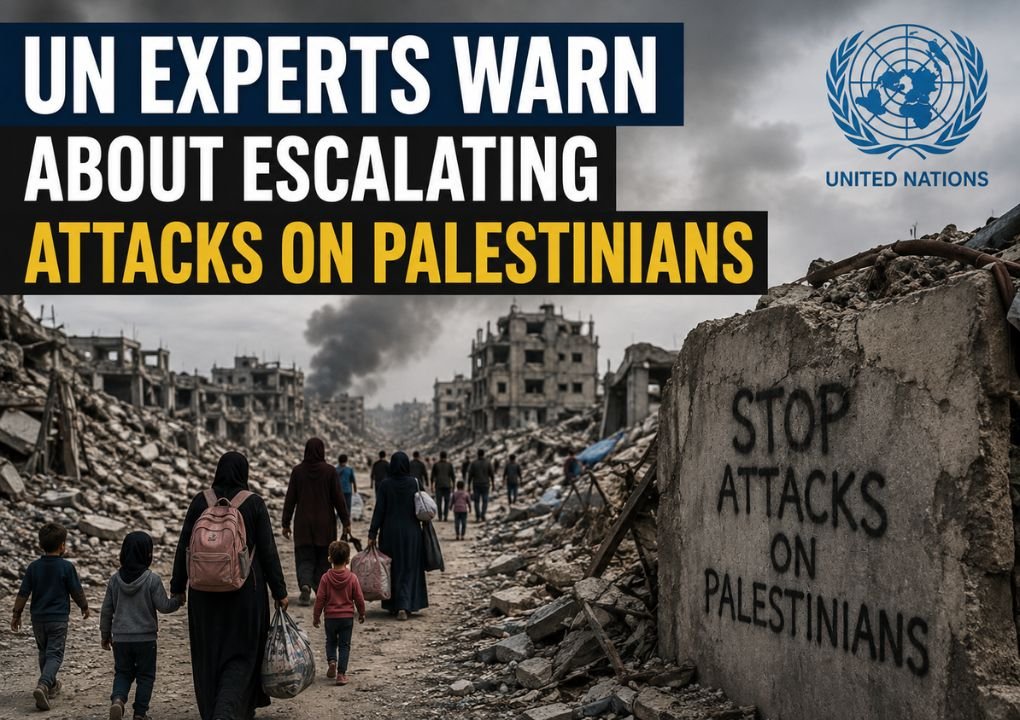
What UN Warn About Escalating Attacks on Palestinians
UN experts are warning about several connected problems affecting Palestinians in Gaza and the West Bank. These include attacks on civilians, settler violence, forced displacement, destruction of homes and limited access to basic services.
Rising Violence Against Palestinians
UN Warn About Escalating Attacks on Palestinians and one of the main concerns is the rising violence.
In the West Bank, the UN has reported a sharp rise in attacks by Israeli settlers. These attacks have affected families, farmers and entire communities. Some incidents have involved physical assaults, property damage, attacks on farmland and destruction of homes and other buildings.
The UN reported that there were about 190 settler attacks every month during the first four months of 2026. At the same time, injuries linked to settler attacks have increased sharply.
UN officials have described the situation in the West Bank as reaching a very serious level. In August 2026, UN Deputy Special Coordinator Ramiz Alakbarov said the West Bank was at a “breaking point” and that settler violence had reached unprecedented levels.
This increase in violence is creating fear among Palestinian communities. People who live in affected areas may be afraid to leave their homes, work on their farms or travel to nearby towns. For families that depend on farming, attacks can also affect their income and food supply.
The problem becomes even more serious when attacks happen repeatedly. A single incident may cause injuries or property damage, but repeated attacks can make an entire community feel unsafe. Over time, this can increase the pressure on families to leave their homes.
Attacks Affecting Civilians in Gaza
UN warn about escalating attacks on Palestinians, along with the affecting civilians in Gaza.
In July 2026, the UN Human Rights Office reported that Israeli military attacks had intensified and had killed and injured Palestinians, including women and children. Some attacks affected residential buildings, crowded areas and a tent being used as a shelter by displaced people.
The UN has stressed that civilians and civilian infrastructure must be protected under international humanitarian law.
For Palestinians living in Gaza, the danger is made worse by repeated displacement. Many people have already lost their homes and have had to move from one place to another. In April 2026, UN experts said that most of Gaza’s population had already been displaced multiple times. They also reported widespread damage to housing.
People living in temporary shelters face additional problems. Tents may not provide enough protection from attacks or extreme weather. Families also face problems accessing water, healthcare, food and other basic services.
This means that the impact of the conflict continues even when people are not directly involved in fighting. A family may lose its home, move to a temporary shelter and then face another evacuation. This repeated movement can make it difficult for people to find safety or rebuild their lives.
Growing Forced Displacement
Another major concern of the focused article where UN warn about escalating attacks on Palestinians is the forced displacement of Palestinians.
Forced displacement means people are pushed or forced to leave their homes or communities because of violence, threats, demolitions, evictions or other conditions that make it impossible to remain safely.
The UN has reported large-scale displacement in both Gaza and the West Bank.
In the West Bank, the UN Human Rights Office reported in March 2026 that more than 36,000 Palestinians had been forcibly displaced during the period covered by its report. The report linked the displacement to settlement expansion, violence and actions by Israeli security forces and settlers.
More recent UN figures show that displacement has continued during 2026. By August, around 3,800 Palestinians had been displaced because of settler violence, demolitions and evictions.
Displacement affects much more than a person’s home. When families leave their communities, they can lose access to schools, jobs, healthcare, farmland, water and other services.
Children can be especially affected because repeated displacement can interrupt their education and separate them from familiar surroundings. They may also have to move between different schools or stop their education completely.
For adults, losing a home can also mean losing a source of income. Farmers may lose access to their land, while workers may struggle to reach their jobs. These problems can continue long after the initial violence has ended.
Attacks on Homes and Property
Another major concern of the focused article where UN warn about escalating attacks on Palestinians which include attacks on homes and property.
In some West Bank communities, settlers have been accused of entering Palestinian areas, damaging homes, attacking residents and destroying property. The UN has also reported cases involving damage to farmland, water sources and other infrastructure.
These attacks can make daily life difficult even when people are not directly injured.
For example, if farmland is damaged, farmers may lose their source of income. If water or electricity is cut off, families can struggle to meet basic needs. If roads and entrances are blocked, people may find it harder to reach schools, hospitals or workplaces.
The UN has warned that these conditions can increase the pressure on Palestinian families to leave their communities.
This creates a cycle that can be difficult to break. Violence can damage a family’s home or land. The damage can then make it harder for the family to earn money or access basic services. If the situation continues, the family may feel that leaving is the only safe option.
Restrictions on Movement
UN warn about escalating attacks on Palestinians, adds another concern which is restrictions on movement.
Palestinians in parts of the West Bank face checkpoints, road closures and other restrictions. These can make it difficult for people to travel between communities or reach essential services.
The UN Human Rights Office said in July 2026 that movement restrictions affecting Palestinians had become tighter, making it harder for people to access essential services.
For a family, this can have serious effects. A person may struggle to reach a hospital for treatment. A child may have difficulty getting to school. A farmer may be unable to reach agricultural land.
When violence and movement restrictions happen together, the pressure on communities becomes greater.
Movement restrictions can also affect humanitarian work. When roads are blocked or access becomes difficult, delivering food, medicine and other supplies can become harder.
Why UN Warn About Escalating Attacks on Palestinians and Why it is concerned ?
The UN’s concern is not only about individual incidents. It is also about the wider pattern.
Repeated attacks, displacement, property destruction and restrictions can change the conditions in which Palestinian communities live.
In June 2026, UN experts warned about increasing settler violence and displacement in the occupied Palestinian territory. They said that the violence was affecting Palestinian communities and increasing the risk of further displacement.
The UN Human Rights Office has also reported concerns about settlement expansion and its connection with the displacement of Palestinians.
This is why the experts continue to call for stronger protection of civilians, respect for international law and action to prevent further displacement.
The warnings show that the crisis is not only about the number of people killed or injured. It is also about whether Palestinian families can safely remain in their homes, access basic services and live without constant fear of violence.
The situation also has a serious effect on children. When families are displaced, children may lose access to school and healthcare. They may also have to leave friends, relatives and familiar surroundings.
For the international community, the challenge is to turn these warnings into practical action that protects civilians and reduces further violence.
Conclusion
UN warn about escalating attacks on Palestinians is becoming more serious. Rising violence, attacks on civilians, destruction of homes and forced displacement are affecting communities in both Gaza and the West Bank.
The problem is not limited to the number of people killed or injured. Palestinian families are also losing homes, land, income and access to basic services. Children are facing disruptions to their education and daily lives, while repeated displacement is making it harder for families to live safely.
The United Nations has called for greater protection of civilians, respect for international law and action against those responsible for violence. However, these calls need to be followed by practical action.
Reducing violence and protecting civilians should be the immediate priority. At the same time, international efforts are needed to address the wider issues that continue to cause displacement and insecurity.
The “UN warn about escalating attacks on Palestinians” make one thing clear: the crisis cannot be understood only through individual attacks or casualty figures. Protecting Palestinian civilians, preventing further displacement and ensuring access to basic services must remain at the center of international efforts to address the conflict.
For more articles related to international news, diplomacy visit:- Globaltides.in
