China–Philippines South China Sea tensions: A Clear Guide to the Dispute
The South China Sea dispute is a long-running conflict over maritime boundaries, islands, fishing grounds, energy resources and military access. China and the Philippines are among the main parties involved, but Vietnam, Malaysia, Brunei and Taiwan also have claims in the region.
The disagreement has become more serious in recent years as Chinese and Philippine vessels increasingly operate near contested reefs and waters. Although the two countries have not entered a formal war, confrontations at sea, diplomatic protests and military activity have raised concerns about a possible accident or wider crisis.
What Is the South China Sea Dispute? (China–Philippines South China Sea tensions)
The South China Sea is a strategically important body of water linking East Asia with Southeast Asia and the Indian Ocean. It carries major commercial shipping routes and supports fishing communities across the region.
The dispute concerns who has legal rights over particular islands, reefs, maritime zones and natural resources. China claims extensive areas of the sea based on its interpretation of historical rights. The Philippines and other coastal states argue that maritime boundaries should be determined according to international law, especially the United Nations Convention on the Law of the Sea, or UNCLOS.
The disagreement is therefore both territorial and legal. It is also connected to national security because control of certain locations could provide military advantages and improve access to surrounding waters.
Why Are China and the Philippines in Conflict?
China and the Philippines disagree over several maritime features and surrounding waters. Manila says some of these areas fall within its legally recognized maritime zone. Beijing disputes that interpretation and maintains its own claims.
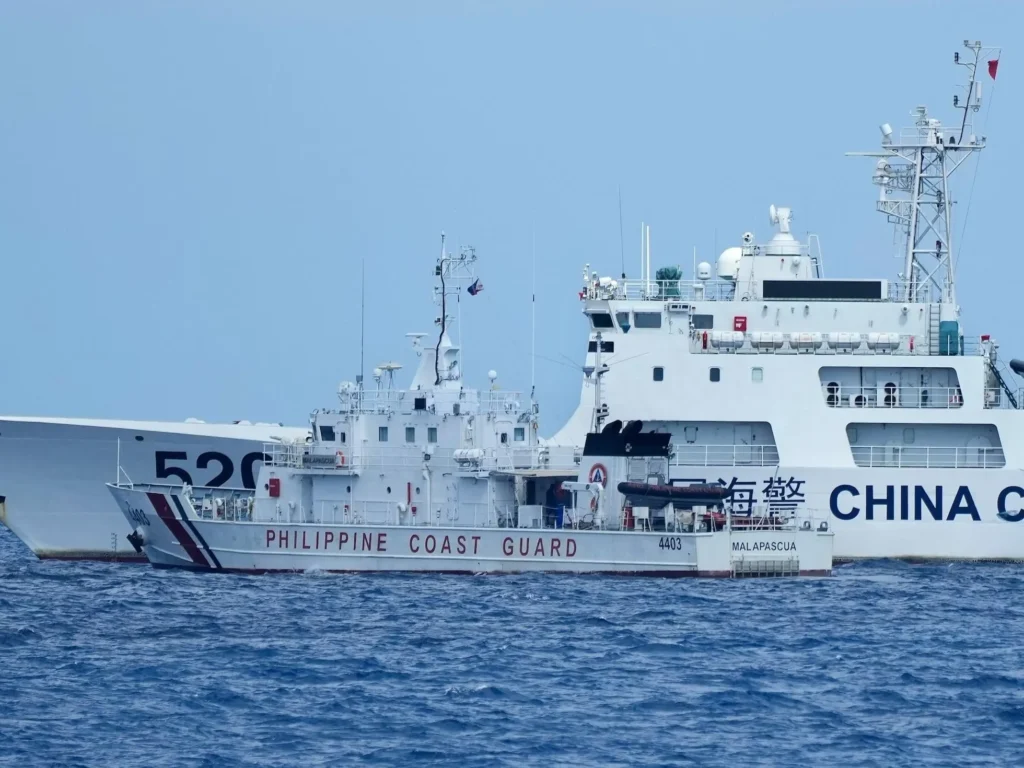
The Philippines has accused Chinese coast guard and maritime militia vessels of blocking, shadowing or using force against Philippine ships. Reported tactics have included dangerous manoeuvres, water-cannon incidents and attempts to prevent access to contested locations.
These actions are often described as “gray-zone” pressure. The term refers to coercive activity that remains below the level of conventional armed conflict. Such operations can change conditions at sea without triggering an immediate military response.
China rejects the Philippine accusations and says its maritime forces are protecting Chinese sovereignty. Beijing has also criticized Manila for what it describes as provocative actions supported by outside powers.
The Importance of the 2016 Arbitration Ruling (China–Philippines South China Sea tensions)
A major legal turning point came in 2016, when an arbitration tribunal in The Hague issued a decision in a case brought by the Philippines.
The tribunal rejected important elements of China’s broad claims to historic rights across much of the South China Sea. It also examined the legal status of several maritime features and concluded that certain areas could not generate the extensive maritime zones claimed by China.
The Philippines welcomed the ruling and continues to cite it in diplomatic statements. China rejected the decision and said the tribunal had no authority to settle the dispute.
This disagreement over the ruling remains central to the conflict. Manila treats the decision as an important legal foundation, while Beijing maintains that the issue should be resolved through direct negotiations between the countries concerned.
Why Are Incidents at Sea So Dangerous?
The South China Sea contains a mixture of coast guard ships, naval vessels, fishing boats, research vessels and commercial traffic. These ships often operate close to one another in areas where governments hold competing claims.
A collision or dangerous encounter could quickly become a political crisis. Even if neither side initially intends to use military force, public pressure could make it harder for leaders to compromise.
The risk is especially serious when vessels use water cannons, lasers, blocking manoeuvres or other methods that could injure personnel or damage ships. Repeated incidents can also create a pattern of confrontation in which each side becomes more willing to take risks.
For this reason, communication channels and agreed procedures for managing encounters are essential.
The Role of the United States
The United States is closely involved in (China–Philippines South China Sea tensions) because it has a defense treaty with the Philippines. Washington has repeatedly stated that the treaty applies to armed attacks on Philippine armed forces, public vessels or aircraft, including those operating in the South China Sea.
The United States also conducts military exercises and maritime operations with the Philippines. These activities are intended to strengthen deterrence, improve coordination and support freedom of navigation.
China views the expanding U.S.-Philippine security relationship with suspicion. Beijing argues that Washington is encouraging Manila to take a harder position. The United States and the Philippines, however, say their cooperation is defensive and designed to uphold international law.
This alliance makes any serious confrontation more complicated. A clash involving Philippine government vessels could create pressure for the United States to respond, even if all sides initially want to avoid escalation.
Why Does the Dispute (China–Philippines South China Sea tensions) Matter Beyond Asia?
The South China Sea is one of the world’s most important maritime trade corridors. Commercial ships carrying fuel, manufactured goods, food and raw materials pass through the region.
A major conflict could disrupt shipping, raise insurance costs and affect supply chains. Even a prolonged period of tension could make companies more cautious about using certain routes.
The sea is also important for fishing and possible offshore energy development. Coastal communities in several Southeast Asian countries depend on access to these waters for income and food.
The dispute also tests the strength of international law. Smaller countries are watching to see whether legal decisions and maritime rules can protect their interests when they disagree with a much larger power.
China’s Expanding Regional Influence
China’s economic and military power has grown significantly across East Asia. Its navy and coast guard are larger and more capable than those of most regional states, giving Beijing greater ability to maintain a presence in disputed waters.
China has also developed extensive trade and investment relationships throughout Southeast Asia. These ties give Beijing influence, although they do not eliminate concerns among neighboring countries about maritime pressure.
Some governments want strong economic relations with China while also seeking security partnerships with the United States, Japan, Australia, India or European countries. This balancing strategy reflects the complexity of the regional environment.
The Philippines’ Security Response
The Philippines has responded by improving its maritime surveillance, modernizing its armed forces and expanding defense cooperation with foreign partners.
Manila has increased joint exercises with the United States and strengthened security ties with countries such as Japan, Australia, Canada, France, New Zealand and the United Kingdom.
These partnerships can help the Philippines monitor its waters and improve its ability to respond to emergencies. They may also discourage more aggressive actions.
However, greater military activity can create additional risks if ships and aircraft operate in crowded or disputed areas. Security cooperation must therefore be combined with communication and careful crisis management.
Could the Dispute Lead to War? (China–Philippines South China Sea tensions)
A full-scale war is not the most likely outcome. China, the Philippines and the United States all have strong economic and strategic reasons to avoid a major conflict.
The more immediate danger is an unintended escalation. A collision, injury, boarding attempt or serious confrontation could trigger public anger and diplomatic retaliation.
The situation (China–Philippines South China Sea tensions) is also complicated by the difference between civilian and military vessels. Coast guard ships may be involved in confrontations that are politically significant but not treated in the same way as attacks by naval forces. This ambiguity can make it difficult for governments to decide how to respond.
Preventing escalation will require direct communication, professional conduct at sea and clear procedures for handling incidents.
ASEAN’s Role
The Association of Southeast Asian Nations, or ASEAN, has an important diplomatic role, although its members do not all share the same position on China.
Some ASEAN countries have their own maritime disputes with Beijing. Others prioritize economic cooperation and prefer to avoid public confrontation.
ASEAN and China have discussed a regional Code of Conduct for the South China Sea. Such an agreement could establish guidelines for behavior, communication and crisis prevention.
Progress has been slow because the countries involved disagree over the scope, legal force and enforcement of any future code. Still, regional diplomacy remains important because it offers a way to address the dispute without relying only on military alliances.
What Happens Next? (China–Philippines South China Sea tensions)
The dispute (China–Philippines South China Sea tensions) is likely to remain active for the foreseeable future. China and the Philippines will probably continue asserting their claims, monitoring one another’s vessels and using diplomatic channels to defend their positions.
Several developments will shape the future:
- The frequency and intensity of encounters at sea
- The strength of the U.S.-Philippine alliance
- Progress on ASEAN-China negotiations
- The willingness of both sides to use crisis hotlines
- The response of other regional governments
- The ability of leaders to separate legal disagreements from military confrontation
The most probable near-term outcome is continued competition rather than open war. However, repeated confrontations could gradually make the situation more dangerous if no effective safeguards are established.
Conclusion
The South China Sea dispute is not a single disagreement but a combination of territorial claims, legal arguments, economic interests and strategic competition.
China wants to defend what it considers its historic and sovereign rights. The Philippines wants to protect its maritime claims and rely on international law. The United States seeks to support its ally and preserve access to international waters.
These competing objectives make the dispute difficult to resolve quickly. Yet conflict is not unavoidable. Better communication, restraint at sea, respect for international rules and sustained regional diplomacy could reduce the risk of a serious crisis.
The future of the South China Sea will affect not only China and the Philippines but also trade, security and international law across the Indo-Pacific.
