Modi–Xi Meeting Signals India-China Thaw
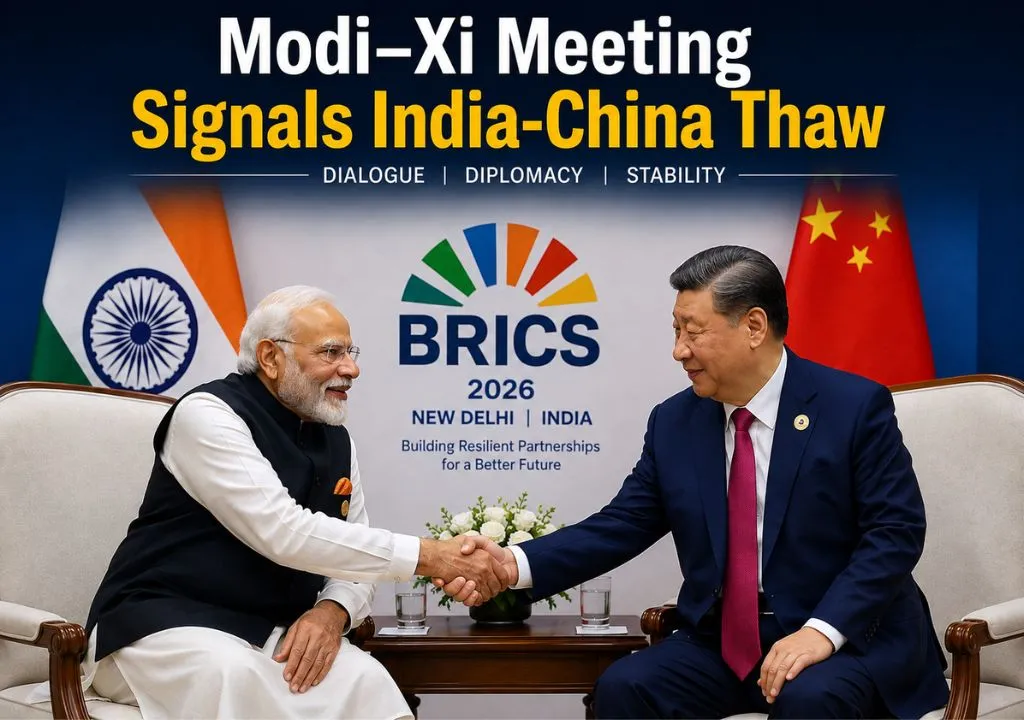
The meeting between Prime Minister Narendra Modi and Chinese President Xi Jinping in New Delhi has put India-China relations back in the international spotlight. The meeting took place during the BRICS Summit on September 12, 2026, at a time when both countries appear interested in reducing tensions and creating a more stable relationship.
The engagement is important because India and China have spent the past several years dealing with serious disagreements. The military confrontation in eastern Ladakh in 2020 damaged political trust and changed the way New Delhi viewed its relationship with Beijing. Border security became a central concern, while economic and diplomatic ties also came under greater pressure.
The latest meeting does not suggest that these differences have disappeared. Instead, it indicates that both governments may be moving towards a more practical approach in which disagreements are managed through dialogue rather than allowed to dominate the entire relationship.
This cautious improvement could have wider consequences for Asian geopolitics. India and China are two major economic and military powers, and their relationship affects regional security, trade, supply chains and the balance of power across the Indo-Pacific.
A New Phase After Years of Tension (Modi–Xi Meeting Signals India-China Thaw)
Relations between India and China have never been completely free of disagreements, particularly because of their unresolved border. However, the situation became much more serious after the Galwan Valley confrontation in June 2020.
The clash between Indian and Chinese troops resulted in the deaths of 20 Indian soldiers and four Chinese soldiers. It became a major turning point in bilateral relations and led to a significant increase in military activity along the Line of Actual Control. Both countries strengthened their positions in the Himalayan region, while diplomatic relations entered a difficult period.
The effects were felt beyond the border.
India introduced stricter scrutiny of Chinese investments and took action against a number of Chinese mobile applications. Businesses from both countries faced a more complicated operating environment, while direct travel and people-to-people exchanges were disrupted.
For several years, the relationship was therefore dominated by security concerns.
The situation began to change gradually through negotiations between military and diplomatic officials. In October 2024, the two countries reached an agreement related to disengagement along parts of the disputed frontier. This helped reduce some of the immediate pressure between their forces, although it did not resolve the larger boundary question.
The current Modi-Xi engagement is part of this longer process of attempting to bring greater stability to the relationship.
Why the Modi-Xi Meeting Is Significant (Modi–Xi Meeting Signals India-China Thaw)
The significance of the meeting comes partly from its timing.
Xi Jinping’s visit to India in 2026 is his first visit to the country since 2019. The two leaders therefore had an opportunity to discuss bilateral relations after several years of military tension and limited high-level interaction.
The meeting also took place in the setting of BRICS, where India and China have shared interests even though they do not agree on every international issue.
The message emerging from the engagement appears to be that communication should continue despite strategic differences.
This is important because diplomatic relationships between major powers do not always need complete agreement to remain functional. In many cases, regular communication is necessary precisely because disagreements exist.
India and China have significant differences over territory, regional security and economic policy. However, allowing these issues to turn into permanent confrontation would create costs for both sides.
The current approach therefore appears to be based on a simple idea: competition can continue, but it should be managed carefully.
Border Stability Will Decide the Future
The biggest test for the relationship remains the India-China border.
The two countries have not reached a final settlement over their Himalayan boundary. The Line of Actual Control remains disputed in several areas, and different perceptions of the frontier can create the possibility of future incidents.
This makes border stability extremely important for New Delhi.
India is unlikely to treat diplomatic relations with China as fully normal if military tensions continue along the frontier. Economic cooperation and political engagement can improve, but another serious border incident could quickly reverse that progress.
The 2024 disengagement process reduced tensions at some locations, but disengagement should not be confused with a permanent border settlement.
Both countries still need to address larger questions concerning troop positions, patrol arrangements and the overall management of the frontier.
The success of future diplomatic engagement will therefore depend heavily on whether India and China can maintain peace on the ground.
A stable border would give both governments greater political space to work on other areas of the relationship.
Trade Creates a Strong Reason for Cooperation (Modi–Xi Meeting Signals India-China Thaw)
Economic relations add another layer to the India-China relationship.
Political tensions have not eliminated the importance of bilateral trade. China remains a major source of goods, components and industrial inputs for India. According to Reuters, China became India’s largest import partner during the 2025–26 financial year, with bilateral trade reaching approximately $132 billion.
This creates an important economic reality.
India wants to develop domestic manufacturing and become less dependent on imports in strategically important industries. At the same time, replacing Chinese suppliers immediately would be difficult because Chinese companies are deeply connected to several global manufacturing networks.
The relationship therefore involves both cooperation and caution.
India wants greater access to foreign markets while also protecting domestic industries. It is also concerned about a large trade imbalance with China. Beijing, on the other hand, has an interest in maintaining access to India’s huge consumer and industrial market.
This situation creates space for economic diplomacy.
A more stable political relationship could make it easier for both countries to discuss market access, investment rules, supply chains and other commercial concerns.
However, India is expected to remain cautious about Chinese involvement in sensitive sectors. National security considerations will continue to influence decisions involving technology, telecommunications, infrastructure and strategic industries.
Direct Connectivity Could Help Rebuild Trust (Modi–Xi Meeting Signals India-China Thaw)
Diplomatic relations are not shaped only by leaders and government officials. Connections between ordinary citizens, businesses, universities and professional communities also matter.
The gradual return of direct flights between India and China is therefore an important development.
Air connectivity can support tourism, business travel, education and professional exchanges. It can also make it easier for companies and institutions to maintain regular contact.
These connections were weakened during the period of heightened political tension.
Restoring them cannot solve the border dispute, but it can help create a more normal environment between the two societies.
The same applies to visa arrangements and other forms of cross-border interaction. If these areas continue improving, they could contribute to a gradual rebuilding of confidence.
However, trust cannot be restored quickly.
After the events of 2020, both governments and their citizens have reasons to remain cautious. The return of connectivity is therefore better understood as one part of a longer process rather than proof that relations have returned to their earlier condition.
India and China Remain Strategic Competitors (Modi–Xi Meeting Signals India-China Thaw)
Improved dialogue does not mean that India and China have stopped competing.
Both countries want greater influence in Asia and the wider Global South. They have different approaches towards regional security, infrastructure development and international institutions.
China’s close relationship with Pakistan is another important concern for India. Beijing has developed extensive economic and defence ties with Islamabad, while India views Pakistan as a major security challenge.
India is also expanding its partnerships with countries across the Indo-Pacific. Its relationships with the United States, Japan, Australia and European countries have become increasingly important to its foreign policy.
China closely observes these developments.
This means that the India-China relationship will continue to contain an element of strategic competition even if diplomatic relations improve.
The objective is therefore unlikely to be the creation of a close alliance.
Instead, both sides may be looking for a framework in which they can compete without constantly moving towards confrontation.
BRICS Gives Both Countries Room to Cooperate (Modi–Xi Meeting Signals India-China Thaw)
BRICS provides an important platform for India and China because it allows the two countries to cooperate on international issues even when their bilateral relationship remains complicated.
Both countries support a stronger role for developing and emerging economies in global institutions. They have also supported discussions about changes to the international financial and political system.
However, their views are not identical.
India has traditionally promoted strategic autonomy and maintains relationships with a wide range of major powers. It does not want BRICS to become an organisation defined only by opposition to the West.
China has generally been more willing to present BRICS as part of a broader shift in global power.
Despite these differences, the organisation provides a useful diplomatic space.
The Modi-Xi meeting during the BRICS Summit shows how multilateral platforms can create opportunities for bilateral communication. Leaders can discuss shared international interests while separately managing disagreements between their countries.
This type of engagement can become increasingly important as global politics becomes more fragmented.
The Global Impact of Better India-China Relations
Modi–Xi Meeting Signals India-China Thaw would not affect only the two countries.
Their combined economic weight makes their bilateral relationship important for global trade and investment. Their military capabilities also mean that tensions between them can affect wider Asian security.
A prolonged confrontation could encourage greater military competition, increase pressure on neighbouring countries and complicate international efforts to manage regional crises.
On the other hand, greater stability could create opportunities for cooperation on issues such as climate change, development, trade and global governance.
This does not mean India and China will agree on major geopolitical questions.
It simply means that a stable relationship gives both countries more opportunities to work together when their interests overlap.
For countries across Asia, this could also create a more predictable regional environment.
What Should India Watch Next?
The next few months will be important in determining whether the current diplomatic opening (Modi–Xi Meeting Signals India-China Thaw) becomes meaningful.
The first indicator will be the border.
If military tensions remain under control and communication between the two sides continues, confidence could gradually increase. If a new confrontation occurs, however, the recent diplomatic progress could face serious difficulties.
The second indicator will be economic policy.
Greater discussion on trade and investment could demonstrate that both countries are prepared to translate political engagement into practical cooperation.
The third indicator will be connectivity.
More flights, easier travel and increased business exchanges would show that the relationship is becoming more functional at several levels.
Finally, India’s broader strategic partnerships will remain important.
New Delhi is unlikely to abandon its relationships with the United States, Japan, Australia, Russia or European countries simply because relations with China are improving. India’s foreign policy is increasingly based on maintaining multiple partnerships while protecting its strategic independence.
China will have to take this reality into account.
A Cautious Thaw Rather Than a Complete Reconciliation
It would be premature to describe the (Modi–Xi Meeting Signals India-China Thaw) as a complete reset in India-China relations.
Too many difficult issues remain unresolved.
The border dispute continues. Strategic mistrust has not disappeared. Economic concerns remain, and India and China continue to compete for influence in Asia.
Yet the meeting is still significant because it shows that both sides are willing to invest in communication.
After years of tension, even a limited improvement can be important when it reduces the possibility of misunderstanding and confrontation.
The relationship may therefore be entering a phase of managed competition, where India and China accept that they will remain strategic rivals but attempt to prevent rivalry from becoming a permanent crisis.
This could be a more realistic goal than expecting either country to completely change its strategic position.
Conclusion
The Modi-Xi meeting in New Delhi signals a cautious improvement in India-China relations after several years of serious tension. The meeting does not erase the legacy of the 2020 border crisis, nor does it resolve the long-standing territorial dispute between the two countries.
What it does show (Modi–Xi Meeting Signals India-China Thaw) is a renewed willingness to keep diplomatic channels active.
For India, stable relations with China can reduce security risks and create room to focus on economic development and wider international priorities. For China, better relations with India can reduce tensions with another major Asian power and create opportunities for economic engagement.
The path ahead will not be simple.
Border stability, trade, connectivity and strategic competition will continue to test the relationship. Both governments will need to show that diplomatic statements can be supported by practical steps.
The most realistic expectation is therefore not an immediate friendship between New Delhi and Beijing. Instead, the current moment points towards a relationship in which disagreement and cooperation exist at the same time.
If both sides can maintain peace along the border while expanding dialogue in economic and diplomatic areas, the current cautious thaw could develop into a more stable phase of India-China relations.
For Asia and the wider international system, that stability could prove to be just as important as any major diplomatic agreement.
The meeting between Prime Minister Narendra Modi and Chinese President Xi Jinping in New Delhi has put India-China relations back in the international spotlight (Modi–Xi Meeting Signals India-China Thaw). The meeting took place during the BRICS Summit on September 12, 2026, at a time when both countries appear interested in reducing tensions and creating a more stable relationship.
The engagement is important because India and China have spent the past several years dealing with serious disagreements. The military confrontation in eastern Ladakh in 2020 damaged political trust and changed the way New Delhi viewed its relationship with Beijing. Border security became a central concern, while economic and diplomatic ties also came under greater pressure.
The latest meeting does not suggest that these differences have disappeared. Instead, it indicates that both governments may be moving towards a more practical approach in which disagreements are managed through dialogue rather than allowed to dominate the entire relationship.
This cautious improvement could have wider consequences for Asian geopolitics. India and China are two major economic and military powers, and their relationship affects regional security, trade, supply chains and the balance of power across the Indo-Pacific.
