Introduction (Indo-Pacific Matters: Why the Region Is More Important to the World)
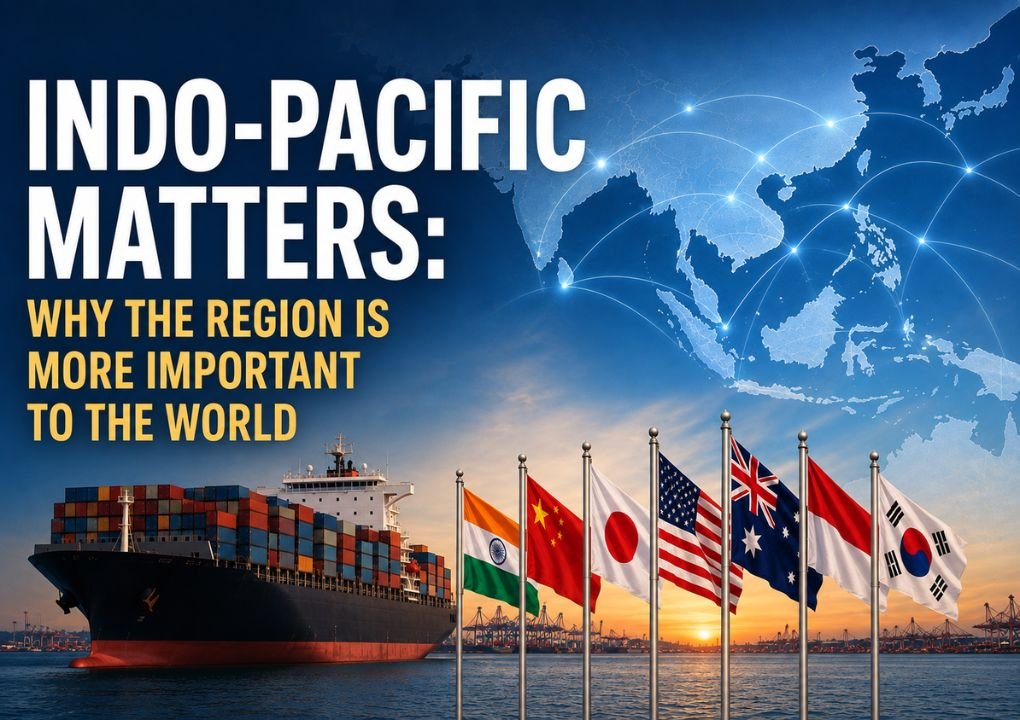
The Indo-Pacific matters has become one of the most important regions in world affairs. It stretches across the Indian and Pacific Oceans and connects some of the world’s largest economies, busiest sea routes and most important strategic locations.
Countries such as India, China, Japan, Australia, the United States, Indonesia and South Korea all have major interests in the region. Southeast Asian countries, Pacific Island states and other regional powers also play an important role.
The importance of the Indo-Pacific is not limited to military or political competition. It affects global trade, supply chains, energy security, technology, climate change and international diplomacy.
The region is home to more than half of the world’s population and accounts for around 60% of global GDP, according to the U.S. Department of State. The Asia-Pacific economies represented in APEC alone accounted for 59.4% of global GDP and 46.2% of global exports of goods and commercial services in 2025.
This makes the Indo-Pacific much more than a regional issue. What happens here can have consequences for countries far beyond Asia.
What Is the Indo-Pacific?
The term “Indo-Pacific” refers broadly to the connected space covering the Indian Ocean and the Pacific Ocean and the countries surrounding them.
Unlike the older idea of the “Asia-Pacific,” the Indo-Pacific gives greater importance to the Indian Ocean and countries such as India. It recognizes that the Indian and Pacific Oceans are closely connected through trade, energy routes, security interests and economic networks.
There is no single definition of the Indo-Pacific. Different countries use the term according to their own strategic interests.
For India, the Indo-Pacific is closely connected to maritime security, economic growth, regional connectivity and its role as a major Indian Ocean power. India launched the Indo-Pacific Oceans Initiative (IPOI) in 2019. The initiative focuses on areas such as maritime security, maritime ecology, disaster management, science and technology, trade, connectivity and maritime transport.
For the United States, Japan and Australia, the concept is often linked to a free and open regional order, freedom of navigation and respect for international law.
ASEAN also has an important role. Its ASEAN Outlook on the Indo-Pacific focuses on cooperation rather than creating rival blocs. ASEAN’s central position makes Southeast Asia an important part of the region’s future.
1. The Indo-Pacific Is the Centre of Global Trade
One of the biggest reasons the Indo-Pacific matters is trade.
The region contains some of the world’s largest manufacturing economies and major consumer markets. China, Japan, India, South Korea and the economies of Southeast Asia are deeply connected to global supply chains.
Products such as electronics, automobiles, machinery, medicines and consumer goods move through the region every day.
The sea routes are particularly important. Ships carrying oil, natural gas, raw materials and manufactured products travel between the Indian Ocean, Southeast Asia and the Pacific.
The Indian Ocean is especially important for energy and commercial shipping. Australia’s Department of Defense describes it as one of the world’s busiest and most strategically significant maritime corridors, carrying a major share of global bulk cargo and oil shipments.
This means that instability in the region can affect prices, shipping costs and supply chains around the world.
A crisis in an important maritime route could delay goods and increase transportation costs. Companies in Europe, Africa and the Americas could feel the effects even if they are thousands of kilometers away.
2. It Is Critical to Global Supply Chains
The Indo-Pacific is also at the center of global manufacturing.
China is a major manufacturing power. Japan and South Korea are important in automobiles, electronics and advanced technology. Southeast Asian countries have become increasingly important manufacturing and investment destinations. India is also expanding its role in electronics, pharmaceuticals, digital services and manufacturing.
This creates a highly connected regional production network.
However, global companies have learned that depending too heavily on one country or one supply route can create risks. The COVID-19 pandemic, geopolitical tensions and disruptions to international shipping have increased interest in making supply chains more resilient.
As a result, countries are trying to diversify production and develop trusted supply chains.
The Quad—India, Australia, Japan and the United States—has made supply-chain resilience, critical technologies and economic security important areas of cooperation. At their May 2026 meeting in New Delhi, Quad foreign ministers highlighted maritime security, economic prosperity, critical and emerging technologies, and humanitarian response as major areas of cooperation.
3. The Region Is at the Heart of Global Security
The Indo-Pacific is also a major security theatre.
The region includes several sensitive areas, including the South China Sea, the Taiwan Strait and the Korean Peninsula.
The South China Sea is especially important because of its strategic location and maritime trade. Several countries have competing territorial and maritime claims in the area.
The Taiwan Strait is another major concern. Any serious conflict involving Taiwan could affect regional security, global markets and semiconductor supply chains.
These issues have encouraged countries to strengthen defense partnerships and maritime cooperation.
India, Japan, Australia and the United States cooperate through the Quad. Other partnerships and regional institutions also contribute to security discussions.
The objective is not simply military cooperation. Countries are increasingly working together on maritime surveillance, disaster response, cybersecurity, illegal fishing and protection of critical infrastructure.
In May 2026, the Quad announced the Indo-Pacific Maritime Surveillance Collaboration initiative to strengthen maritime domain awareness, initially with a focus on the Indian Ocean region.
4. China and the Changing Balance of Power
China’s growing economic and military influence is one of the major factors shaping the Indo-Pacific matters.
China is deeply connected to the region through trade, investment and infrastructure. At the same time, its growing military capabilities and assertive actions in some maritime areas have raised concerns among several neighbouring countries.
This has contributed to a broader debate about the balance of power in the Indo-Pacific matters.
The issue is not simply about China versus the United States. Regional countries have their own interests and do not necessarily want to choose between major powers.
India, Japan, Australia and Southeast Asian countries, for example, want to protect their economic interests while maintaining strategic independence.
This is why regional diplomacy is so important.
A stable Indo-Pacific requires countries to manage competition without allowing disagreements to turn into conflict.
5. India Has a Major Role to Play
India’s geographical position gives it a central role in the Indo-Pacific.
India sits at the center of the Indian Ocean and has access to important maritime routes connecting the Middle East, Africa, Southeast Asia and the wider Pacific.
India’s economic growth also makes it an increasingly important regional power.
New Delhi has promoted the idea of a free, open, inclusive and rules-based Indo-Pacific. It has also developed initiatives such as the Indo-Pacific Oceans Initiative and strengthened partnerships with countries including Japan, Australia, the United States and ASEAN members.
India’s approach is not limited to defense.
It also focuses on connectivity, trade, disaster management, maritime resources, climate issues and sustainable development.
India’s growing cooperation with Japan is one example. In August 2026, India and Japan strengthened maritime security cooperation and discussed deeper collaboration in areas including naval shipbuilding.
India’s role is therefore important not only because of its military capabilities but also because it can act as a bridge between the Indian Ocean and the wider Indo-Pacific.
6. Technology Makes the Indo-Pacific Even More Important
The Indo-Pacific is also becoming a center of technological competition.
Semiconductors, artificial intelligence, telecommunications, batteries, critical minerals and cybersecurity are increasingly connected to national security.
Countries want secure access to technologies that are essential for modern economies and defense systems.
Taiwan is particularly important to the global semiconductor industry. South Korea and Japan are also major technology powers, while China is investing heavily in advanced technologies. India is seeking to expand its semiconductor and digital manufacturing capabilities.
This makes technology another major reason why the Indo-Pacific matters.
A disruption in the region’s technology supply chains could affect industries around the world, from smartphones and automobiles to data centers and defense equipment.
7. Climate Change and Natural Disasters
The Indo-Pacific also faces serious environmental challenges.
Many countries in the region are vulnerable to cyclones, floods, earthquakes, rising sea levels and extreme heat.
Pacific Island countries are particularly exposed to the effects of climate change. Coastal communities across South and Southeast Asia also face risks from rising sea levels and extreme weather.
Climate change therefore cannot be separated from regional security.
A major disaster can destroy infrastructure, interrupt trade and create humanitarian emergencies. Countries need to cooperate on early-warning systems, disaster response, resilient infrastructure and climate adaptation.
This is another area where cooperation can be more useful than competition.
The Indo-Pacific matters needs stronger regional mechanisms that can help countries respond quickly when disasters occur.
8. ASEAN Is Essential to the Region
ASEAN has a central role in the Indo-Pacific matters.
The Association of Southeast Asian Nations brings together countries located at the crossroads of the Indian and Pacific Oceans. Southeast Asia is strategically important because major shipping routes pass through the region and because ASEAN countries have strong economic connections with China, India, Japan, the United States and other powers.
ASEAN also provides an important platform for dialogue.
The major powers may compete with one another, but ASEAN gives regional countries a space to discuss security, trade and economic cooperation.
In July 2026, the Quad countries reaffirmed their support for ASEAN unity and centrality and discussed cooperation on maritime security, economic prosperity, emerging technologies and humanitarian assistance.
This shows why the future of the Indo-Pacific cannot be shaped by major powers alone.
9. The Indo-Pacific matters and the Future of Global Governance
The Indo-Pacific matters because it is increasingly influencing how international rules are created and applied.
Questions about freedom of navigation, maritime law, digital governance, climate action, trade and supply-chain security require international cooperation.
Regional countries have different political systems and national interests. Yet they share many common challenges.
The key question is whether countries can build an Indo-Pacific where competition does not destroy cooperation.
International law, dialogue and regional institutions can help reduce tensions.
The Quad has repeatedly emphasized the importance of sovereignty, territorial integrity, freedom of navigation, the rule of law and peaceful resolution of disputes.
At the same time, ASEAN and other regional institutions remain important for maintaining dialogue.
What Happens in the Indo-Pacific Affects the Whole World
It is easy to think of the Indo-Pacific as a distant regional issue. But the reality is very different.
A conflict in the Taiwan Strait could affect global technology supply chains. Tensions in the South China Sea could affect shipping. Disruptions in Asian manufacturing could raise prices in other parts of the world. Climate disasters could create humanitarian crises and migration pressures.
The region’s economic growth also creates opportunities.
Growing markets in India, Southeast Asia and other parts of the Indo-Pacific can support investment, trade and innovation.
This means the Indo-Pacific is not only a region of risk. It is also a region of opportunity.
Conclusion
The Indo-Pacific matters because it connects many of the forces shaping the 21st century: economic growth, international trade, technology, energy, security, climate change and global diplomacy.
Its importance is likely to increase as countries compete for influence while also trying to maintain economic cooperation.
The biggest challenge will be managing this competition peacefully.
Countries in the region will need to protect freedom of navigation, strengthen supply chains, respond to climate risks and maintain open channels of communication. They will also need regional institutions such as ASEAN and broader partnerships such as the Quad to support dialogue and practical cooperation.
For India, the Indo-Pacific offers both a strategic responsibility and an opportunity. Its location, economy and growing partnerships give it an important role in shaping the region.
Ultimately, the future of the Indo-Pacific will not be decided by one country alone. It will depend on whether regional powers can balance competition with cooperation.
The Indo-Pacific is no longer simply an important part of the world. It is becoming one of the places where the future of the global order will be decided.
If you find this post interesting, then you should visit Globaltides.in for more content like this.
