Strait of Hormuz Crisis: Why the World Is Watching
The Strait of Hormuz has become one of the most closely watched places in the world as tensions between the United States and Iran continue to create uncertainty across the Middle East. The waterway is only a narrow passage between Iran and Oman, but its importance goes far beyond its size.
A large share of the world’s energy trade has traditionally passed through this route. That means a serious disruption in the Strait of Hormuz can affect oil prices, shipping costs, inflation and energy security in countries far away from the Persian Gulf.
The issue has gained fresh attention after Iran proposed a process that could lead to the reopening of the strait and a return to negotiations with the United States. US President Donald Trump rejected the proposal, although he has indicated that American negotiators could continue discussions with Iran.
This has left governments, energy companies and financial markets watching the situation closely.
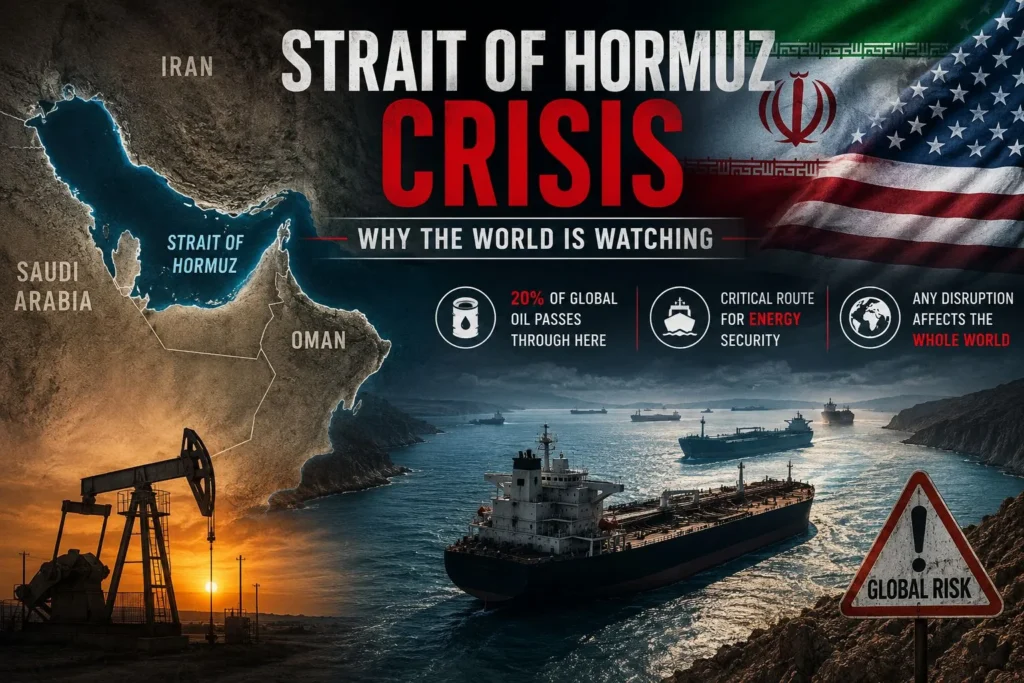
What Is the Strait of Hormuz? (Strait of Hormuz Crisis: Why the World Is Watching)
The Strait of Hormuz connects the Persian Gulf with the Gulf of Oman and the Arabian Sea. It sits between Iran to the north and Oman and the United Arab Emirates to the south.
Its geography makes it a natural gateway for several major oil-producing countries. Saudi Arabia, Iraq, Kuwait, the UAE, Qatar and Iran all have energy exports connected to the Gulf, making the strait an important part of the international energy system.
The US Energy Information Administration estimates that about 20.9 million barrels of oil and petroleum liquids per day passed through the Strait of Hormuz during the first half of 2025. That was equivalent to roughly one-fifth of global petroleum liquids consumption at the time.
The strait is also important for liquefied natural gas, particularly because Qatar is one of the world’s major LNG exporters. Around one-fifth of global LNG trade moved through Hormuz in 2024, according to the EIA.
This explains why events around the strait quickly become an international concern.
Why Is the Strait of Hormuz in the News?
The current situation (Strait of Hormuz Crisis: Why the World Is Watching) is linked to the wider conflict between the United States and Iran.
Iran has proposed a temporary arrangement under which the Strait of Hormuz could be reopened while negotiations resume. Reports indicate that Tehran’s proposal included conditions involving US military pressure, sanctions and the naval blockade. Washington has not accepted the proposal in its current form.
At the same time, Trump has indicated that further talks with Iran could take place. This creates an uncertain diplomatic situation because negotiations and military pressure are continuing at the same time.
For markets, uncertainty itself can be important.
Oil traders do not need to wait for a complete shutdown before reacting. If there is a growing possibility that ships may face delays, higher insurance costs or greater security risks, traders can begin adjusting prices immediately.
That is what makes Hormuz such an important geopolitical pressure point.
Why Does Hormuz Matter for Global Oil Supplies?
The simplest answer (Strait of Hormuz Crisis: Why the World Is Watching) is “geography“.
The Gulf contains some of the world’s largest oil-producing economies, while many of the biggest energy consumers are located in Asia. The Strait of Hormuz provides the maritime connection between these producers and international buyers.
The EIA estimates that approximately 84% of crude oil and condensate and 83% of LNG moving through the strait went to Asian markets in 2024. China, India, Japan and South Korea were among the most important destinations.
Therefore, the consequences of a disruption would not be limited to the United States or the Middle East.
Asian economies could face higher energy costs, while companies involved in transportation and manufacturing could experience increased operating expenses. Airlines, shipping companies and industries that depend heavily on fuel would also have to deal with higher costs if the disruption continued.
This is how a regional security crisis can turn into a global economic problem.
What Happens to Oil Prices? (Strait of Hormuz Crisis: Why the World Is Watching)
Oil markets respond strongly to concerns about future supply.
When traders believe that an important supply route could become less reliable, the price of crude can rise because buyers are willing to pay more to secure supplies and compensate for increased risk.
That reaction has already appeared in the current crisis. On September 28, oil prices rose after Trump rejected Iran’s proposal to reopen the Strait of Hormuz. Brent crude moved above $107 per barrel during trading, although prices fluctuated during the day.
A higher oil price can eventually affect ordinary consumers.
Fuel becomes more expensive, transportation costs can increase and businesses may face higher production expenses. Depending on the size and duration of the shock, some of those additional costs can eventually reach consumers through higher prices for goods and services.
However, it is important not to assume that every disruption will automatically produce the same economic result. Oil prices also depend on global inventories, production decisions, demand, alternative supplies and expectations about how long the disruption will last.
Why India Is Watching Closely
India has a particularly strong interest in developments around the Strait of Hormuz because it is one of the world’s major energy-importing economies.
The EIA identified India, China, Japan and South Korea as the leading Asian destinations for crude oil moving through Hormuz in 2024. Together, these four countries accounted for about 69% of crude oil and condensate flows through the strait that year.
For India, the issue is therefore closely connected to energy security.
A prolonged disruption could increase the cost of importing crude oil and put pressure on refiners and other industries. Higher international energy prices could also affect transportation and manufacturing costs.
At the same time, India has been looking for ways to diversify its energy supplies. Recent trade data has shown changes in the sources and routes used for Indian crude imports, including increased attention to supplies from outside the Strait of Hormuz.
Diversification can reduce exposure, but it cannot completely remove the importance of Hormuz because of the enormous volume of energy normally moving through the region.
Can Countries Simply Use Another Route? (Strait of Hormuz Crisis: Why the World Is Watching)
This is one of the most important questions surrounding the crisis.
There are alternative pipelines and export routes, but their capacity is limited compared with the amount of oil normally passing through Hormuz.
The EIA estimates that Saudi Arabia’s East-West pipeline and the UAE’s Abu Dhabi pipeline together could provide about 4.7 million barrels per day of capacity to bypass the strait. That is far below the approximately 20.9 million barrels per day that moved through Hormuz during the first half of 2025.
Alternative routes can therefore provide some protection, but they cannot completely replace the strait.
There is another problem as well: longer routes generally mean longer journeys and potentially higher transportation costs.
For countries and companies that depend on predictable energy deliveries, even a partial shift away from established routes can create logistical challenges.
The Crisis Is Also About Shipping
Hormuz is not only an oil issue (Strait of Hormuz Crisis: Why the World Is Watching).
The security of the waterway affects commercial shipping more broadly. If vessels face greater risks while travelling through the region, shipping companies may reconsider routes, schedules and insurance arrangements.
Recent maritime traffic has already been significantly lower than the level seen before the current conflict. Data cited by Al Jazeera showed 132 vessel transits between September 21 and 27, compared with roughly 130 crossings per day before the war began.
This illustrates an important point: a waterway does not need to be completely closed to become economically disruptive.
Reduced traffic, delays, security concerns and higher insurance premiums can all increase the cost of international trade.
What Does This Mean for Global Geopolitics?
The Strait of Hormuz Crisis: Why the World Is Watching has become a strategic issue because several major interests meet in the same place.
For Iran, control over access to the waterway provides significant geopolitical leverage. For the United States, keeping international shipping routes open is connected to broader regional security and its relationship with Gulf partners.
For Gulf countries, the stability of energy exports is directly connected to their economies. For Asian countries, the issue is closely linked to energy security and economic stability.
This creates a complicated diplomatic environment in which many countries have an interest in reducing tensions even when they have different political relationships with Washington and Tehran.
The situation also demonstrates the growing importance of strategic chokepoints in international politics. A chokepoint is a narrow route through which a large volume of trade must pass, making it especially vulnerable to political or military disruption.
Hormuz is one of the world’s most important examples.
What Should the World Watch Next? (Strait of Hormuz Crisis: Why the World Is Watching)
The biggest question is whether US-Iran diplomacy can produce an arrangement that reduces pressure around the Strait of Hormuz.
Trump has rejected Iran’s latest proposal, but reports indicate that further talks could take place. Regional countries, including Qatar, have also been involved in efforts to facilitate communication between the two sides.
Markets will also be watching the movement of oil tankers, changes in crude prices and the availability of alternative supplies.
For India and other major Asian energy consumers, the key issue will be whether supplies remain reliable and whether higher global prices persist.
The longer uncertainty continues, the more pressure could fall on governments and businesses to find alternative sources and routes.
Conclusion
The Strait of Hormuz crisis is much bigger than a dispute between the United States and Iran.
It is about energy security, international trade, shipping, diplomacy and the vulnerability of the global economy to events in strategically important locations.
The strait carries a huge volume of the world’s energy supplies, with Asia receiving a particularly large share. Its alternatives can provide some relief, but they cannot easily replace its full capacity.
That is why the world is watching Hormuz.
Whether the current tensions move toward diplomacy or further confrontation will have consequences beyond the Middle East. For countries such as India, China, Japan and South Korea, the stability of this narrow waterway is closely connected to energy security. For global markets, it remains a reminder that a crisis in one part of the world can quickly influence economies everywhere.
The Strait of Hormuz may be narrow on the map, but its place in global geopolitics is enormous.
Interested one, visit Geopolitics category in the blog section.
