Trump-Xi Summit: Impact on Global Politics
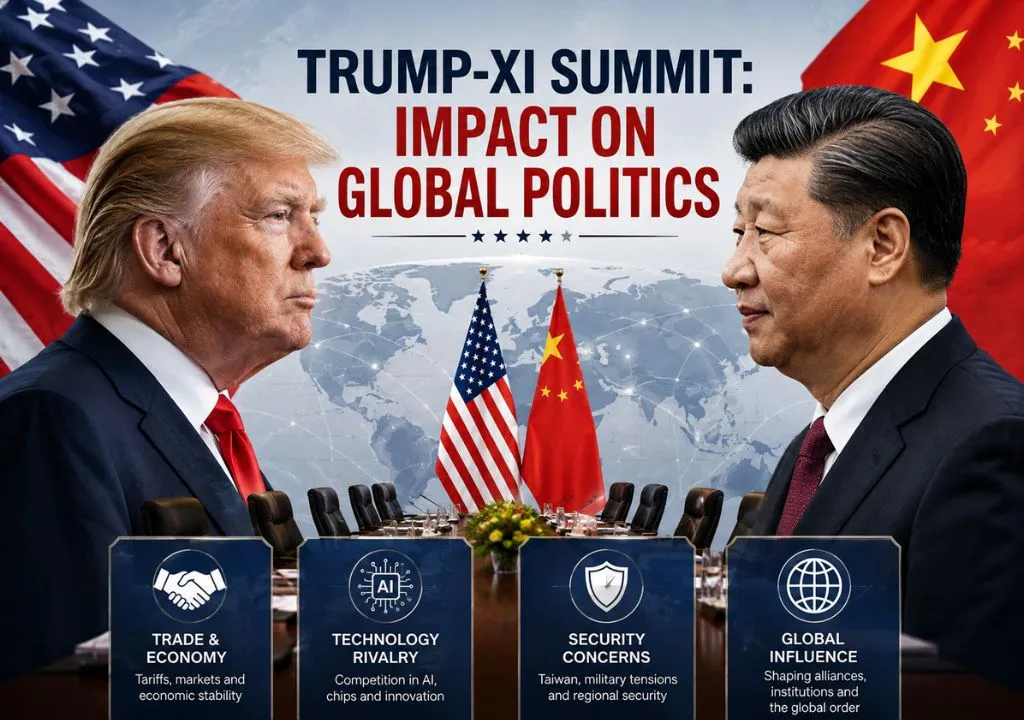
The meeting between US President Donald Trump and Chinese President Xi Jinping in Washington on September 24, 2026, has brought the relationship between the world’s two largest economies back into the global spotlight. The summit comes at a time when Washington and Beijing are trying to manage serious disagreements over trade, advanced technology, Taiwan and the wider security environment.
Xi Jinping arrived in the United States on September 23 for a three-day state visit, marking his first visit to Washington in nearly three years. Trump personally welcomed him at Joint Base Andrews, setting a diplomatic tone for a meeting that carries significant economic and geopolitical importance.
Although the summit includes opportunities for cooperation, it is taking place against a background of strategic competition. The two countries have reduced some of the pressure created by their earlier trade conflict, but important disagreements remain unresolved.
Why the Trump-Xi Summit Matters
The United States and China have an enormous influence on international trade, technology, investment and security. Decisions taken by Washington and Beijing can therefore affect countries far beyond their borders.
The current summit is particularly important because both governments are attempting to prevent their competition from developing into a broader confrontation. Recent negotiations have already produced an extension of the existing trade truce, giving both sides additional time to work toward a wider economic understanding.
This extension does not remove the fundamental disagreements between the two countries. Instead, it creates additional diplomatic space for negotiations while reducing the immediate risk of another sharp escalation in tariffs.
For the global economy, that distinction matters (Trump-Xi Summit: Impact on Global Politics) because prolonged uncertainty between the US and China can influence supply chains, commodity markets, manufacturing decisions and international investment.
Trade Remains at the Centre of the Relationship
Trade is one of the most visible areas of competition between Washington and Beijing.
The two countries entered a period of intense tariff escalation after Trump’s return to the White House in 2025. Tariffs increased dramatically before the two governments eventually moved toward a temporary truce. China also restricted some exports of rare-earth materials and magnets that are important for industries ranging from electronics to defence and clean energy.
Recent negotiations have attempted to move the relationship away from another immediate tariff confrontation. US and Chinese officials have discussed possible reductions involving selected non-strategic goods, while Washington has also sought greater Chinese purchases of American agricultural products and aircraft.
The latest extension of the trade truce is therefore significant because it keeps negotiations alive.
However, trade between the two countries is no longer only about tariffs. It has become closely connected to technology, critical minerals, industrial policy and national security.
This means that even if Washington and Beijing reach additional trade agreements, competition between their economies is likely to continue in other areas.
Artificial Intelligence Is Becoming a New Geopolitical Battleground
Artificial intelligence has become another major issue in US-China relations.
Both countries want to maintain a strong position in advanced AI, and competition has increasingly moved beyond commercial products into areas connected with computing power, semiconductor technology and national security.
The United States has used export controls and other restrictions to limit China’s access to certain advanced technologies, while China has continued developing its own technological capabilities.
Ahead of the Trump-Xi Summit: Impact on Global Politics, US and Chinese officials discussed the possibility of creating a communication mechanism for serious AI-related incidents. The proposal reflects a growing recognition that technological competition can also create security risks if communication between the two countries becomes too limited.
At the same time, cooperation on AI faces clear obstacles because both governments view advanced technology as an important component of their economic and strategic strength.
The AI competition therefore represents a difficult balance. Washington and Beijing want to maintain their technological advantages while also avoiding situations in which an accident, cyber incident or misunderstanding could create a wider crisis.
Taiwan Remains a Major Security Issue (Trump-Xi Summit: Impact on Global Politics)
Taiwan is another central issue in the US-China relationship.
Beijing considers Taiwan part of China and has consistently opposed actions that it views as supporting Taiwanese independence. Washington, meanwhile, maintains important political and security ties with Taiwan.
The issue has become particularly sensitive because of US arms sales to Taiwan. It had been reported that the Trump administration approved an $11 billion arms package for Taiwan in December, while another package worth approximately $14 billion has remained on hold.
China is expected to raise concerns about US military support for Taiwan during the summit.
The Taiwan issue makes the relationship different from a conventional trade dispute because it directly involves questions of security and military strategy. Any major misunderstanding in the Taiwan Strait could have consequences for regional stability and international markets.
For this reason, communication between Washington and Beijing remains important even when the two governments disagree strongly.
Iran Adds Another Layer to the Summit
The ongoing conflict involving Iran has also entered the wider US-China diplomatic discussion.
China maintains significant economic ties with Iran and has an important role in global energy markets. Washington has been interested in whether Beijing can use its relationship with Tehran to support efforts toward reducing tensions.
However, China’s interests do not necessarily match those of the United States.
Beijing has maintained its economic relationship with Iran while also calling for diplomacy and restraint. This creates another area where the two countries may discuss cooperation without sharing the same strategic objectives.
The Iran issue demonstrates how US-China competition now extends beyond their bilateral relationship. Their policies increasingly intersect in different parts of the world, from the Middle East and Indo-Pacific to international trade and technology.
What the Summit Means for Global Geopolitics (Trump-Xi Summit: Impact on Global Politics)
The Trump-Xi meeting is important because US-China relations have become one of the major factors shaping the international system.
For many years, economic interdependence encouraged both countries to maintain extensive commercial relations despite political disagreements. Today, national security concerns are increasingly influencing decisions about technology, investment, supply chains and critical resources.
This has encouraged several countries to reconsider their economic and strategic relationships.
Countries in Europe, Asia, Africa and Latin America are closely watching the relationship because they have economic links with both Washington and Beijing. A major deterioration between the two powers could force other governments and businesses to make difficult choices about technology suppliers, trade routes and investment partnerships.
At the same time, a period of greater stability could provide countries with more room to maintain economic relations with both sides.
The summit therefore has implications beyond the United States and China. It is also about how the international system manages competition between major powers.
The Importance of Strategic Stability
One of the most important questions surrounding the “Trump-Xi Summit: Impact on Global Politics” is whether Washington and Beijing can establish a more stable way of managing their disagreements.
The two governments do not need to agree on every major issue to avoid escalation. Instead, they need channels through which disagreements can be communicated and managed.
Recent discussions between US and Chinese officials have included trade, AI and other areas where misunderstandings could create wider problems. The possibility of stronger military-to-military communication is also important because direct communication can reduce the risk that an incident develops into a larger confrontation.
Strategic stability, however, does not mean the end of competition.
The United States and China are likely to continue competing for technological leadership, economic influence and strategic partnerships. The more realistic question is whether this competition can remain within boundaries that prevent a serious crisis.
What Comes Next for US-China Relations? (Trump-Xi Summit: Impact on Global Politics)
The immediate focus will be on whether the summit produces concrete agreements.
The extension of the trade truce gives negotiators additional time, but major questions remain regarding tariffs, critical minerals, technology restrictions and market access. The two countries also need to manage disagreements involving Taiwan and other international security issues.
The summit may therefore be better understood as part of a continuing diplomatic process rather than a single meeting capable of resolving every disagreement.
For the global economy, even limited progress can reduce uncertainty. For international security, continued communication can help prevent disagreements from becoming crises.
The longer-term direction of US-China relations will depend on what happens after the diplomatic ceremonies end.
Conclusion
The “Trump-Xi Summit: Impact on Global Politics” represents an important moment in the evolving relationship between the United States and China. Trade remains a central issue, but the relationship now covers a much wider range of subjects, including artificial intelligence, critical minerals, Taiwan and conflicts in other parts of the world.
The extension of the trade truce provides Washington and Beijing with more time to negotiate, while discussions over technology and security show how deeply their competition has expanded.
For the rest of the world, the outcome matters because US-China relations influence global trade, technology and security. A more stable relationship could reduce uncertainty, while renewed escalation could create pressure across international markets and supply chains.
The summit is therefore not simply a meeting between two presidents. It is another stage in the broader effort to manage competition between two major powers whose decisions increasingly shape the global order.
If you find the article informative, then visit the website Globaltides.
