Introduction – ITBP chief: China face-off continues in Arunachal
Tensions along the India-China border in Arunachal Pradesh remain a concern after Indo-Tibetan Border Police (ITBP) Director General Shatrujeet Singh Kapoor confirmed that face-offs with Chinese troops are continuing at multiple locations in the state. His statement, made ahead of the ITBP’s 65th Raising Day on October 24, 2026, has brought fresh attention to the challenges faced by Indian security personnel along the Line of Actual Control (LAC).
The statement is significant because it highlights the difficulties of maintaining stability along a sensitive Himalayan frontier despite ongoing military and diplomatic discussions between the two countries. Kapoor also spoke about India’s efforts to strengthen border security through modern equipment, drone technology, specialised combat training and improved infrastructure. These measures reflect the growing importance of preparing security forces for changing conditions along the border.
The latest developments also raise broader questions about India-China relations, regional security and the role of military communication in preventing misunderstandings between the two neighbouring countries. Although dialogue remains important, the ITBP chief: China face-off continues in Arunachal shows that several border-related challenges still require attention.
ITBP Chief Confirms Face-Offs at Multiple Locations
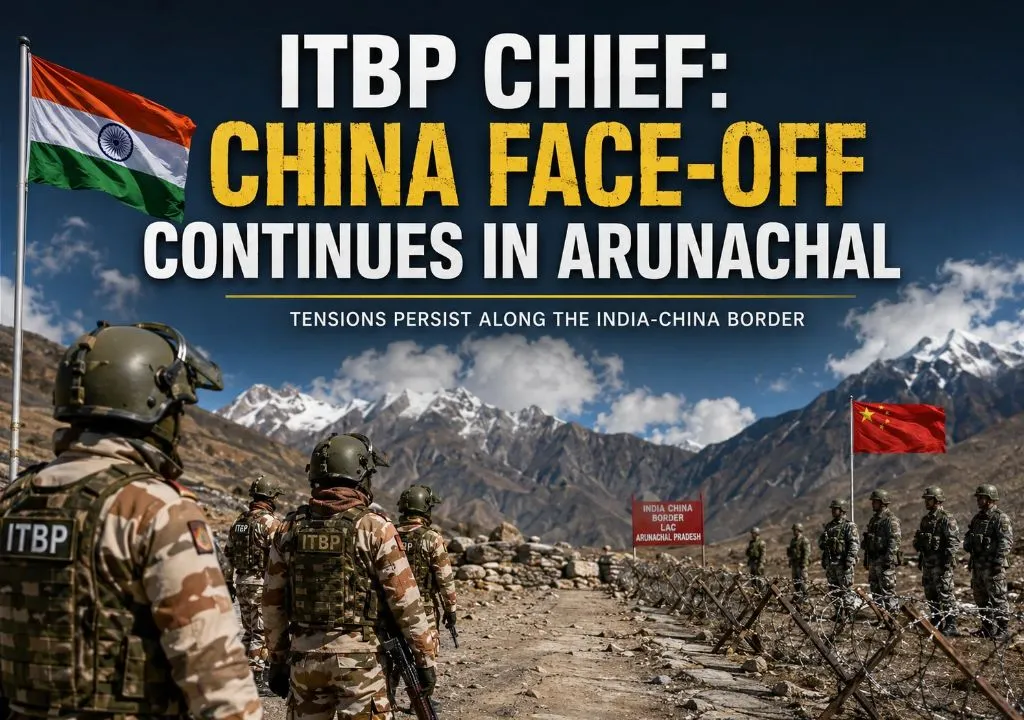
ITBP chief Shatrujeet Singh Kapoor confirmed that Indian personnel have faced Chinese People’s Liberation Army (PLA) troops at several locations along the Arunachal Pradesh border. He also praised the performance of ITBP personnel and highlighted the role of a specialised combat team known as the Shaurya commandos during the ongoing face-offs.
His remarks (ITBP chief: China face-off continues in Arunachal) indicate that the situation along parts of the frontier remains sensitive even as India and China continue using established channels to discuss border-related concerns. However, a face-off does not necessarily mean that a full-scale armed conflict is taking place. Such encounters can occur when patrol teams from both countries meet in areas where their interpretations of the boundary differ.
The distinction is important because the India-China border remains disputed in several sectors, and the two countries do not agree on every aspect of the LAC’s alignment. When patrols enter areas claimed by both sides, personnel may challenge each other’s presence, leading to confrontations that require careful handling.
Kapoor’s statement (ITBP chief: China face-off continues in Arunachal) has drawn attention to the operational responsibilities of the ITBP, which guards India’s frontier with China. The force operates in difficult mountain terrain, where extreme weather, high altitudes and limited access can make routine patrols and logistical support challenging.
The ITBP’s role includes maintaining a visible security presence, monitoring developments along the frontier and responding to situations that arise in its area of responsibility. The latest statement highlights why training, equipment and coordination remain essential for personnel serving in these regions.
Why Arunachal Pradesh Is Strategically Important
Arunachal Pradesh occupies an important position in India’s northeastern region and shares an international border with China. Beijing claims the Indian state as part of what it calls South Tibet, a position that India firmly rejects. India considers Arunachal Pradesh an integral and inalienable part of the country.
This disagreement forms part of the wider India-China boundary dispute (ITBP chief: China face-off continues in Arunachal), which stretches across several sectors of the Himalayan frontier. Both countries maintain military and border security deployments in sensitive areas, while diplomatic and military mechanisms are used to manage differences and reduce the risk of escalation.
The geography of Arunachal Pradesh adds to the complexity of border management. Much of the region consists of mountainous terrain, dense forests and remote settlements, where movement can be difficult and weather conditions can change rapidly. Building roads, maintaining communication networks and supplying personnel require substantial planning and resources.
The area is also important because developments along the frontier can influence the broader relationship between India and China. A local confrontation may attract national attention, particularly when it involves competing territorial claims or concerns about patrol access.
For India, maintaining security in Arunachal Pradesh involves more than deploying personnel along the border. It also requires infrastructure development, reliable surveillance, effective communication and close coordination among relevant security agencies.
Taksing Face-Off and Military Talks
The latest reports follow an earlier face-off near Taksing in the Upper Subansiri district of Arunachal Pradesh. The incident (ITBP chief: China face-off continues in Arunachal) drew attention to the continuing difficulties of managing patrol encounters in areas where India and China have different perceptions of the LAC.
Reports indicated that the two sides held corps commander-level talks on September 6, 2026, at the Wacha-Damai border meeting point on the Indian side. These discussions were intended to address the situation and support efforts to manage the dispute through established military channels.
Such meetings are an important part of border management because they provide a direct means for military representatives to communicate, exchange views and discuss ways to prevent confrontations from becoming more serious. Local commander-level contacts and higher-level military discussions can also help clarify the circumstances surrounding an encounter.
However, the existence of dialogue does not automatically mean that every disagreement has been resolved. Border issues may require repeated discussions, particularly when they involve patrol routes, competing territorial claims or differences over the interpretation of the boundary.
The “ITBP chief: China face-off continues in Arunachal” suggest that maintaining stability remains an ongoing task. Both countries need to ensure that personnel on the ground understand the relevant protocols and that communication channels remain available when tensions arise.
For India, the immediate priority is to protect its territorial interests while managing encounters in a manner that reduces the possibility of unintended escalation.
India Strengthens ITBP’s Modern Combat Capabilities
Alongside his comments (ITBP chief: China face-off continues in Arunachal) about the border situation, Kapoor outlined steps being taken to prepare the ITBP for modern security challenges. One major development is the creation of drone platoons across the force’s border units.
Drones have become increasingly important in military operations because they can provide aerial observation, assist surveillance and help personnel assess difficult terrain. They can also support logistical and reconnaissance tasks in areas where direct access is limited.
Modern conflicts have demonstrated that unmanned systems can influence operations even when used by forces with fewer conventional resources. At the same time, drones create new challenges, including the need to detect, track and counter hostile systems.
According to reports, the ITBP has established drone platoons in its border units and is training personnel to operate these systems. The force is also developing its own drone capabilities as part of a broader effort to improve operational readiness.
The Home Ministry has given in-principle approval to a larger modernisation programme worth approximately ₹4,000 crore, according to the ITBP chief’s reported remarks. Of this amount, around ₹1,000 crore is expected to be allocated to drone and anti-drone systems.
The proposed investment reflects the growing importance of technology in border security. Surveillance equipment, modern communication systems and counter-drone capabilities can help security personnel respond more effectively to changing situations.
However, technology alone cannot solve every border challenge. It must be supported by trained personnel, reliable infrastructure, effective procedures and coordination between different security agencies.
New Strike Course to Prepare Personnel for Combat
Another important announcement concerns a specialised training programme called the Strike course. The ITBP has developed this course to improve its personnel’s ability to respond to close-range confrontations and other demanding combat situations.
The programme is intended to prepare personnel for situations resembling the violent clashes witnessed in the Galwan Valley in Ladakh in June 2020. During those clashes, 20 Indian soldiers were killed, making the incident a major turning point in recent India-China relations.
The Galwan episode demonstrated the serious risks that can arise when troops confront each other in disputed border areas. It also highlighted the importance of discipline, physical preparedness, tactical awareness and clear procedures for responding to rapidly developing situations.
According to the ITBP chief’s reported statement (ITBP chief: China face-off continues in Arunachal), the entire force is expected to undergo the new training by the end of 2027. The aim is to strengthen the ability of personnel to handle difficult operational circumstances while improving their overall readiness.
The ITBP has also raised a specialised team known as the Shaurya commandos. Kapoor said this team had demonstrated its capabilities during the face-offs with Chinese troops in Arunachal Pradesh.
These developments indicate that the force is focusing on both technology and human capabilities. While drones and surveillance systems can improve awareness of the border environment, trained personnel remain essential for making decisions and responding appropriately to encounters on the ground.
Underground Infrastructure and Border Modernisation
The ITBP chief also highlighted the development of underground infrastructure along the frontier. Such facilities can support personnel and equipment in demanding environments, although their precise design and operational use depend on the requirements of individual locations.
Infrastructure is a critical part of border security because mountain deployments create substantial logistical difficulties. Personnel need reliable access to supplies, communication systems, suitable accommodation and equipment that can operate in extreme weather conditions.
Improved facilities can support the long-term deployment of security personnel and help reduce some of the difficulties associated with serving in remote areas. They can also contribute to the force’s ability to maintain operational readiness during adverse weather and other emergencies.
Modernisation efforts are taking place against the wider background of infrastructure development along the India-China frontier. Both countries have invested in roads and other facilities that support access to border areas.
For India, strengthening its border infrastructure is important not only for military preparedness but also for improving connectivity in remote regions. At the same time, development in sensitive areas must be managed carefully to avoid unnecessary misunderstandings and preserve stability.
The emphasis on underground infrastructure, drones and specialised training suggests that the ITBP is preparing for a security environment in which conventional patrol duties increasingly operate alongside modern surveillance and combat technologies.
What the Continuing Face-Off Means for India-China Relations
The reported ITBP chief: China face-off continues in Arunachal come at a time when India and China continue to balance diplomatic engagement with unresolved border concerns. Both countries have reasons to prevent local encounters from developing into a wider military crisis, given the economic, political and security consequences of a prolonged confrontation.
India has repeatedly emphasised the importance of peace and tranquillity along the border for the development of broader bilateral relations. China and India have also used diplomatic and military mechanisms to discuss outstanding issues, although progress has varied across different sectors of the frontier.
The continuing tensions demonstrate that dialogue and military preparedness are not necessarily opposing approaches. Communication helps manage disputes, while adequate security capabilities ensure that personnel can protect their positions and respond to emerging challenges.
For India, the challenge is to maintain a credible border presence without allowing individual encounters to undermine wider diplomatic efforts. For China, continued engagement through established mechanisms is also important if both sides want to reduce the risk of miscalculation.
The latest ITBP statement should therefore be understood as an indication of continuing operational challenges rather than proof that a larger conflict is inevitable. The situation will depend on developments on the ground, the conduct of patrols and the effectiveness of communication between the two countries.
Conclusion
The ITBP chief: China face-off continues in Arunachal highlights the challenges India faces along its sensitive Himalayan frontier. The developments also show why border management requires a combination of trained personnel, modern technology, reliable infrastructure and effective communication.
The ITBP’s expansion of drone platoons, development of Shaurya commandos, introduction of the Strike course and plans for improved infrastructure form part of its effort to strengthen operational readiness. These measures are intended to prepare the force for a changing security environment in which surveillance technology and specialised training are becoming increasingly important.
At the same time, military and diplomatic dialogue remains essential for preventing local confrontations from escalating. India and China will need to continue using established channels to manage disagreements and work towards greater stability along the LAC.
For now, the reported face-offs serve as a reminder that the border dispute remains unresolved in several areas. India’s approach will require sustained vigilance, careful crisis management and continued investment in the capabilities needed to protect its frontier.
If you want similar article like this, then visit Globaltides.
