Introduction
China’s economy showed signs of improvement in the third quarter of 2026, with gross domestic product (GDP) growing by 4.5% compared with the same period last year. The latest figure released on October 19 by China’s National Bureau of Statistics (NBS) exceeded economists’ expectations and marked an improvement from the 4.3% growth recorded in the second quarter. The result offers some relief to policymakers as they work to maintain economic stability amid weak domestic demand, pressure on the property sector, and uncertainty in global trade.
The latest economic performance (China’s Q3 Growth Hits 4.5%, Beating Forecasts) also highlights the important role of exports and industrial production in supporting China’s growth. However, the stronger headline figure does not mean that every part of the economy is recovering at the same pace. While manufacturing and overseas sales have remained important sources of economic activity, businesses and households continue to face challenges that could influence the country’s performance in the coming months.
China’s Q3 Growth Hits 4.5%, Beating Forecasts
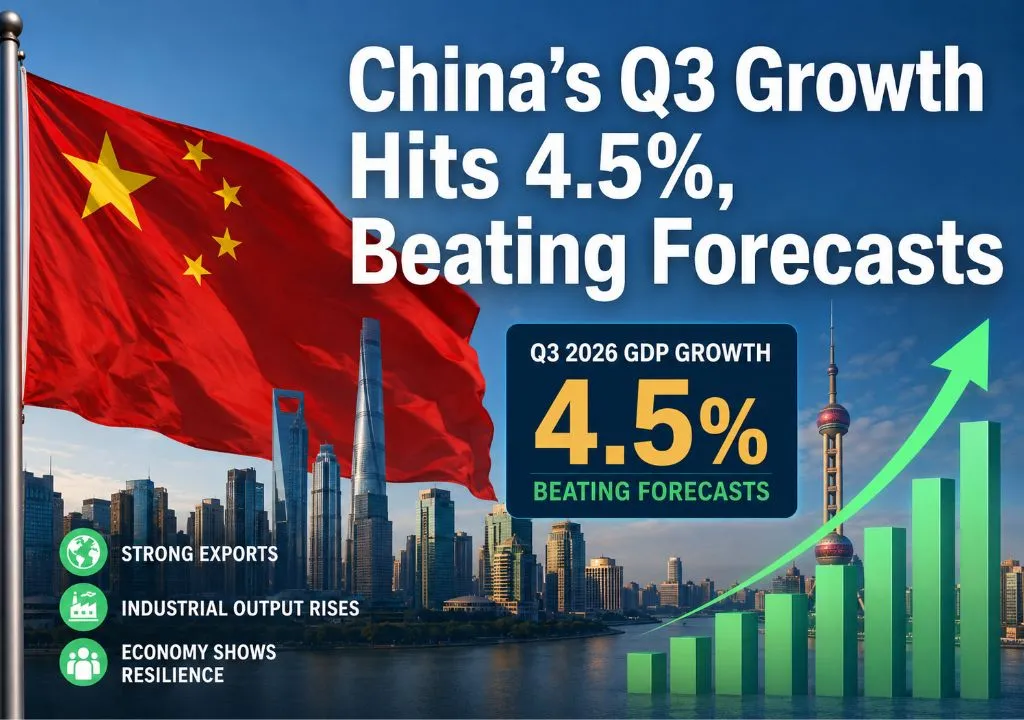
According to the National Bureau of Statistics, China’s economy expanded by 4.5% year-on-year in the July-September quarter, slightly higher than the 4.4% forecast. The economy also recorded quarter-on-quarter growth of 1.2%, indicating that economic activity improved compared with the previous three-month period.
The latest result represents a modest recovery from the second quarter, when China’s economy grew by 4.3%, its slowest quarterly growth rate in more than three years. The improvement suggests that industrial activity, exports, and selected areas of consumer spending have provided support during a challenging economic period.
For the first nine months of 2026, China recorded overall GDP growth of 4.6% compared with the same period in 2025. This performance keeps the country broadly on track to achieve its annual economic growth target of between 4.5% and 5%.
Although the third-quarter figures are encouraging, the outlook remains uncertain because economic growth depends on several factors, including consumer confidence, private investment, international demand, and government policy decisions.
Strong Exports Support China’s Economic Performance
Exports have played an important role in supporting China’s economic growth (China’s Q3 Growth Hits 4.5%, Beating Forecasts) throughout 2026. The country remains a major global supplier of manufactured products, electronic equipment, machinery, electric vehicles, batteries, and other technology-related goods. Demand for some advanced industrial products has helped Chinese manufacturers maintain production and compete in international markets.
The growing importance of technology manufacturing has also supported China’s efforts to move towards higher-value industries. Businesses producing advanced equipment, electronic components, and products connected with artificial intelligence have benefited from opportunities in international markets, although demand varies across sectors.
China’s trade performance has remained particularly important because domestic consumption and private investment have not recovered strongly enough to provide equally broad support. When overseas customers purchase more Chinese products, factories can maintain production, businesses can generate revenue, and employment can receive support across parts of the manufacturing supply chain.
However, depending heavily on exports also creates risks. A slowdown in major economies could reduce demand for Chinese goods, while trade restrictions, tariffs, and disputes over industrial competition could make it more difficult for exporters to maintain their current performance. These external pressures could become more significant if global demand for technology products begins to weaken.
Industrial Production Shows Signs of Strength
China’s industrial sector has remained another important source of economic activity. Official data showed that industrial output increased by 5.5% year-on-year in September 2026, reflecting continued production across manufacturing and related industries.
High-tech manufacturing has performed particularly well, supported by investment in advanced equipment, electronics, and other technology-intensive products. During the first nine months of the year, the value added of China’s high-tech manufacturing sector increased by 14.3% compared with the same period in 2025, while equipment manufacturing grew by 10.2%.
These figures indicate that China continues to invest in industries that can improve productivity, strengthen its manufacturing capabilities, and support competition in international markets. The expansion of advanced manufacturing may also help the country reduce its dependence on some traditional industries over time.
Nevertheless, strong industrial production does not automatically translate into a balanced economic recovery. Factories may increase output without creating an equivalent rise in household income or consumer spending, particularly when companies face intense competition or limited demand in certain markets.
For sustained economic growth, China will need to ensure that industrial progress is accompanied by stronger consumption, business confidence, and employment opportunities.
Weak Consumer Demand Remains a Major Challenge
Despite the improvement (China’s Q3 Growth Hits 4.5%, Beating Forecasts) in GDP growth, domestic demand continues to be an important concern for China’s policymakers. Consumer spending is essential for a large economy because it creates demand for goods and services, encourages businesses to expand, and supports employment across sectors such as retail, transport, hospitality, and entertainment.
China’s retail sales increased by 1.1% year-on-year in September 2026, according to the latest official figures. Although the increase was better than economists had expected, it also suggests that consumer spending remains relatively cautious compared with the strength seen in parts of the industrial sector.
Several factors may influence household spending decisions, including uncertainty about future income, concerns about employment, and falling confidence in the property market. When households are uncertain about their financial position, they may prefer to save money rather than make major purchases, which can slow the recovery in domestic demand.
A stronger consumer recovery would help China create a more balanced economic structure in which growth depends not only on exports and industrial investment but also on spending within the country. Encouraging households to spend more could provide businesses with a larger domestic market and reduce some of the pressure to depend on overseas demand.
Property Sector Weakness Continues to Affect the Economy
The property market remains one of the most significant challenges facing China’s economy. For years, real estate supported investment, construction activity, local government revenue, and household wealth. However, the prolonged downturn in the sector has weakened confidence and created difficulties for developers, investors, and homebuyers.
Official data showed that property development investment fell by 20.6% during the first nine months of 2026 compared with the same period last year. The decline highlights the continuing pressure on a sector that previously played a major role in China’s economic expansion.
Weakness in real estate can affect other parts of the economy because construction projects create demand for steel, cement, machinery, transport, and other services. When property developers reduce investment, these connected industries may also experience slower activity.
The property downturn can also influence consumer behaviour. Households that are concerned about falling home values may delay major purchases, while businesses may become more cautious about investing in new projects.
Addressing these problems will remain important for the government as it attempts to strengthen economic confidence. However, restoring the property sector requires more than a short-term increase in activity, as policymakers must also manage financial risks and rebuild confidence among buyers and investors.
What China’s Growth Means for the Global Economy
China’s economic performance (China’s Q3 Growth Hits 4.5%, Beating Forecasts) matters beyond its borders because the country is one of the world’s largest economies and a major participant in international trade. Changes in Chinese industrial production, consumer demand, and import activity can influence commodity prices, manufacturing supply chains, and the economic outlook of trading partners.
For countries that export raw materials, energy products, agricultural goods, and industrial components to China, stronger economic activity may create additional opportunities. However, the benefits depend on the composition of growth and whether China’s domestic demand increases alongside its manufacturing output.
For India, China’s economic performance is relevant because both countries play important roles in Asian trade and manufacturing. Changes in Chinese export prices, industrial capacity, and global demand may influence competition in sectors such as electronics, renewable energy equipment, chemicals, and machinery. At the same time, opportunities may emerge for Indian businesses that supply products or services to regional and international markets.
The latest figures also raise questions about global trade imbalances. If China continues to rely heavily on exports while domestic consumption remains weak, its manufacturing strength could increase concerns among trading partners about competition and market access. Such concerns may encourage additional trade measures, potentially creating uncertainty for international businesses.
Therefore, China’s economic growth should be assessed not only by the headline GDP figure but also by the extent to which it supports domestic demand and contributes to more balanced international trade.
Will China Maintain Its Economic Growth Momentum?
China’s third-quarter growth of 4.5% provides a positive signal, but maintaining that momentum will depend on how the economy performs during the final months of 2026. Strong exports and industrial production may continue to support activity, although external demand could become less reliable if global economic conditions weaken.
Policymakers face the challenge of supporting growth without creating additional financial risks. Measures that encourage household consumption, improve business confidence, support employment, and address weaknesses in the property market could help create a more sustainable recovery.
Government spending and targeted support may also play a role in strengthening demand, particularly if private businesses remain reluctant to expand investment. However, the effectiveness of these measures will depend on whether they encourage lasting economic activity rather than only providing temporary support.
Another important factor will be the relationship between China’s manufacturing capacity and overseas demand. Continued investment in advanced industries can strengthen competitiveness, but businesses will still need sufficient customers to justify higher production and investment.
The coming quarters will therefore provide a clearer indication of whether the latest improvement represents the beginning of a stronger recovery or a temporary increase supported by exports and industrial activity.
Conclusion
China’s Q3 economic growth of 4.5% in 2026 exceeded market forecasts and improved on the previous quarter’s performance, providing some relief to policymakers and strengthening the country’s chances of meeting its annual growth target. Strong exports, rising industrial production, and continued expansion in high-tech manufacturing have supported the economy despite difficult conditions in the property sector and relatively weak domestic consumption.
However, the latest figures also highlight the difference between economic growth and a fully balanced recovery. China will need stronger household spending, renewed confidence in real estate, and more consistent private investment to reduce its dependence on external demand.
For the global economy, China’s performance will remain important because it influences international trade, manufacturing supply chains, and economic relationships across Asia and beyond. Whether the country can maintain its growth momentum will depend on its ability to turn recent industrial and export strength into a broader recovery that benefits businesses and households across the economy.
If you find this article informative, you should visit Globaltides for more.
Want to know The History of China’s Economy
