Introduction-IMF Global Growth Slows to 3.1% in 2026
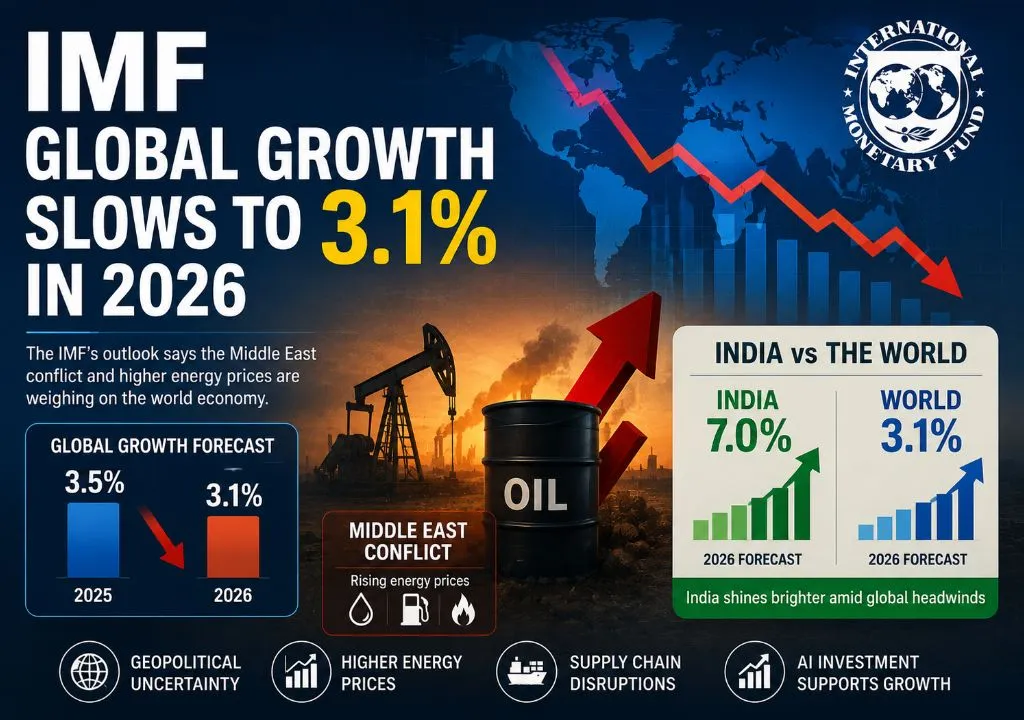
The world economy is facing another difficult year as geopolitical tensions, rising energy prices and uneven investment growth put pressure on countries across the globe. According to the International Monetary Fund (IMF), the global economy is projected to grow by 3.1% in 2026, compared with 3.5% in 2025. Although the latest forecast is slightly better than the IMF’s earlier July projection, the global economy continues to face serious risks, particularly from the prolonged conflict in the Middle East and uncertainty in international energy markets.
However, the “IMF Global Growth Slows to 3.1% in 2026” does not affect every country in the same way. While several economies are struggling with higher costs and weaker growth, India is expected to grow by around 7% in 2026, according to the IMF’s October outlook. This creates an important contrast between India and the rest of the world, raising questions about what is supporting India’s growth and whether the country can maintain its momentum if energy prices remain high.
The difference matters because a country’s economic performance affects employment, household spending, business investment and the cost of everyday goods. Understanding the latest IMF global growth forecast therefore requires looking beyond a single number and examining how international events are shaping different economies.
Why Is Global Economic Growth Slowing in 2026? (IMF Global Growth Slows to 3.1% in 2026)
The global economy is being influenced by two major forces moving in opposite directions. On one side, the Middle East conflict has disrupted energy supplies and increased uncertainty. On the other, investment in artificial intelligence (AI) and related technologies is supporting economic activity in several countries.
The IMF’s October 2026 World Economic Outlook estimates that global growth will reach 3.1% this year, below the 3.5% recorded in 2025. Growth is forecast to improve to 3.4% in 2027, although this outlook depends partly on how international conditions develop.
One of the biggest concerns is that higher energy prices can increase the cost of production, transportation and electricity. When businesses pay more to operate, they may raise prices, reduce investment or delay expansion. Consumers can also feel the pressure when fuel, food and other essential goods become more expensive.
The effects can spread across borders because countries depend on international trade for energy, raw materials and manufactured products. A disruption in one important region can therefore affect businesses and households thousands of kilometres away.
At the same time, investment in AI infrastructure is providing support to some economies. Spending on data centres, computing equipment and advanced technology is creating demand for products and services across international supply chains. However, these benefits are concentrated in particular countries and industries, which means the recovery remains uneven.
How the Middle East Conflict Is Affecting the World Economy
The Middle East plays an important role in international energy markets because the region contains major oil and gas producers and important shipping routes. When conflict threatens energy production or transportation, global markets react to the possibility of supply shortages.
The Strait of Hormuz is especially important because it connects the Persian Gulf with international shipping routes. Disruptions to traffic through the strait can make it more difficult and expensive to transport oil and other energy products to international buyers.
Higher oil prices create several economic challenges. Airlines face increased fuel expenses, transport companies pay more to move goods, and manufacturers may experience higher production costs. These expenses can eventually reach consumers through higher prices for everyday products and services.
Energy-importing countries are particularly exposed because they must spend more money to purchase the same amount of fuel. If these countries cannot easily replace their energy supplies or reduce consumption, their trade balances and currencies may come under pressure.
The conflict also creates uncertainty for investors. Companies may delay major projects when they cannot predict future energy costs, shipping conditions or demand. This can weaken business confidence and slow economic activity even in countries that are geographically distant from the conflict.
The IMF (IMF Global Growth Slows to 3.1% in 2026) has warned that a prolonged conflict could create further inflationary pressure and weaken global growth. Although the world economy has shown resilience, that resilience depends partly on the ability of governments and businesses to manage disruptions without exhausting their financial resources.
India vs the World: Why Is India Growing Faster?
India’s projected growth of around 7% stands well above the IMF Global Growth Slows to 3.1% in 2026. This difference makes India an important part of the international economic story, especially at a time when many countries are dealing with higher energy costs and uncertainty.
One important reason is domestic demand. India’s large population creates substantial demand for housing, transport, consumer goods, financial services and digital products. When households continue spending and businesses invest in response to demand, economic activity can remain strong even when international conditions become difficult.
The services sector is another important source of growth. Information technology, financial services, telecommunications, professional services and other business activities contribute to economic output and connect India with international markets. The country’s expanding digital economy also creates opportunities for businesses to reach more customers and improve productivity.
Investment in infrastructure can provide further support by improving transport, logistics and connectivity. Better infrastructure can reduce business costs, improve access to markets and encourage private investment over time.
However, India’s faster growth does not mean that it is protected from the global slowdown. The country imports a substantial amount of the crude oil it consumes, which makes its economy sensitive to changes in international energy prices. When oil becomes more expensive, India must spend more on imports unless lower consumption or other adjustments offset the increase.
Higher oil prices can also increase pressure on domestic inflation, transportation costs and government finances. If households have to spend more on fuel and essential goods, they may have less money available for other purchases.
The IMF has therefore highlighted the need for India to manage energy-related risks carefully while maintaining economic stability. Strong domestic demand provides a cushion, but the duration of the energy shock will influence how well the country can sustain its growth.
What Do the Numbers Tell Us? (IMF Global Growth Slows to 3.1% in 2026)
The difference between global and Indian growth provides a useful way to understand the current economic environment.
- Global economy: “The IMF Global Growth Slows to 3.1% in 2026” reflecting the effects of geopolitical uncertainty and higher energy costs, partly offset by technology investment.
- India: Growth is projected at around 7%, supported by domestic demand and services activity.
- Inflation: Higher energy and food prices could put pressure on consumers and businesses in several countries.
- International trade: Higher shipping and production costs can affect the prices and competitiveness of goods moving across borders.
- Technology investment: AI-related spending is supporting growth in selected economies, but its benefits are not evenly distributed.
These figures show why the global economy cannot be understood as a single, uniform market. Some countries benefit from technology exports or stronger domestic demand, while others face greater pressure because they depend heavily on imported energy or have limited financial resources.
India’s growth outlook is encouraging in comparison with the global average, but the difference should not hide challenges such as employment creation, income inequality, inflation and the need for sustained investment.
What Could Higher Energy Prices Mean for Indian Households?
For ordinary Indian households, the impact of an international energy shock may appear gradually rather than all at once. Fuel prices influence transportation directly, but energy costs can also affect the production and delivery of food, clothing, electronics and other goods.
When businesses face higher transport and manufacturing expenses, they may pass some of those costs on to customers. This can reduce the purchasing power of households, especially those that already spend a large share of their income on essential items.
Small businesses may face additional pressure because they often have less room to absorb sudden increases in operating costs. Higher expenses can affect their ability to hire workers, expand operations or offer competitive prices.
The government also faces difficult decisions when energy prices rise. Support for consumers and businesses can reduce immediate pressure, but broad subsidies may place additional strain on public finances. Carefully targeted assistance can help protect vulnerable households while limiting the long-term cost to the government.
For India, managing these pressures will require a balance between controlling inflation, supporting economic activity and maintaining financial stability.
Can India Maintain Its Growth Momentum? (IMF Global Growth Slows to 3.1% in 2026)
India’s outlook depends on both domestic economic conditions and developments in the wider world. Continued consumer demand, investment in infrastructure and growth in services could help the economy remain resilient. However, a prolonged energy crisis could make this task more difficult.
Reducing dependence on imported fossil fuels over time could improve energy security. Investment in renewable energy, public transport, energy efficiency and domestic energy infrastructure can help reduce exposure to international price shocks, although these changes require time and investment.
India can also strengthen its position by improving manufacturing competitiveness, expanding exports and building more reliable supply chains. A broader range of export markets can help businesses manage disruptions in individual regions.
At the same time, policymakers must pay attention to inflation and the financial pressures facing households. Strong economic growth is more meaningful when it creates employment, improves incomes and allows families to maintain their purchasing power.
The global outlook also contains opportunities. India’s technology services, digital infrastructure and expanding consumer market may attract further investment, particularly if companies continue to diversify their operations and supply chains.
Still, no growth forecast is guaranteed. The duration of the Middle East conflict, future oil prices, international demand and domestic policy decisions will all influence India’s economic performance in the coming months.
Conclusion
The “IMF Global Growth Slows to 3.1% in 2026” highlights an economy dealing with geopolitical uncertainty, higher energy prices and uneven investment. The Middle East conflict has demonstrated how disruptions in one region can affect fuel costs, international trade and economic activity around the world.
India’s projected growth of around 7% places it ahead of the global average, supported by domestic demand, services and its expanding digital economy. Yet the country remains exposed to international energy prices because of its dependence on imported crude oil.
The key question is not simply whether India can grow faster than the world, but whether it can maintain that growth while managing inflation, protecting household purchasing power and strengthening its energy security.
For Globaltides readers, the India-versus-world comparison offers an important lesson: global economic challenges do not affect every country equally, and long-term resilience depends on how well countries prepare for uncertainty. India’s performance in 2026 will therefore be shaped not only by its domestic strengths, but also by how effectively it responds to an increasingly unpredictable global economy.
