Flydubai Emergency: Indian Pilot Steps In
A routine flight from Dubai to Tel Aviv turned into a frightening mid-air emergency on September 30, 2026, after violence reportedly broke out inside the cockpit of a Flydubai aircraft. What followed was a rapid descent, an emergency diversion and a desperate effort to regain control of the plane.
At the centre of the incident was Captain Smit Machchhar, an Indian pilot who was reportedly attacked by his co-pilot during the flight. Despite suffering injuries, Machchhar was able to help open the cockpit door, allowing passengers and other crew members to intervene. Other qualified Flydubai pilots who were travelling on the aircraft then helped bring the plane under control and land it safely in Saudi Arabia.
The incident has since raised important questions about cockpit security, crew screening and how aviation authorities respond when a threat comes from inside the flight deck rather than from a passenger.
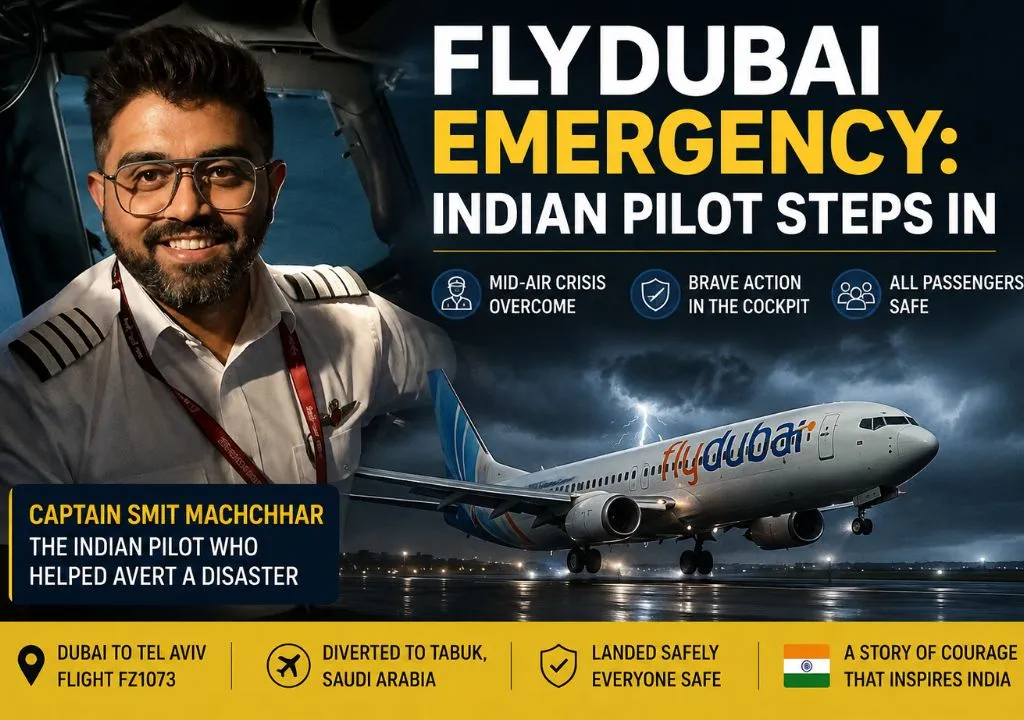
What Happened on Flydubai Flight FZ1073?
Flydubai Flight FZ1073 was travelling from Dubai in the United Arab Emirates to Tel Aviv in Israel on September 30 when a serious confrontation (Flydubai Emergency: Indian Pilot Steps In) reportedly developed between the captain and co-pilot.
According to reports from Israeli officials and other authorities, the aircraft suddenly began losing altitude during the confrontation. Tracking data indicated that the Boeing 737 descended by roughly 14,000 feet in a very short period, creating a potentially dangerous situation for everyone on board.
The situation became even more serious when the captain, Smit Machchhar, was reportedly attacked inside the cockpit. Saudi Arabia’s Interior Ministry later confirmed that its preliminary investigation found that the captain had been assaulted by his co-pilot and that both pilots suffered injuries.
The exact sequence of events is still being examined by investigators, so some details reported immediately after the incident may change as authorities gather more evidence.
(Flydubai Emergency: Indian Pilot Steps In) How Did the Indian Pilot Help Avert the Disaster?
One of the most significant details to emerge from the incident concerns what happened after Captain Machchhar was injured.
According to Israeli officials, Machchhar managed to activate the cockpit door release. This allowed passengers and crew members to enter the cockpit and overpower the alleged attacker. The intervention gave other qualified pilots on board an opportunity to take control of the aircraft.
The aircraft was subsequently diverted to Prince Sultan bin Abdulaziz International Airport in Tabuk, Saudi Arabia, where it landed safely.
The flight was carrying 174 passengers, while other reports put the total number of people on board, including crew, at 182. All passengers ultimately reached Israel safely after the emergency.
For Machchhar, however, the incident ended with serious injuries. He received medical treatment after the emergency landing and underwent surgery. Indian authorities also remained in contact with his family and Saudi authorities regarding his condition. Later said that he was in stable condition.
Who Is Captain Smit Machchhar?
Captain Smit Machchhar is an Indian commercial pilot from Mumbai who has worked in the aviation industry for many years.
Before joining Flydubai, Machchhar worked with Indian airline SpiceJet for more than a decade. He later joined Flydubai and became a captain flying the airline’s Boeing 737 aircraft. His professional background includes years of commercial flying experience.
His background has received considerable attention in India following the incident, particularly because of his actions during the emergency.
Indian officials have also been involved in supporting Machchhar and his family. India’s diplomatic representatives in the region have maintained contact with the relevant authorities while he receives medical care.
Indian Prime Minister Narendra Modi publicly praised Machchhar following the incident, while Israeli Prime Minister Benjamin Netanyahu also highlighted the Indian pilot’s role in helping prevent a potentially catastrophic outcome.
What Happened to the Co-Pilot?
The co-pilot involved in the confrontation was taken into custody following the emergency landing.
However, several important details about him remain unclear. Authorities have not publicly established a complete account of his background or motive, and reports about his nationality have not been consistently confirmed by all relevant authorities.
The United Arab Emirates has launched an investigation into the incident. According to the UAE’s state news agency WAM, investigators are examining the circumstances and motives behind the confrontation and whether it had any connection to terrorist activity, prior planning or outside direction.
This distinction is important because several political and security-related claims were made shortly after the incident. Those claims should not be treated as established facts while the investigation remains underway.
Saudi Arabia has also conducted a preliminary investigation 9Flydubai Emergency: Indian Pilot Steps In). Its Interior Ministry said the initial findings showed that the captain had been assaulted by his co-pilot, with both pilots suffering injuries. The two pilots were later transferred back to the United Arab Emirates after their medical conditions improved.
Why Did the Plane Divert to Saudi Arabia? (Flydubai Emergency: Indian Pilot Steps In)
Once the aircraft was no longer considered stable enough to continue normally toward Tel Aviv, the pilots diverted it to Tabuk in northwestern Saudi Arabia.
Saudi Arabia’s aviation and security authorities responded to the emergency and handled the arrival of the aircraft. After landing, the injured pilots were taken for medical treatment while authorities began investigating what had happened inside the cockpit.
The choice of Tabuk was significant from a practical aviation perspective because an emergency landing requires a suitable airport where the aircraft can be safely brought down and passengers can receive assistance.
After the incident, the passengers were eventually transported onward to Israel on another Flydubai aircraft.
The Bigger Aviation Security Question
The Flydubai incident (Flydubai Emergency: Indian Pilot Steps In) is unusual because the reported threat did not originate from a passenger attempting to enter the cockpit. Instead, the confrontation allegedly involved a member of the flight crew.
Modern commercial aircraft use reinforced cockpit doors and strict procedures to prevent unauthorised access. These measures became especially important after the September 11, 2001 attacks, when aviation security systems around the world underwent major changes.
However, an incident involving a crew member creates a different security challenge.
The Flydubai case has therefore prompted questions about how airlines and aviation authorities assess people who have authorised access to the cockpit. It also raises questions about whether existing security systems are designed primarily to prevent external threats while giving less attention to threats originating within the flight crew.
Experts and authorities will likely examine the incident from several angles, including pilot screening, security checks, cockpit procedures and emergency response.
What Investigators Still Need to Establish
Despite the dramatic events (Flydubai Emergency: Indian Pilot Steps In) on Flight FZ1073, several major questions remain unanswered.
Investigators still need to establish exactly why the confrontation began, what happened inside the cockpit immediately before the aircraft’s rapid descent, and whether the incident was spontaneous or planned.
Authorities are also examining whether there was any broader security motive behind the incident. The UAE investigation specifically includes questions about possible terrorist activity or prior planning, but no final conclusion on motive has been publicly established at this stage.
Another important question concerns how the co-pilot was cleared to operate the flight. Aviation authorities are expected to examine his professional and security background as part of the wider investigation.
These questions will take time to answer, and early reports should therefore be treated carefully.
What the Flydubai Incident Means for India (Flydubai Emergency: Indian Pilot Steps In)
For India, the incident has drawn attention to the role of Indian aviation professionals in international commercial aviation.
Captain Machchhar’s career also demonstrates how Indian pilots increasingly work across international airlines and global aviation networks. His previous experience with SpiceJet and later work with Flydubai connect India’s aviation workforce with one of the world’s busiest international air-travel regions.
The incident has also brought Indian diplomatic authorities into the response because an Indian citizen was among those directly affected. The Indian Embassy and other officials have been communicating with Machchhar’s family and authorities involved in his medical treatment.
Beyond the individual story, the episode could contribute to a wider discussion about international aviation security. Commercial aviation depends on cooperation between airlines, airports, governments and security agencies across multiple countries. When an emergency occurs on an international route, that cooperation becomes particularly important.
A Flight That Could Have Ended Very Differently
The Flydubai FZ1073 incident began like an ordinary international journey but quickly became an aviation emergency involving violence inside the cockpit.
Captain Smit Machchhar was injured during the confrontation, yet he was reportedly able to help open the cockpit door. Passengers and crew then intervened, while other pilots on board helped regain control of the aircraft. The plane eventually landed safely in Saudi Arabia, and the passengers continued their journey to Israel.
The full story is still being investigated. Questions about the motive, the co-pilot’s background and the security procedures surrounding the flight remain open.
For now, the incident serves as a reminder of how quickly an aviation emergency can develop and how important trained crews, passengers and emergency systems can become when something goes wrong thousands of feet above the ground.
If you find this article informative, then visit the website Globaltides.
