Ebola Virus in Congo: Cases, Causes and Outbreaks
The Democratic Republic of the Congo (DRC) has been at the centre of the world’s Ebola story for almost five decades. The disease was first identified in the country in 1976, and since then, the DRC has experienced repeated Ebola outbreaks, making it one of the countries most closely associated with the virus.
Ebola is a severe infectious disease that can cause fever, weakness, vomiting, diarrhoea and, in serious cases, internal or external bleeding. Although Ebola outbreaks have occurred in several African countries, the DRC has recorded more outbreaks than any other country.
The situation is particularly important in 2026 because the country is experiencing another major Ebola disease outbreak. However, there is an important scientific distinction: the current outbreak is being caused by Bundibugyo virus, one of the viruses that can cause Ebola disease, rather than Ebola virus itself. Understanding this difference helps explain both Congo’s long history with Ebola and the current health emergency.
Where Was Ebola First Discovered? (Ebola Virus in Congo: Cases, Causes and Outbreaks)
The history of Ebola is closely connected to the Democratic Republic of the Congo.
In 1976, an outbreak of what is now called Ebola virus disease occurred in Yambuku, in what was then Zaire and is now the Democratic Republic of the Congo. The disease was also identified that year in what is now South Sudan. The virus was named after the Ebola River, which is located near the area of the first outbreak in the DRC.
The 1976 outbreak established Ebola as a serious emerging infectious disease. Since then, scientists and health authorities have continued to monitor the virus and investigate how it moves between animals and humans.
The DRC’s forests and close interaction between communities and wildlife are among the factors that have made the region important in research into Ebola and related viruses.
Why Has Congo Experienced So Many Ebola Outbreaks?
The DRC is a large country with extensive tropical forest areas and many communities that can be difficult to reach quickly. Some areas also experience conflict, displacement and limited access to healthcare, which can make infectious disease surveillance more difficult.
Ebola viruses are believed to have natural hosts among wildlife, particularly fruit bats, although the precise ecology of Ebola transmission is complex. Human infections can occur when people come into contact with infected animals or their bodily fluids. Once the virus enters a human population, it can spread through direct contact with the blood or other bodily fluids of an infected person.
Healthcare conditions can also influence the course of an outbreak. When suspected cases are not identified quickly, an infected person may continue interacting with family members or healthcare workers before receiving appropriate care.
Traditional funeral practices can create another transmission risk because the bodies of people who have died from Ebola disease can remain infectious. Safe and dignified burials are therefore an important part of outbreak control.
These factors do not mean that Ebola is constantly spreading throughout Congo. Instead, they help explain why isolated outbreaks can emerge and become difficult to contain when detection and response are delayed.
Congo Has Experienced the Largest Ebola Outbreaks
The DRC has experienced numerous Ebola disease outbreaks since 1976.
One of the most significant occurred between 2018 and 2020 in eastern DRC. According to the World Health Organization, that outbreak recorded 3,317 confirmed cases and became the country’s largest Ebola outbreak at the time.
The outbreak affected communities in North Kivu and Ituri provinces and presented major challenges because of insecurity and difficulties reaching some affected populations.
The response involved healthcare workers, laboratories, international organisations and local communities. Vaccination also became an important tool during the outbreak because an effective vaccine against Ebola virus disease was available.
The experience demonstrated how quickly an outbreak (Ebola Virus in Congo: Cases, Causes and Outbreaks) can become a major public health challenge when transmission occurs across densely connected communities.
Ebola Virus and Ebola Disease Are Not Exactly the Same
One of the most important points when discussing Ebola in Congo is the difference between Ebola virus and Ebola disease.
Ebola disease is a broader term for severe diseases caused by several viruses belonging to the Orthoebolavirus genus.
WHO identifies three viruses known to have caused major Ebola disease outbreaks:
- Ebola virus (EBOV), which causes Ebola virus disease
- Sudan virus (SUDV), which causes Sudan virus disease
- Bundibugyo virus (BDBV), which causes Bundibugyo virus disease
This distinction matters because vaccines and treatments developed for one virus may not automatically work against another.
For example, licensed vaccines and specific treatments are available for Ebola virus disease, while specific approved vaccines and treatments for Bundibugyo virus disease are not currently available.
What Is Happening in Congo in 2026? (Ebola Virus in Congo: Cases, Causes and Outbreaks)
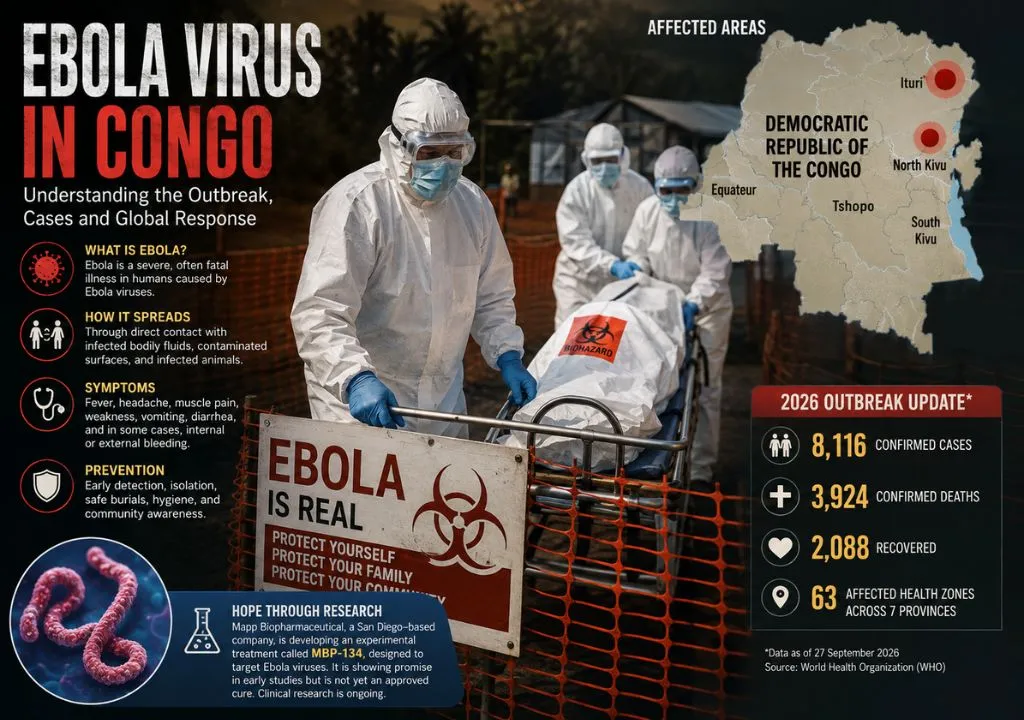
The latest outbreak in the DRC began in May 2026 and is caused by Bundibugyo virus.
According to WHO data available on 27 September 2026, the DRC had reported 8,116 confirmed cases and 3,924 confirmed deaths, with 2,088 people reported as recovered. The confirmed case-fatality ratio was approximately 48%.
The outbreak has spread across multiple provinces. WHO’s latest detailed outbreak report identified 63 affected health zones across seven provinces, with Ituri remaining the epicentre of transmission.
As of 23 September, Ituri had recorded 6,032 confirmed cases, making it by far the most affected province in the current outbreak. North Kivu followed with 1,480 confirmed cases.
These numbers make the 2026 outbreak particularly significant in Congo’s Ebola history.
WHO reported in July that the 2026 outbreak had already surpassed the previous 2018–2020 outbreak in terms of confirmed cases, making it the largest Ebola disease outbreak ever reported in the DRC.
What Are the Symptoms of Ebola?
Ebola disease can begin with symptoms that resemble other infections, making early diagnosis difficult.
Common symptoms include fever, extreme tiredness, muscle pain, headache and sore throat. These symptoms can later be followed by vomiting, diarrhoea, abdominal pain and skin rash. Severe cases can involve problems affecting organs and, in some patients, internal or external bleeding.
The incubation period can range from 2 to 21 days. Importantly, bleeding is not present in every patient and is not necessarily an early symptom.
Because malaria, typhoid and other diseases can produce similar symptoms, laboratory testing is needed to confirm an Ebola infection.
How Does Ebola Spread? (Ebola Virus in Congo: Cases, Causes and Outbreaks)
Ebola is primarily transmitted through direct contact with infected bodily fluids.
A person can become infected by coming into contact with the blood, vomit, stool or other bodily fluids of someone who has Ebola disease. Transmission can also occur through contaminated objects and surfaces.
Healthcare workers are particularly vulnerable when caring for infected patients without appropriate protective equipment and infection-control procedures.
The virus can also be transmitted during traditional burial practices involving direct contact with the body of someone who died from Ebola disease.
Ebola is therefore different from respiratory infections that spread easily through ordinary breathing, casual contact or airborne transmission.
Can Ebola Be Treated or Prevented? (Ebola Virus in Congo: Cases, Causes and Outbreaks)
There is no single treatment that works against every virus capable of causing Ebola disease. Treatment depends on the specific virus responsible for the infection.
For Ebola virus disease caused by Ebola virus, specific antibody treatments are available. These include monoclonal antibody therapies such as Inmazeb and Ebanga, which are designed to target Ebola virus. Patients also require supportive care, including fluids, nutritional support, management of symptoms and treatment of complications.
However, the situation is more complicated for other Ebola-causing viruses. The current 2026 outbreak in the DRC is caused by Bundibugyo virus, for which there are currently no licensed specific treatments or vaccines.
San Diego Researchers Are Developing an Experimental Treatment
At the same time, researchers are continuing to search for treatments that could work against a broader range of Ebola viruses.
One of the companies involved in this research is Mapp Biopharmaceutical, a biotechnology company based in San Diego, California. The company is developing an experimental monoclonal antibody treatment known as MBP-134.
MBP-134 is being investigated because it is designed to target Ebola viruses and potentially provide protection against more than one Ebola virus species. The treatment has produced encouraging results in laboratory and animal research and has attracted attention as researchers look for additional tools against Ebola disease.
However, MBP-134 should not be described as a confirmed cure for Ebola. It remains an experimental treatment, and further clinical research is needed to establish its safety and effectiveness in humans.
The research is particularly relevant because the current Congo outbreak is caused by Bundibugyo virus, for which specific licensed treatments are not currently available. Research into broader treatments could therefore become important for future outbreaks caused by different Ebola viruses.
Prevention remains equally important. Health authorities rely on early detection, laboratory testing, isolation of infected patients, contact tracing and strict infection-prevention measures to limit transmission.
Safe and dignified burial practices are also essential because the bodies of people who have died from Ebola disease can remain infectious.
Vaccination can provide another layer of protection when an outbreak is caused by a virus for which an effective vaccine exists. The Ervebo vaccine, for example, is used to prevent Ebola virus disease caused by Ebola virus. However, it does not provide universal protection against every virus that can cause Ebola disease.
The development of experimental treatments such as MBP-134 shows how scientists and biotechnology companies are continuing to search for broader ways to respond to Ebola. While these developments are important, experimental treatments should be distinguished from medicines that have already been approved and demonstrated to be effective in patients.
Why Is the Current Congo Outbreak Difficult to Control?
The scale of the 2026 outbreak is only one part of the challenge.
WHO has reported that conflict, insecurity, displacement and limited access to basic services are complicating surveillance, contact tracing, infection prevention and access to medical care.
The number of contacts requiring monitoring has also become very large. Health authorities have had to track thousands of people who may have been exposed to infected individuals.
These figures demonstrate the amount of work required to identify people who may have been exposed before they develop symptoms and potentially transmit the virus to others.
Another challenge is that communities may delay seeking treatment because early Ebola symptoms can resemble other illnesses or because people may fear isolation and treatment centres.
For this reason, community engagement is an important part of Ebola response efforts.
What Does Congo’s Ebola History Tell Us?
The DRC’s long experience with Ebola shows that the disease cannot be understood only as a medical problem.
The country has repeatedly dealt with outbreaks in areas where healthcare access can be difficult and where conflict and displacement can disrupt public health operations. At the same time, the country has developed considerable experience in Ebola surveillance, laboratory testing, treatment and outbreak response.
The 2026 outbreak shows both sides of this experience. Health authorities have been able to identify and track thousands of cases, but continued transmission across multiple provinces demonstrates how difficult it can be to stop an outbreak once it becomes widespread.
The country’s history also shows the importance of investing in healthcare systems before an outbreak begins rather than waiting until cases have already increased.
Conclusion
The Democratic Republic of the Congo has a unique place in the history of Ebola. It was the location of the first recognized outbreak of Ebola virus disease in 1976 and has experienced repeated outbreaks over the decades. The country has also recorded some of the largest Ebola disease outbreaks ever documented.
The current 2026 outbreak has added a new chapter to that history. However, it is important to distinguish Ebola virus disease from other forms of Ebola disease. The current Congo outbreak is caused by Bundibugyo virus, not the Ebola virus species itself.
As of 27 September 2026, WHO reported 8,116 confirmed cases and 3,924 confirmed deaths in the DRC. Ituri has been the main centre of transmission, while cases have also been reported across several other provinces.
Congo’s experience demonstrates why Ebola remains an important global health concern. Early diagnosis, supportive medical care, infection prevention, contact tracing, safe burials and community cooperation all play a role in controlling outbreaks.
At the same time, research such as Mapp Biopharmaceutical’s experimental MBP-134 treatment in San Diego highlights the continuing scientific effort to develop broader tools against Ebola viruses. Although MBP-134 is not yet a proven cure, developments like this could contribute to the future response to Ebola disease.
For Congo and the international health community, the challenge remains both immediate and long-term: controlling current transmission while developing better vaccines, treatments and public health systems to prepare for future outbreaks.
If you find this article informative then visit the Globaltides.
