UN General Assembly 2026: Peace Takes Center Stage as World Leaders Call for Action
What Happened at the 2026 General Debate?
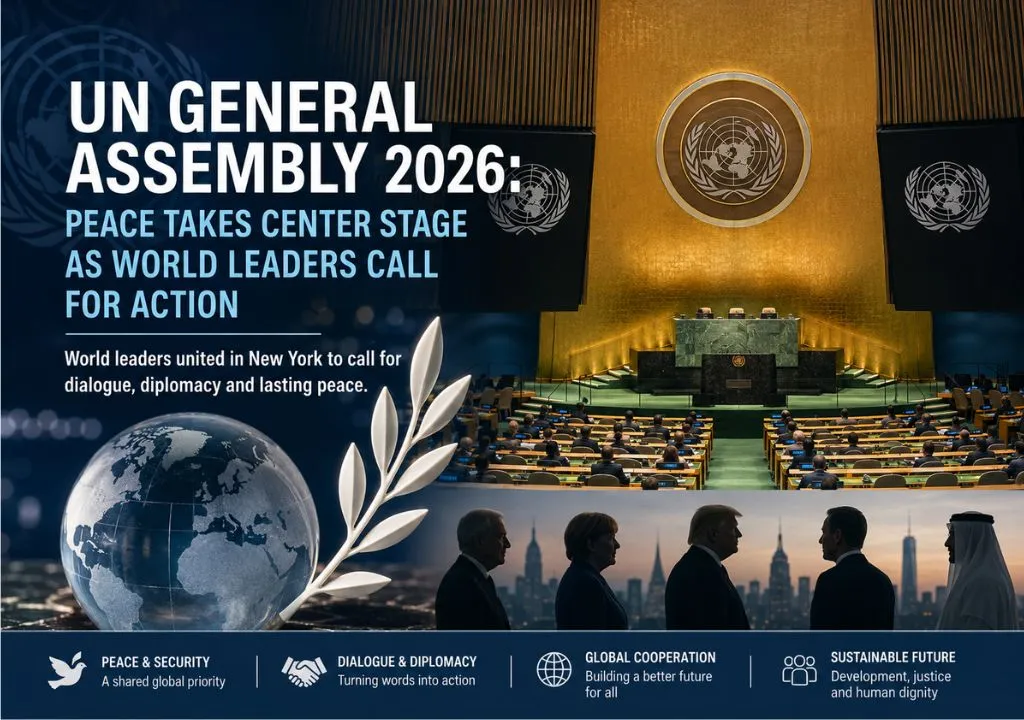
The 2026 General Debate opened on September 22 and concluded on September 28, with no session held on Sunday. According to General Assembly President Khalilur Rahman, 194 speakers addressed the Assembly during the debate.
The speakers included 113 heads of state and government, one crown prince, 11 vice presidents, seven deputy prime ministers and 48 ministers.
The official theme of the 81st session focused on restoring trust and managing change, with the broader goal of building a United Nations that delivers for everyone.
That theme reflected one of the central concerns running through the session: whether the UN can respond effectively to an increasingly divided world.
Alongside the General Debate, the UN calendar included high-level discussions on climate action, rising sea levels, pandemic preparedness, racism and nuclear disarmament. While the General Debate has concluded “UN General Assembly 2026: Peace Takes Center Stage” the wider 81st session continues, with important decisions still ahead.
UN General Assembly 2026: Peace Takes Center Stage: Why?
The emphasis on peace was closely connected to the conflicts dominating international affairs.
The wars in Ukraine and the Middle East remained major issues throughout the week. Leaders from different regions repeatedly highlighted the human and economic costs of conflict, including displacement, inequality and setbacks to development.
In his closing remarks, Rahman described a world facing conflict, stalled progress and rapid technological change. He also called for words to be translated into action.
That message captured one of the biggest challenges facing the General Assembly. World leaders can use the UN platform to express their positions, but turning those statements into agreements and practical measures requires cooperation after the speeches end.
Peace is also closely connected to many of the UN’s other priorities. Armed conflict can divert resources away from healthcare, education, climate action and economic development. For many governments, therefore, discussions about peace are also discussions about development and human security.
The United States: A Push to Return to “Basics”
The United States brought a distinct message to the General Assembly.
President Donald Trump argued that the United States is stronger than ever and emphasized his administration’s preference for action over what he portrayed as excessive international discussion. He also stressed national sovereignty and expressed opposition to forms of global governance that his administration views as limiting national independence.
The US State Department presented its broader approach to the UN around the idea of delivering prosperity through peace and returning the organization to what it described as its core responsibilities.
These priorities include international peace and security, respect for the independence of member states, measurable results and greater accountability for financial resources.
Supporters of this approach argue that the UN has expanded into too many areas and needs to focus more strongly on its core functions.
Others argue that areas such as health, climate change, human rights and development are closely connected to long-term international stability.
The disagreement is therefore not simply about whether the UN should be effective. It is also about what the organization should prioritize and how its success should be measured.
That debate is likely to remain important throughout the 81st session.
Ukraine, Iran and the Middle East Take Center Stage (UN General Assembly 2026: Peace Takes Center Stage)
Some of the most closely watched speeches came from leaders directly connected to major international conflicts.
Ukrainian President Volodymyr Zelenskyy used his address to criticize Russian President Vladimir Putin and warn about the broader security consequences of the war in Ukraine.
Iranian President Masoud Pezeshkian also addressed the General Assembly, offering a very different perspective on international affairs and Iran’s position in the current geopolitical environment.
The Middle East generated some of the week’s most dramatic moments.
Reports of a large walkout during Israeli Prime Minister Benjamin Netanyahu’s speech drew international attention, highlighting the deep divisions surrounding the war in Gaza and the wider regional crisis.
These moments demonstrated both the importance and the limitations of the General Assembly.
The UN General Assembly (UN General Assembly 2026: Peace Takes Center Stage) provides one of the world’s largest diplomatic platforms, where governments with opposing positions can publicly present their views. However, General Assembly resolutions are generally not legally binding in the same way as certain decisions adopted by the UN Security Council.
Even so, the political significance of the Assembly should not be underestimated. Speeches and votes can demonstrate diplomatic support, expose divisions and influence international discussions.
Restoring Trust in the United Nations
Trust was another major theme of the 81st session (UN General Assembly 2026: Peace Takes Center Stage).
At the opening of the session on September 8, General Assembly President Khalilur Rahman pledged to work toward rebuilding confidence in the institution.
His message focused on the connection between trust, delivery and reform. The argument is straightforward: if the UN wants public and governmental confidence, it must demonstrate that its decisions and programmes produce tangible results.
This challenge comes at a difficult time for the organization.
The UN has faced financial pressures and disagreements among major contributors over funding and spending priorities. Questions about efficiency and accountability have therefore become increasingly important.
For member states, the issue is not simply how much money the UN receives. It is also whether countries can clearly see what those resources achieve.
Reform, meanwhile, has been discussed at the UN for decades. Changing the institution’s structures is considerably more difficult than agreeing that reform is necessary.
One notable feature of the current debate is that countries with very different political positions increasingly recognize that the organization faces serious challenges. However, they continue to disagree over what reforms should look like and how far they should go.
The Race for the Next UN Secretary-General
Behind the speeches at the General Assembly, another important diplomatic process is underway: the selection of the next UN Secretary-General.
António Guterres is scheduled to complete his second term on December 31, 2026. His successor is expected to begin the five-year term on January 1, 2027.
The process involves both the Security Council and the General Assembly. The Security Council recommends a candidate, after which the General Assembly formally appoints the Secretary-General.
Eight candidates are currently in the race, and the process remains open.
In the third informal straw poll, Costa Rica’s Rebeca Grynspan received nine votes of encouragement, the minimum threshold needed for a formal decision in the poll. However, she also received five votes of discouragement, meaning the result does not guarantee that she will become the next Secretary-General.
The permanent members of the Security Council also have the power to veto a candidate, making their positions particularly important.
Several political considerations are shaping the selection process.
There has been longstanding discussion about whether the next Secretary-General should come from Latin America and the Caribbean. There is also significant international pressure for the UN to appoint a woman to the position for the first time.
The United States has not publicly endorsed a candidate but has indicated that it wants contenders to support reforms it believes are necessary at the organization.
With the end of Guterres’ term approaching, the selection process is likely to receive increasing diplomatic attention in the coming weeks.
What Comes Next After the General Debate?
The speeches may be over, but the major issues discussed during the General Debate (UN General Assembly 2026: Peace Takes Center Stage) remain unresolved.
The first issue to watch is the selection of the next Secretary-General. With the transition scheduled for January 2027, negotiations will become increasingly important.
The second is whether calls for peace translate into meaningful diplomatic efforts, particularly concerning Ukraine and the Middle East.
The third is the implementation of commitments made during the high-level meetings on climate change, pandemic preparedness, nuclear weapons and other global challenges.
These issues will ultimately determine whether the General Debate produces more than diplomatic statements.
The UN can provide the platform for dialogue, but its ability to produce results depends heavily on the willingness of member states to cooperate.
Conclusion
The 2026 UN General Assembly General Debate reflected a world facing deep divisions but still relying on diplomacy as a way to address them.
The “UN General Assembly 2026: Peace Takes Center Stage” which emerged as one of the strongest themes of the week, but the speeches also exposed major disagreements over conflicts, sovereignty, the future role of the United Nations and the organization’s priorities.
The real test begins after the speeches.
The coming weeks will show whether calls for peace lead to meaningful diplomatic action, whether the UN can make progress on reform and whether member states can agree on a new Secretary-General.
As Rahman’s message suggested, the challenge for the United Nations is no longer simply to speak about global problems. It is to demonstrate that international cooperation can produce results.
