Climate Change and Biodiversity Loss: A Simple Guide
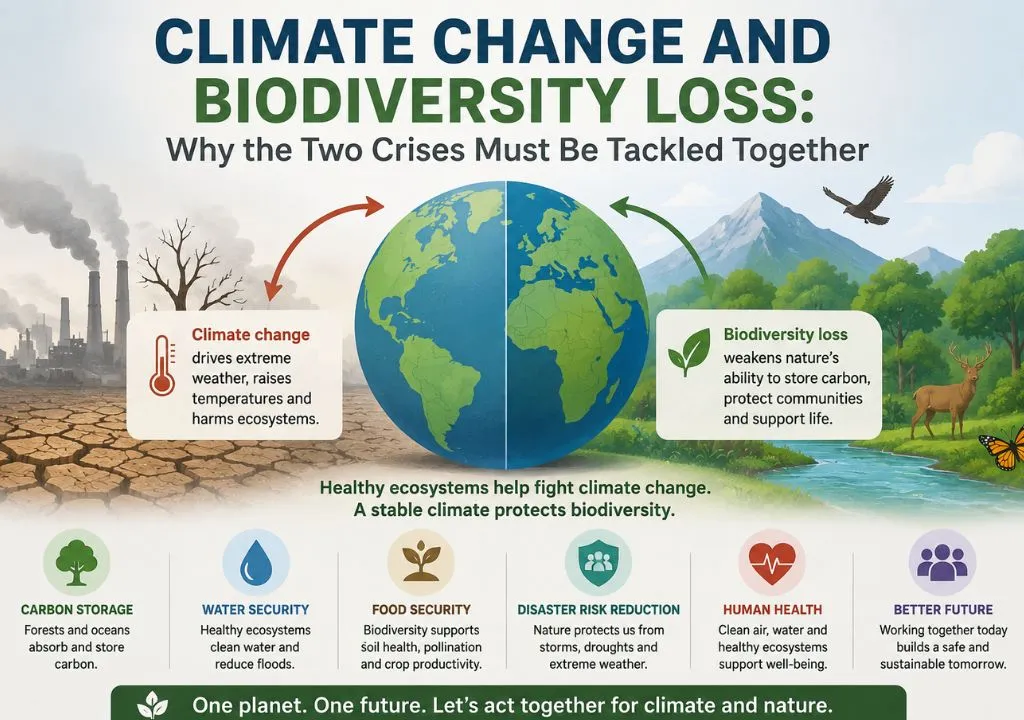
Climate change and biodiversity loss are closely connected environmental problems. Rising temperatures are changing natural habitats, while the destruction of forests, wetlands and other ecosystems can make climate change worse. This means governments cannot fully address one crisis while ignoring the other.
Climate change refers to long-term changes in temperatures and weather patterns. Human activities, especially burning coal, oil and gas, are the main cause of current global warming. Biodiversity refers to the variety of life on Earth, including plants, animals, microorganisms, genes and ecosystems.
Both crises are already affecting food systems, water resources, human health and economic activity. The Intergovernmental Science-Policy Platform on Biodiversity and Ecosystem Services (IPBES) has highlighted the strong links between biodiversity, climate change, food, water and health.
This is why climate change and biodiversity loss must be addressed together rather than through completely separate policies.
What Is the Connection Between Climate Change and Biodiversity? (Climate Change and Biodiversity Loss: A Simple Guide)
The natural world plays an important role in regulating the climate. Forests, oceans, wetlands, grasslands and other ecosystems store carbon and help control water and temperature. When these ecosystems remain healthy, they support climate stability and provide important services to people.
However, when forests are cleared, wetlands are destroyed or marine ecosystems are damaged, their ability to provide these benefits declines.
At the same time, climate change is putting additional pressure on ecosystems. Rising temperatures, changing rainfall patterns, stronger heatwaves, droughts, floods and changes in ocean conditions can make it harder for many species to survive.
This creates a cycle in which climate change damages ecosystems, while damaged ecosystems become less capable of helping society respond to climate change.
The IPCC and IPBES have described climate and biodiversity as deeply connected environmental challenges, with actions in one area often affecting the other.
How Climate Change Affects Biodiversity (Climate Change and Biodiversity Loss: A Simple Guide)
Climate change is changing the conditions in which plants and animals live. Many species depend on specific temperature ranges, water availability and seasonal patterns, so rapid environmental changes can create serious pressure on their survival.
For example, warmer temperatures can change the timing of flowering, breeding and migration. Some species may move towards cooler areas, while others may not be able to move quickly enough to find suitable habitats.
Marine ecosystems are also facing major challenges. Warmer oceans can affect marine species and ecosystems, while changing ocean conditions can place additional pressure on coral reefs and other sensitive habitats.
Climate change can also increase the risk of wildfires, droughts and extreme weather events. These events can damage habitats and reduce the ability of ecosystems to recover.
When several environmental pressures occur at the same time, species face an even greater risk because they have fewer opportunities to adapt.
How Biodiversity Loss Can Make Climate Change Worse?
The relationship (Climate Change and Biodiversity Loss: A Simple Guide) works in the other direction as well.
Healthy ecosystems can help absorb carbon dioxide from the atmosphere. Forests, mangroves, wetlands and other natural systems store carbon in vegetation, soil and sediments.
When these ecosystems are destroyed or seriously degraded, some of the stored carbon can be released into the atmosphere. At the same time, the world loses part of its natural ability to remove carbon from the air.
This is one reason why protecting ecosystems should be considered part of climate policy rather than only a conservation issue.
Forests are a clear example. They provide habitats for thousands of species while also storing carbon and supporting local communities. Protecting forests can therefore support both biodiversity and climate goals.
The same principle applies to wetlands, mangroves, grasslands and marine ecosystems, although the role and benefits of each ecosystem are different.
Why Healthy Ecosystems Matter for People? (Climate Change and Biodiversity Loss: A Simple Guide)
Biodiversity is not only about protecting rare animals or beautiful landscapes. Human societies depend on healthy ecosystems for food, water, soil quality, pollination and many other benefits.
Agriculture, for example, depends on a wide range of organisms that support soil health and pollination. Genetic diversity can also help crops and livestock become more resilient to environmental changes.
Healthy ecosystems contribute to water security. Forests, wetlands and other natural systems can influence water storage, filtration and the movement of water through landscapes.
The connection with health is also important. Biodiversity supports ecological processes that affect human well-being, while environmental degradation can create additional risks for communities.
The 2024 IPBES Nexus Assessment highlighted the connections between biodiversity, food, water and health and called for more integrated approaches to these challenges.
Why Separate Policies Are Not Enough? (Climate Change and Biodiversity Loss: A Simple Guide)
For many years, climate policy and biodiversity policy have often developed through separate international processes.
Climate discussions generally focus on reducing greenhouse gas emissions and helping societies adapt to climate impacts. Biodiversity policies focus more on protecting species, restoring ecosystems and reducing habitat destruction.
Both approaches are necessary, but treating them as completely separate problems can create gaps.
For example, a climate project may aim to reduce emissions but still damage local ecosystems if it is poorly planned. Similarly, a conservation project may protect an ecosystem but fail to consider how future climate changes could affect it.
This does not mean climate action and biodiversity protection are always in conflict. In many cases, they can support each other when policies are carefully designed.
The goal should be to identify solutions that reduce emissions, protect nature and improve community resilience at the same time.
Nature-Based Solutions Can Help
Nature-based solutions (Climate Change and Biodiversity Loss: A Simple Guide) are one way to connect climate action with biodiversity protection.
Restoring forests, wetlands, mangroves, grasslands and other ecosystems can provide several environmental benefits. These projects can protect habitats while supporting carbon storage, water management and climate adaptation.
Mangrove restoration, for example, can provide habitat for marine species while helping protect coastal communities from storms and erosion. Wetland restoration can support wildlife while improving water management in some areas.
However, nature-based solutions need careful planning. Planting trees in unsuitable locations or using a single species across large areas may not provide the same benefits as restoring a diverse, naturally suitable ecosystem.
Climate policies should therefore consider the quality and ecological value of restoration projects rather than focusing only on the number of trees planted or the amount of land covered.
The Importance of International Cooperation
Climate change and biodiversity loss do not respect national borders. Carbon emissions from one country can contribute to global warming, while damage to oceans and migratory ecosystems can affect many countries at the same time.
This makes international cooperation essential.
The United Nations, climate institutions, biodiversity organisations and national governments all have roles to play in developing policies that connect climate and nature protection.
Countries also need to share scientific knowledge, technology and financial resources. Developing countries often face significant environmental pressures while having fewer resources available for large-scale adaptation and conservation.
International finance can help countries protect forests, restore ecosystems, improve agriculture and prepare communities for climate-related risks.
The challenge is to ensure that environmental funding supports solutions that benefit both climate goals and biodiversity instead of creating new environmental problems.
What Governments Can Do? (Climate Change and Biodiversity Loss: A Simple Guide)
Governments can take several steps to address the two crises together.
First, environmental policies should consider both climate and biodiversity impacts before major projects are approved. This can help reduce unintended damage to ecosystems.
Second, countries can increase efforts to protect natural ecosystems such as forests, wetlands, mangroves and coastal areas. Protection is often more effective when combined with restoration of ecosystems that have already been damaged.
Third, governments can encourage more sustainable agriculture and land-use practices. Food production needs to remain productive while reducing unnecessary pressure on forests, soil, water and wildlife.
Fourth, climate adaptation plans should include nature. Restoring wetlands, protecting forests and improving urban green spaces can help communities deal with climate risks while supporting biodiversity.
Finally, governments need stronger cooperation between ministries and institutions. Climate departments, environment ministries, agriculture authorities and development agencies should not work in isolation when their policies affect the same ecosystems.
What Businesses and Communities Can Do?
Governments cannot solve these challenges alone.
Businesses have an important role because industries influence energy use, land use, agriculture, manufacturing and supply chains. Companies can reduce emissions, improve resource efficiency and examine how their activities affect ecosystems.
Local communities are equally important because people living near forests, rivers, coastlines and agricultural areas often have detailed knowledge of their local environment.
Indigenous peoples and local communities can also play an important role in conservation when their rights, knowledge and participation are properly recognised.
Successful environmental policies should involve the people who depend directly on natural resources rather than treating communities only as recipients of government programmes.
Why the Next Decade Matters (Climate Change and Biodiversity Loss: A Simple Guide)
The decisions made during the coming years will influence how well societies can respond to climate change and biodiversity loss.
If ecosystems continue to decline while global temperatures rise, the challenges facing food systems, water supplies, economies and communities could become more difficult to manage.
However, the connection between the two crises also creates an opportunity.
A single policy can sometimes deliver several benefits when it is designed properly. Protecting a forest can support wildlife, store carbon and protect local water systems. Restoring a wetland can create habitat while helping communities manage water. Improving agricultural practices can protect soil, support biodiversity and strengthen food security.
This approach requires governments to look beyond individual environmental targets and consider how different systems interact.
Conclusion
Climate change and biodiversity loss are two of the most important environmental challenges facing the world today, but they should not be treated as completely separate crises.
Climate change is putting pressure on ecosystems, while biodiversity loss and ecosystem destruction can reduce nature’s ability to support climate stability. These problems are connected through forests, oceans, agriculture, water systems and human communities.
Scientific assessments have increasingly highlighted these links and the need for integrated solutions.
The answer is not simply to create more environmental policies. The bigger challenge is to create better-connected policies that protect nature while reducing emissions and helping communities adapt to a changing climate.
The future of climate action will depend not only on how quickly countries reduce greenhouse gas emissions, but also on how effectively they protect and restore the natural systems that support life.
Tackling climate change and biodiversity loss together is not just an environmental choice. It is an important part of building a more resilient, secure and sustainable future.
If you find this article interesting, then visit Globaltides.
