Introduction (UN General Assembly Opening)
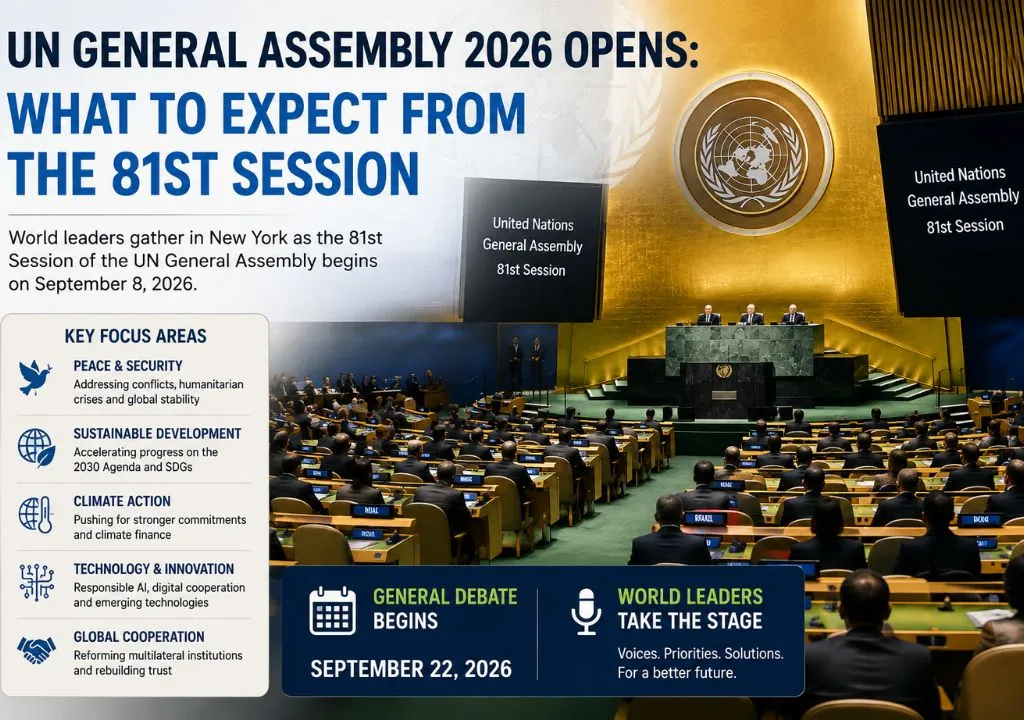
The United Nations General Assembly (UNGA) 2026 has opened its 81st session. Countries from around the world are meeting at a time of great global uncertainty. The President of the 81st session, H.E. Khalilur Rahman, will open the 81st session of the United Nations General Assembly on 8 September 2026, at 3pm (local time in New York)..
The 81st session begins as the world faces wars, humanitarian crises, climate risks, economic pressure and growing tensions between major powers. It will also test the strength of international cooperation.
The main theme of the session is “Restoring trust, managing transformation: a United Nations that delivers for all.” This theme reflects concerns about trust in international institutions. It also highlights the need for the UN to respond better to global problems.
What Is the UN General Assembly?
The UN General Assembly is one of the main bodies of the United Nations. It includes all 193 UN member states.
Each country has one vote in the General Assembly. Leaders and diplomats use the forum to discuss peace and security, development, human rights, climate change and other global issues.
The General Assembly is different from the UN Security Council. It usually does not make legally binding decisions on most international issues. However, its resolutions can shape global debate. They can also help build support for international action.
The annual session gives countries a chance to share their views. It also allows them to negotiate on major global issues.
What Does the Theme of UNGA 81 Mean?
The theme of the UN General Assembly Opening of it’s 81st session focuses on two main ideas: restoring trust and managing transformation.
Trust has become a major issue in international relations. Countries often disagree about conflicts, international rules, trade, development and the role of global institutions.
The world is also changing quickly. Artificial intelligence, climate change, new technologies, economic shifts and changing political relationships are transforming societies.
The UN wants to show that international cooperation can still produce useful results.
This theme is important because the organisation faces pressure to become more effective, open and responsive.
Major Global Issues Expected at UNGA 81
1. Wars and International Security
Conflict will remain one of the biggest issues during the 81st session.
Wars and political crises in different regions have caused serious humanitarian problems. Countries are expected to discuss ways to prevent conflicts and protect civilians. They will also discuss how to strengthen international peace efforts.
The UN General Assembly Opening will give countries a platform to share their views on major geopolitical disputes.
The main challenge will be finding areas where countries with different positions can work together.
2. Gaza and the Middle East
The Middle East is expected to remain a major focus of the discussions.
The humanitarian situation in Gaza will receive significant attention. Countries are also likely to discuss regional security and the future of the Israeli-Palestinian conflict.
They may debate humanitarian aid, civilian protection and the possibility of a long-term political solution.
The issue could also reveal disagreements between major powers about how the international community should respond.
3. Ukraine and European Security
The war in Ukraine will remain another major issue at the UN. The conflict has affected European security, energy markets, food supplies and relations between Russia and Western countries.
At UN General Assembly (Opening) 81, countries are expected to discuss the wider effects of the war. They will also discuss the need for diplomatic solutions.
The debate may show differences over sanctions, security arrangements and the role of international organisations.
4. Climate Change
Climate change will continue to be a major priority. Extreme weather, rising temperatures, floods, droughts and wildfires are affecting countries around the world.
Developing countries are likely to call for more climate finance. They are also expected to seek greater support for adapting to climate change.
The UN General Assembly Opening will provide a chance to discuss faster action on climate commitments and sustainable development.
For many countries in the Global South, climate change is more than an environmental issue. It is also an economic and development challenge.
5. Sustainable Development Goals
The Sustainable Development Goals (SDGs) will remain an important topic.
The goals cover poverty, hunger, education, healthcare, gender equality, clean energy and sustainable cities.
The 2030 deadline is getting closer. Countries are under growing pressure to make faster progress.
The UN will need to discuss financing and inequality. It will also need to consider how developing countries can reach their development targets.
6. Artificial Intelligence and New Technology
Artificial intelligence is becoming a major international issue.
AI is changing education, jobs, business, security and government services. It has also raised concerns about misinformation, privacy, discrimination and the misuse of technology.
UN General Assembly (Opening) 81 is likely to add to the global debate about responsible AI.
The main question will be how countries can support new technology while protecting people and maintaining international security.
What to Expect From the September 22 General Debate?
One of the most important events of UN General Assembly (Opening) 81 will be the General Debate. It begins on September 22, 2026.
During the General Debate, heads of state and government, ministers and senior representatives meet at UN Headquarters. They discuss major international issues. The debate will continue through September 26 and resume on September 28.
The speeches will allow countries to explain their foreign-policy priorities. They will also share their views on major global issues.
Major Powers Will Set the Tone
Statements from major powers will receive close international attention.
Countries will use the General Debate to discuss conflicts, economic relations, climate policy, international security and global governance.
The speeches may also show where countries agree. They may reveal where diplomatic tensions remain.
The Global South Will Demand Greater Representation
Countries from Africa, Asia, Latin America and other developing regions are expected to highlight several issues.
These may include development finance, climate justice, debt and greater representation in global institutions.
Many developing countries believe they do not have enough influence in international decision-making. This issue is likely to remain important during the debate.
India’s Role Will Be Closely Watched
India is also expected to receive considerable attention during the high-level week.
India has increasingly presented itself as a voice for developing countries and the Global South. Its statements are likely to focus on development, international cooperation, terrorism, technology, climate change and reform of global institutions.
India’s views on UN reform and greater representation for developing countries will be especially important.
UN Reform Will Remain a Key Priority
The future of the United Nations itself will be another major issue during UN General Assembly (Opening) 81.
The organisation faces questions about how well it can respond to modern conflicts and global challenges.
Calls to reform the UN Security Council are expected to continue. Many countries argue that its current structure does not reflect today’s global balance of power.
There are also wider discussions about making the UN system more efficient. Countries are also calling for stronger international cooperation.
The theme of restoring trust is closely linked to these reform discussions.
Why UNGA 81 Matters
The 81st session matters because the world is facing many challenges at the same time.
Wars are causing humanitarian crises. Climate change is increasing risks for communities. New technologies are changing economies and societies. Disagreements between major powers are also making cooperation more difficult.
The General Assembly provides a rare platform for almost every country to present its views.
However, speeches alone will not solve these problems.
The real test will be whether countries can turn political statements into practical cooperation.
What Could Make UNGA 81 Different?
The biggest question this year is whether countries can rebuild trust in international cooperation.
The UN is working in a world where countries often have competing interests. However, global problems such as climate change, pandemics, AI and economic instability cannot be solved easily by one country alone.
This creates a difficult balance.
Countries want to protect their national interests. At the same time, they understand that international cooperation is necessary.
UNGA 81 will therefore be watched for signs of compromise, new partnerships and practical solutions.
Conclusion
The UN General Assembly 2026 begins at an important moment for international relations.
The 81st session will focus on restoring trust, managing global change and making the United Nations more effective. Conflicts in the Middle East and Ukraine, climate change, sustainable development, artificial intelligence and UN reform are expected to remain major issues.
The September 22 General Debate will be one of the most important moments of the session. World leaders will use the platform to present their priorities. They will also respond to the major challenges facing the international community.
The challenge for the United Nations is clear. It must show that international cooperation can still produce meaningful results.
For the world, UNGA 81 will show whether countries can move beyond political disagreements. It will also show whether they can work together on problems that affect everyone.
The question is no longer only what the United Nations can discuss. The bigger question is what countries can actually achieve together.
