Haiti’s Security Crisis: Why the UN Security Council Is Concerned
Haiti is facing a serious security crisis as armed gangs continue to control parts of the country and attack local communities. The violence has made everyday life difficult for millions of people and has created problems for the government, police and aid organisations.
The situation has also become an important issue for the United Nations Security Council, which is responsible for discussing major threats to international peace and security.
The latest violence has increased concern about the safety of ordinary people in Haiti. A recent gang attack in Kenscoff, near the capital Port-au-Prince, killed at least 47 people and led to the kidnapping of more than 50 others.
The attack has once again raised questions about whether Haiti’s security forces have enough resources to protect people and stop armed gangs.
The Haiti’s Security Crisis is not only about violence. Haiti is also dealing with political problems, food shortages, people leaving their homes, weak public services and a lack of security resources. These problems are connected and have made it harder for the country to return to normal life.
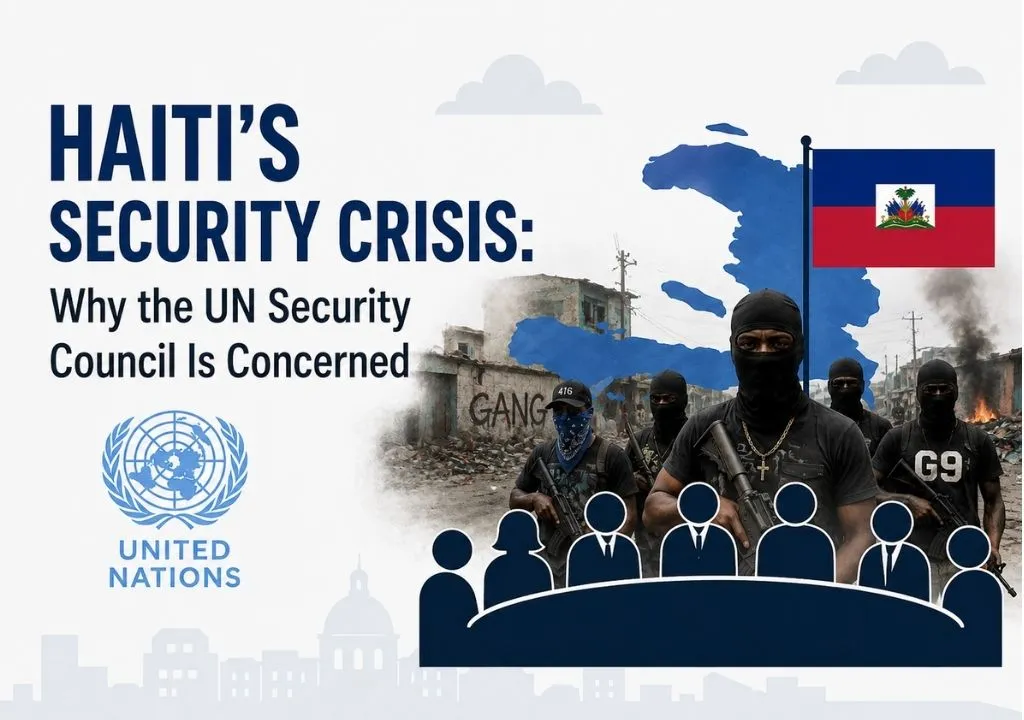
Haiti’s Security Crisis: What Is Happening in Haiti?
Haiti has faced gang violence for several years, but the problem has become much more serious in recent times. Armed groups have increased their control over parts of Port-au-Prince and other areas of the country.
These groups use weapons and violence to control communities and important roads. They are also involved in crimes such as kidnapping and extortion, where people and businesses are forced to pay money.
For many people, this has made simple activities such as going to work, school or a hospital much more difficult.
A recent attack in Kenscoff showed the seriousness of the problem. According to reports, at least 47 people were killed and more than 50 people were kidnapped. Children were among those killed, while several homes were also burned.
The attack forced many residents to leave the area because they no longer felt safe.
This has created another major problem for Haiti because thousands of people are already living away from their homes due to violence.
Why Is the UN Security Council Concerned?
The UN Security Council is concerned because the violence is affecting almost every part of life in Haiti.
When gangs control roads and neighbourhoods, people may not be able to travel safely. Food and other important goods may also have trouble reaching communities.
Hospitals and schools can also be affected because workers and students may be unable to travel through dangerous areas.
The violence has forced around 1.47 million people to leave their homes inside Haiti. Many people have moved to safer parts of the country, but these new areas can also face security problems.
Food is another major concern. Millions of Haitians are facing serious problems getting enough food because violence has affected transportation, businesses and access to markets.
The United Nations is therefore concerned about both security and the basic needs of the people.
The situation is also important because Haiti is preparing for elections. If people cannot travel safely or if large areas remain under gang control, holding free and fair elections will be difficult.
The Recent Kenscoff Attack ( Haiti’s Security Crisis )
The recent attack in Kenscoff has become an important example of Haiti’s growing security problem.
Kenscoff is close to Port-au-Prince and had been seen as a relatively safer area. The attack showed that armed gangs can still reach communities outside the main areas of gang control.
At least 47 people were killed during the attack, including children and other civilians. More than 50 people were also kidnapped.
Several homes were burned, and many residents were forced to leave their neighbourhoods.
The attack has raised concerns about the ability of the Haitian police to respond quickly when large groups of armed men attack communities.
It has also increased pressure on the international community to provide more support to Haiti.
How Much Power Do the Gangs Have?
Armed gangs have gained considerable power in Haiti, especially around the capital.
Their influence comes from their control of territory, weapons and money from criminal activities. They also use fear to control local communities.
In some areas, gangs have become powerful enough to control important roads and transport routes.
This has consequences for the entire country. When major roads are blocked or controlled by gangs, food and other goods cannot move easily from one place to another.
Businesses can also struggle to operate because workers and customers may be afraid to travel.
For families, the situation can mean higher food prices, fewer jobs and limited access to schools and hospitals.
This is why the UN sees the gang problem as much more than a law-and-order issue. It is affecting the economy and the daily lives of ordinary people.
The Human Cost of the Crisis
The people of Haiti are facing the greatest impact of the violence.
Around 1.47 million people have been forced to leave their homes because of insecurity. Many families have lost their homes and belongings and now depend on relatives, communities or aid organisations for help.
Children are especially affected. Many children have had problems attending school because of violence ( Haiti’s Security Crisis ) and unsafe roads. Some are also at risk of being forced or encouraged to join armed groups.
Women and girls face other dangers, including sexual violence and kidnapping.
The shortage of food has made the situation even harder. When people cannot safely travel to markets or when roads are controlled by gangs, getting food becomes more difficult.
Aid organisations are trying to help affected communities, but they also face security problems while delivering food, medicine and other supplies.
This shows how the security crisis is creating problems in many different parts of Haitian society.
Why Is International Help Needed?
Haiti’s police and government do not have enough resources to deal with the scale of the gang problem ( Haiti’s Security Crisis ) on their own.
This is one reason why international support has become important.
The UN Security Council has supported an international security effort aimed at helping Haitian authorities deal with armed gangs.
The international force is expected to support Haitian security forces and help create safer conditions for communities.
However, the mission has also faced problems related to money, equipment and the number of personnel available.
Without enough officers, equipment and financial support, it becomes difficult for the mission to work effectively.
At the same time, international forces cannot solve Haiti’s problems permanently. Haiti will need stronger police and government institutions that can protect people over the long term.
Why Are Illegal Weapons a Problem? ( Haiti’s Security Crisis )
The flow of illegal weapons into Haiti is another major concern.
Gangs need weapons to control territory and fight against rival groups and government forces. A continued supply of illegal firearms therefore makes it harder to reduce violence.
The UN has already taken steps to target the illegal movement of weapons connected to Haiti.
However, stopping the flow of weapons is not easy. Haiti needs stronger checks at its borders, ports and other entry points.
Other countries also need to work together to stop weapons from reaching criminal groups in Haiti.
Without reducing the supply of illegal weapons, security operations are likely to face major difficulties.
How Is the Crisis Affecting Haiti’s Political Future?
Haiti’s security crisis are closely connected to its political situation.
The country has experienced political instability for years, and weak government institutions have made it difficult to provide basic services across the country.
Gang violence has made this situation even worse.
Haiti is now preparing for elections that are expected to take place in late 2026 and early 2027. However, elections require a safe environment in which people can register, travel to polling stations and vote without fear.
Political candidates also need to be able to campaign safely.
If gangs continue to control large parts of the country, some people may not be able to take part in the election process.
This is one of the main reasons the UN Security Council is paying close attention to Haiti.
Why Are Elections Important?
Elections cannot solve all of Haiti’s security crisis, but they can help the country create a more stable political system.
A government needs public support to make decisions and improve important services such as security, education and healthcare.
However, elections can only work properly when people are able to participate freely.
If voters are afraid to leave their homes or cannot reach polling stations, many people may be unable to vote.
There is also a risk that some political candidates may not be able to campaign in areas controlled by gangs.
For this reason, improving security is an important part of preparing Haiti for elections.
Can Security Operations Solve the Problem?
Security operations are necessary, but they are not enough to solve Haiti’s security crisis.
The country also needs stronger government institutions, more jobs, better schools and improved public services.
Many communities face poverty and limited opportunities. These conditions can make it easier for armed groups to attract young people.
If people do not have access to education or employment, gangs may become one of the few sources of income available to them.
This means that Haiti needs a long-term plan that goes beyond fighting gangs.
The country will need better security as well as economic and social support.
International organisations can help, but Haitian institutions will also need to become stronger so that they can manage the country’s problems themselves.
What Is the UN Doing?
The United Nations continues to monitor the situation and discuss ways to support Haiti.
The UN Security Council has backed international efforts to improve security in the country. It has also taken measures against people and groups connected to serious criminal activity.
Another important area is humanitarian support.
The UN and other organisations are working to provide food, healthcare and other basic assistance to people affected by the violence.
The international community is also being asked to provide more money, equipment and personnel to support security efforts.
However, international support alone will not be enough.
Haiti’s own government and police will need to become stronger if the country is to achieve lasting stability.
Why Does Haiti’s Security Crisis Matter to Other Countries?
Although Haiti’s crisis is happening in the Caribbean, its effects are not limited to Haiti.
Large numbers of people have been forced to leave their homes, and some have travelled to other countries in search of safety and better living conditions.
This has created challenges for neighbouring countries and others in the region.
The crisis also affects international efforts to fight organised crime and illegal weapons.
Countries in the Caribbean, North America and Latin America therefore have an interest in helping Haiti become more stable.
The situation also shows why international cooperation is important when a country faces a major security and humanitarian crisis.
What Could Happen Next?
The UN Security Council is likely to continue discussing Haiti as the security situation develops.
One major question will be whether the international security mission receives enough money, equipment and personnel to do its work effectively.
Another important issue will be the safety of civilians.
The UN and other aid organisations will also need to find ways to continue helping people living in areas affected by violence.
At the same time, Haiti will need to prepare for its planned elections and work toward stronger government institutions.
The country therefore faces several challenges at the same time. It needs to improve security, support people affected by violence, strengthen the government and create conditions for elections.
Conclusion
Haiti is facing a serious security crisis because armed gangs continue to control parts of the country and carry out attacks against communities.
The recent attack in Kenscoff, which killed at least 47 people and led to more than 50 kidnappings, shows how difficult the situation remains.
The crisis has also forced around 1.47 million people to leave their homes, while millions more are struggling to get enough food and basic services.
The UN Security Council is concerned because the violence is not only a security problem. It is also affecting Haiti’s economy, political system and plans for future elections.
International support can help Haiti improve security, but it cannot solve the country’s problems on its own.
Haiti will also need stronger police and government institutions, better public services, more jobs and greater access to education.
The planned elections in 2026 and 2027 make the situation even more important. People need to feel safe if they are expected to vote and take part in the political process.
For the United Nations, the main challenge is to help Haiti become safer while also supporting the country in building stronger institutions.
The future of Haiti will depend not only on reducing gang violence but also on creating the conditions in which people can live safely, access basic services and take part in the country’s political life.
If you find this article interesting, then visit the site Globaltides for more articles related to global affairs
