Congress vs BJP: Why Haldwani ‘Purification’ Row Is Escalating?
Introduction ( Why Haldwani ‘Purification’ Row Is Escalating? )
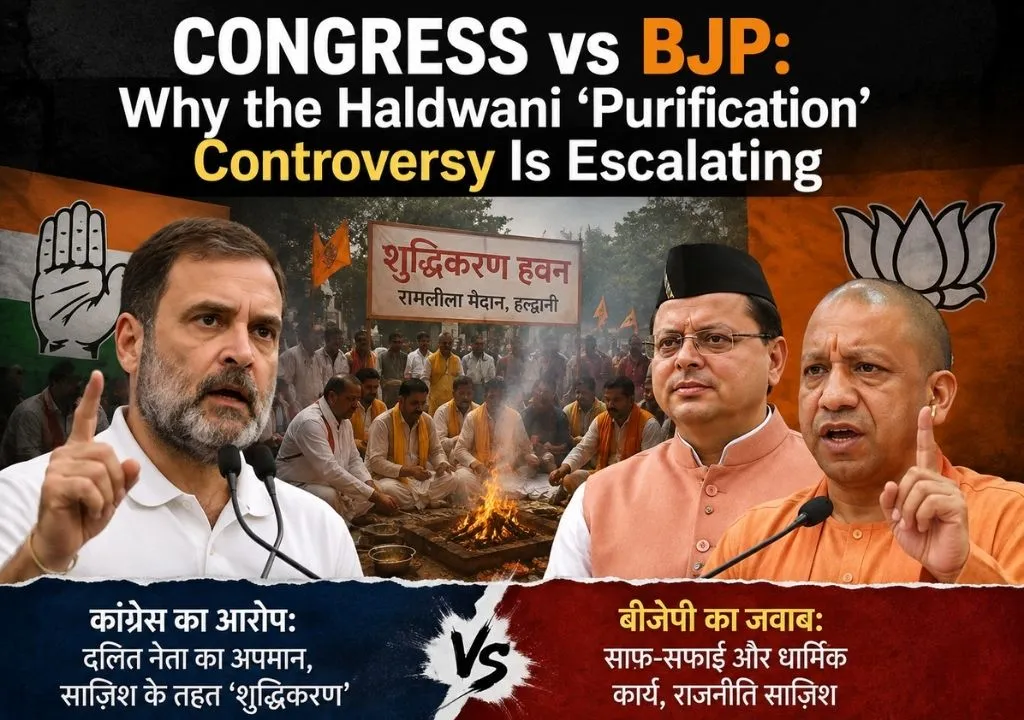
The political battle between the Congress and BJP has intensified over a controversial “purification” ritual held at the Ramlila Maidan in Haldwani, Uttarakhand, after a rally addressed by Congress president Mallikarjun Kharge.
What initially appeared to be a local controversy has now developed into a national political dispute involving Rahul Gandhi, Mallikarjun Kharge, the BJP, the Uttarakhand government and the Scheduled Castes and Scheduled Tribes (Prevention of Atrocities) Act.
The controversy began after Kharge addressed a Congress rally at the Haldwani venue on August 8, 2026. A religious ceremony described as “shuddhikaran”, or purification, was subsequently held at the same location. Congress leaders argued that the act was linked to Kharge’s Dalit identity and amounted to caste discrimination. The BJP and Uttarakhand government have rejected that interpretation, saying the ceremony was not conducted because of Kharge’s caste and that the BJP had no role in organising it.
The issue became even more serious on August 30 when an FIR was registered against Rahul Gandhi over his remarks about the incident. Congress has now announced protests, while BJP leaders have accused the opposition of deliberately giving a caste angle to a religious and cleanliness-related event.
The Haldwani controversy therefore raises a much larger question: Is this simply a political dispute between Congress and BJP, or does it reflect deeper questions about caste, social equality and political representation in India?
What Happened in Haldwani?
The controversy centres on an event held at Ramlila Maidan in Haldwani, where Mallikarjun Kharge addressed a Congress rally on August 8.
Why Haldwani ‘Purification’ Row Is Escalating?
According to reports, a “shuddhikaran havan” was held at the venue shortly afterward. Congress leaders interpreted the ceremony as a symbolic act against Kharge because he is a Dalit leader.
Kharge later raised the matter in Parliament, saying the incident had humiliated him. Congress argued that conducting a purification ceremony after a Dalit political leader had addressed the venue was not an ordinary cleaning exercise but a discriminatory act.
The BJP rejected this interpretation.
BJP leaders said the party was not responsible for the ceremony. They argued that the venue was associated with a religious site and that the ritual was connected to the condition of the ground after the Congress rally. Uttarakhand Chief Minister Pushkar Singh Dhami also denied that the ceremony was motivated by caste discrimination.
This disagreement over the meaning of the ceremony became the foundation of the wider political conflict.
Why Did the Issue Become a Congress vs BJP Battle?
The controversy ( Why Haldwani ‘Purification’ Row Is Escalating? ) became politically explosive because both parties interpreted the incident in completely different ways.
For Congress, the issue is about caste discrimination and dignity.
For the BJP, it is about what the party describes as an attempt by Congress to turn a religious or cleanliness-related ceremony into a political attack on the BJP.
Congress leaders have argued that the timing of the ceremony is significant. It took place after Kharge’s rally at the same venue, and Kharge’s status as a Dalit leader has made the incident particularly sensitive.
The BJP, however, has repeatedly denied involvement and accused Congress of spreading a misleading narrative.
The political confrontation intensified further after Uttarakhand BJP president Mahendra Bhatt defended the purification ceremony and argued that the event was related to the condition and religious character of the venue. His remarks gave Congress another reason to accuse the BJP of defending the incident.
The BJP has maintained that there is no evidence that the ritual was conducted because of Kharge’s caste.
Rahul Gandhi Enters the Controversy
The issue moved from state politics to national politics when Rahul Gandhi publicly condemned the incident.
On August 29, Gandhi described the alleged purification as an expression of untouchability and demanded that Prime Minister Narendra Modi ensure an FIR against those responsible.
He also called for action under the SC/ST Act and linked the controversy to what he described as a wider BJP-RSS mindset toward Dalits.
For Congress, Rahul Gandhi’s intervention changed the scale of the controversy.
The party was no longer discussing only what happened at a rally venue in Haldwani. It was presenting the incident as part of a larger national debate about caste discrimination and the treatment of Dalit leaders.
Gandhi also argued that if a senior national leader such as Kharge could face such treatment, the country should think about the discrimination experienced by ordinary Dalit citizens.
This argument gave Congress an opportunity to connect the Haldwani incident with broader questions of social equality.
BJP’s Response to Rahul Gandhi
The BJP strongly rejected Rahul Gandhi’s allegations.
The party accused Congress of using the issue for political purposes and argued that Gandhi had given a caste-based interpretation to an event that, according to the BJP, was not directed against Kharge.
The BJP has also questioned Congress’s record on Dalit issues and invoked the party’s historical relationship with leaders such as B.R. Ambedkar and Jagjivan Ram.
BJP leaders have repeatedly emphasised that the party itself was not involved in organising the purification ceremony.
The Uttarakhand government has also rejected the allegation that the event represented caste discrimination.
This has created an important distinction in the controversy: Congress is focusing on the symbolism of the act, while BJP is challenging the interpretation and denying organisational responsibility.
Why the FIR Against Rahul Gandhi Changed Everything
The controversy ( Why Haldwani ‘Purification’ Row Is Escalating? ) took another dramatic turn when an FIR was registered against Rahul Gandhi.
The case followed a complaint alleging that Gandhi gave a caste-based interpretation to the ceremony and hurt the sentiments of members of the Valmiki community.
According to reports, the FIR invokes provisions of the Bharatiya Nyaya Sanhita as well as the SC/ST Act. Police have said that an investigation is underway.
The FIR created an unusual political situation.
Rahul Gandhi had demanded that an FIR be registered against those responsible for the alleged purification ritual. Instead, an FIR was subsequently registered against him over his comments about the incident.
Congress immediately criticised the move and described the case as politically motivated.
The party has announced protests and said it will continue demanding action against those responsible for the Haldwani ceremony.
This development has turned the controversy into a direct legal and political confrontation between the opposition and the BJP-led Uttarakhand government.
Why Caste Is at the Centre of the Dispute
The most sensitive aspect of the controversy ( Why Haldwani ‘Purification’ Row Is Escalating? ) is the question of caste.
Mallikarjun Kharge is one of India’s most prominent Dalit political leaders. Congress therefore argues that the meaning of the purification ceremony cannot be separated from his social identity.
The party’s argument is based largely on the symbolism of conducting a purification ceremony after a public event addressed by a Dalit leader.
The BJP’s response is that the ceremony was not directed at Kharge and that Congress has incorrectly connected the event with caste.
This difference is important because the available accounts do not establish a universally accepted explanation for why the ceremony was held.
That is why responsible reporting on the issue should distinguish between what happened and how the political parties interpret what happened.
The ceremony itself has been reported. The claim that it was specifically conducted because Kharge is Dalit remains a political allegation disputed by the BJP and Uttarakhand government.
The Role of Mallikarjun Kharge
Kharge’s position makes the controversy ( Why Haldwani ‘Purification’ Row Is Escalating? ) especially significant.
As Congress president and one of the country’s most senior Dalit political figures, his treatment at a public venue has become a matter of political symbolism.
Kharge raised the issue in Parliament and said the incident made him feel humiliated.
For Congress, the controversy therefore represents more than an argument between two political parties.
It is being presented as a question of whether India’s political and social institutions are fully respecting the dignity of Dalit citizens and leaders.
At the same time, BJP leaders argue that the Congress is using Kharge’s identity to create a political narrative against the ruling party.
This disagreement is one of the main reasons the controversy has continued to grow.
Why Uttarakhand Matters
The location of the ongoing controversy ( Why Haldwani ‘Purification’ Row Is Escalating? ) is also politically important.
Uttarakhand is governed by the BJP, while Congress remains one of its principal political opponents.
Haldwani is an important urban centre and a significant political area in the state.
As a result, every controversy involving the Congress and BJP in Uttarakhand can quickly acquire a wider political dimension.
The Haldwani incident is therefore being viewed through the larger competition between the two parties.
Congress sees an opportunity to challenge the BJP on questions of social justice.
The BJP, meanwhile, wants to prevent the incident from becoming a broader attack on its government or ideological supporters.
The Political Battle Over Social Justice
The controversy ( Why Haldwani ‘Purification’ Row Is Escalating? ) has also reopened the wider political debate over social justice in India.
Caste remains an important issue in Indian politics, even though the Constitution guarantees equality and prohibits untouchability.
Political parties regularly debate reservations, representation, discrimination and the rights of Scheduled Castes and Scheduled Tribes.
Congress has traditionally presented itself as a defender of social justice and is using the Haldwani controversy to reinforce that position.
The BJP, meanwhile, has highlighted its own welfare programmes and outreach to Dalit communities while rejecting the allegation that its ideology promotes caste discrimination.
The controversy therefore fits into a much larger political competition over which party can claim to represent India’s marginalised communities.
Why Congress Is Escalating the Issue ( Why Haldwani ‘Purification’ Row Is Escalating? )
There are several reasons why Congress is keeping the controversy alive.
First, the party wants accountability for what it considers an insulting act against its president.
Second, the issue allows Congress to raise questions about caste discrimination at a national level.
Third, Rahul Gandhi’s intervention gives the party an opportunity to challenge the BJP on constitutional values and social equality.
Finally, the FIR against Gandhi has given Congress another political argument: the party can now claim that instead of investigating the original incident, the government has acted against the person who criticised it.
Congress has announced nationwide protests over what it describes as an attack on constitutional values and social justice.
Why BJP Is Pushing Back
The BJP also has strong reasons to respond aggressively.
The party does not want the Haldwani incident to become associated with its broader political identity.
If the controversy is widely understood as an example of caste discrimination supported by BJP workers, it could create political difficulties for the party, particularly among Dalit voters.
That is why BJP leaders have repeatedly denied organisational involvement.
The party has instead focused on challenging Congress’s interpretation of the ceremony and accusing the opposition of politicising the issue.
The BJP’s strategy is therefore to separate itself from the ceremony while attacking Congress’s political narrative.
Is the Controversy About Religion or Caste?
At the heart of the dispute ( Why Haldwani ‘Purification’ Row Is Escalating? ) is a simple but difficult question: What was the purpose of the ceremony?
The BJP side has described it as connected to cleanliness and the religious nature of the venue.
Congress sees it differently. It argues that there is a significant difference between cleaning a public ground after a political event and conducting a religious purification ceremony after a Dalit leader has addressed it.
This difference in interpretation explains why the dispute has become so emotional.
The controversy is not simply about what happened at the venue. It is about what that action is understood to represent.
For one side, it is a religious or cleanliness-related activity.
For the other, it is a symbolic reminder of caste-based exclusion.
Until there is greater clarity about the circumstances and intent behind the ceremony, the political disagreement is likely to continue.
What Could Happen Next?
The controversy ( Why Haldwani ‘Purification’ Row Is Escalating? ) is unlikely to disappear quickly.
The FIR against Rahul Gandhi has added a legal dimension to an already intense political dispute.
Congress is expected to continue demanding action against those involved in the purification ceremony, while the BJP and Uttarakhand government are likely to defend their position that the event was not caste-driven.
The investigation into the FIR against Gandhi will also be closely watched.
The issue could remain part of political debates in Parliament and Uttarakhand, especially as both parties attempt to shape public opinion around caste, religion and social justice.
The controversy may also encourage wider discussions about how political parties respond when religious practices intersect with questions of caste and public dignity.
Conclusion
The Haldwani ‘purification’ controversy has grown from a dispute over a ceremony at a rally venue into a major Congress vs BJP political battle.
Congress argues that the ceremony following Mallikarjun Kharge’s rally was an insulting act linked to his Dalit identity. Rahul Gandhi has described it as an expression of untouchability and demanded legal action.
The BJP and Uttarakhand government reject that interpretation. They deny BJP involvement in the ceremony and argue that Congress has given the incident a caste-based political angle.
The registration of an FIR against Rahul Gandhi has now pushed the dispute into a new phase. Congress has promised protests, while the legal process will determine how the case develops.
Beyond the immediate political fight, the controversy raises important questions about caste discrimination, constitutional equality, religious practices and the treatment of Dalit leaders in public life.
For readers, the most important thing is to distinguish between established facts and political claims.
The ceremony took place. The political parties disagree sharply about its meaning and purpose. The BJP denies responsibility, while Congress says the incident reflects a deeper problem of caste discrimination.
That disagreement is precisely why the Haldwani controversy has become bigger than one rally or one political leader.
It has become another chapter in India’s continuing debate over caste, identity, political power and social equality.
If you find this article informative then you should explore Globaltides.in.
