What Is International Relations: A Simple Guide
Introduction — What Is International Relations?
Countries deal with each other every day. They trade goods. They make agreements. They share information. They solve disputes. They also compete for power, resources, and influence. All of these activities are part of international relations.
In simple words, international relations is about how countries and other global actors interact with each other. It helps us understand why countries cooperate, why they compete, and why conflicts happen. International relations covers much more than wars and politics. It includes diplomacy, foreign policy, international trade, security, climate change, migration, human rights, international law, and global organizations.
For example, when two countries sign a trade agreement, they are taking part in international relations. When countries meet to discuss a war, that is also international relations. When governments work together to fight climate change, they are also building international cooperation.
International relations affects our daily lives too. A conflict in another part of the world can affect fuel prices, food prices, trade, travel, and security. A new trade deal can create jobs and change the price of products. A global climate agreement can affect national policies.
So, understanding international relations helps us understand what is happening in the world. In this guide, we will explain what is international relations, why it matters, how it works, its main areas, and the major issues it deals with.
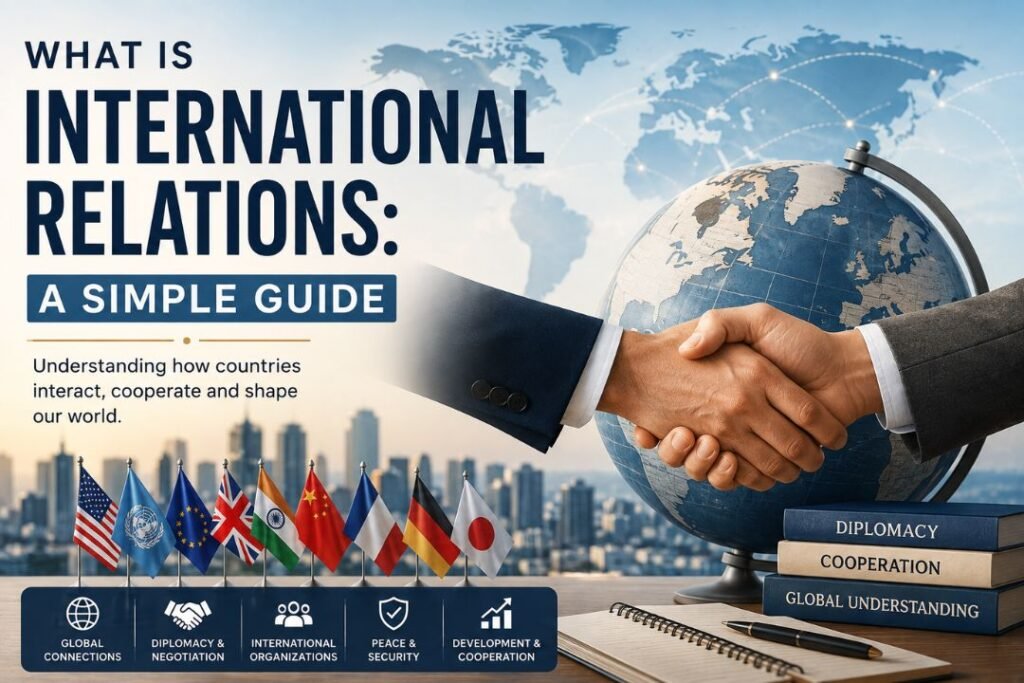
What Is International Relations?
International relations is the study of how countries and other global actors interact with each other. Countries are the main actors in international relations. Each country has its own interests and goals. Governments make decisions based on these interests. A country may want stronger security. It may want more trade. It may want access to energy or natural resources. It may also want better relations with other countries.
International relations looks at how countries try to achieve these goals. It also looks at how countries respond to each other. Sometimes they cooperate. Sometimes they compete. In some cases, they may enter into conflict.
For example, two countries may work together on trade. They may also disagree about a border. Both things can happen at the same time. This makes international relations a broad field. It does not focus on one type of relationship. It looks at politics, economics, security, law, diplomacy, and many other areas.
Who Takes Part in International Relations?
Countries are not the only actors in international relations. Several other groups can influence global affairs.
1. Countries
Countries play the biggest role in international relations. Their governments make foreign policy decisions. They build relationships with other countries. They also negotiate agreements and take part in international organizations.
For example, India has relationships with countries across Asia, Europe, Africa, North America, and other regions. These relationships cover trade, defence, education, technology, energy, and many other areas.
2. International Organizations
International organizations bring countries together. The United Nations is one of the best-known examples. Countries use the UN to discuss global issues such as peace, security, development, and human rights.
Other organizations focus on specific areas. Some deal with trade. Others focus on regional cooperation, development, or security. These organizations give countries a place to discuss common problems.
3. Non-Governmental Organizations
Non-governmental organizations, or NGOs, also take part in global affairs. Many NGOs work on human rights, poverty, education, health, refugees, and environmental issues. They may conduct research, provide aid, and raise awareness about global problems. Their work can influence governments and international organizations.
4. Multinational Companies
Large companies can also affect international relations. Many companies operate in several countries. They trade goods, invest money, create jobs, and build supply chains across borders. Their decisions can affect national economies. Governments also negotiate with companies over trade, investment, technology, and other issues.
5. Regional Organizations
Countries in the same region often create organizations to work together. The European Union is one example. The African Union is another. These organizations help countries cooperate on issues that affect their region.
So, international relations is not only about what governments do. Many actors can shape global affairs.
What Is International Relations All About?
International relations covers many different areas. It is not limited to meetings between presidents or foreign ministers.
At its core, the field asks a simple question:
How do countries and global actors deal with each other?
There are several important parts of this question.
Politics Between Countries
Politics plays a major role in international relations. Countries make decisions based on their national interests. They may try to gain support from other countries. They may build partnerships or alliances. They may also compete for influence.
For example, two powerful countries may compete for influence in a particular region. Smaller countries may then decide how they want to respond.
International relations helps us understand these choices.
Diplomacy
Diplomacy is another major part of international relations. Countries use diplomacy to communicate and negotiate with each other. Diplomats represent their countries abroad. They meet foreign officials and discuss important issues. Diplomacy can help countries solve disagreements without using force.
For example, countries may use diplomatic talks to discuss a border dispute, trade problem, or security concern.
International Security
Security is one of the oldest areas of international relations. It includes war, peace, terrorism, nuclear weapons, military alliances, and national defense. Countries need to protect their people and territory. At the same time, their security decisions can affect other countries.
For example, when one country increases its military strength, neighbouring countries may feel less secure. They may respond by increasing their own defence spending.
International relations helps us understand these actions and reactions.
International Trade and the Global Economy
Countries depend on each other for many goods and services. They import and export products. They invest in other countries. They build supply chains across borders. This makes economics an important part of international relations. Governments often negotiate trade agreements to make it easier for businesses to operate across borders. Economic decisions can also create political tensions. Countries may use tariffs, sanctions, or trade restrictions to put pressure on other governments.
Global Problems
Some problems cannot be solved by one country alone.
Climate change is one example. Pollution can cross borders. Changes in the global climate can affect many countries.
Migration is another example. People may move across borders because of conflict, poverty, disasters, or better economic opportunities.
Global health is also connected to international relations. Diseases can spread across countries within a short time.
International cooperation helps countries deal with these problems.
Why Is International Relations Important?
International relations matters because countries are connected. What happens in one country can affect people in another country.
A war can affect energy prices and food supplies. A trade agreement can affect businesses and jobs. A political crisis can increase migration. A change in government can affect relationships with other countries.
International relations helps us understand these connections.
It Helps Maintain Peace
Countries often have disagreements. Diplomacy and negotiations can help them manage these disagreements. International organizations can also provide a place for countries to discuss conflicts. Diplomacy does not solve every conflict. But it can give countries a peaceful way to communicate.
It Supports International Trade
Modern economies depend on international trade. Countries buy and sell goods across borders. Businesses also depend on global supply chains. Good relations between countries can make trade easier.
It Helps Countries Deal With Global Problems
Countries need to work together on issues such as climate change, pandemics, migration, terrorism, and cyber threats. No single country can solve all these problems alone. International relations provides ways for governments and organizations to cooperate.
It Helps Us Understand World News
International news can seem confusing without background knowledge.
Why are two countries arguing?
Why did a country impose sanctions?
Why are leaders meeting?
Why did a trade agreement matter?
International relations helps answer these questions.
How Does International Relations Work?
International relations does not follow one fixed process. Different issues require different approaches. However, countries often follow a few basic steps when dealing with each other.
Step 1: Countries Identify Their Interests
Every country has national interests. These interests may include security, economic growth, trade, energy, or regional stability. Before taking action, governments consider what they want to achieve.
Step 2: Countries Communicate
Countries need to communicate with each other. They use diplomats, ambassadors, foreign ministers, government officials, and national leaders. They can also communicate through international organizations.
Step 3: Countries Negotiate
Countries often have different interests. They may need to negotiate to find a solution. Each side explains what it wants. The countries then discuss possible options. Negotiations can take days, months, or even years.
Step 4: Countries Cooperate or Compete
Countries do not always work together. They may cooperate when they have common interests. They may compete when their interests clash. For example, two countries may cooperate on climate change while competing over trade.
Step 5: Countries Make Agreements
Successful negotiations can lead to agreements. These can include trade agreements, peace agreements, security arrangements, or other international treaties. Countries then need to follow the terms of those agreements.
What Are the Main Areas of International Relations?
International relations covers several major areas.
1. Diplomacy and Foreign Policy
Diplomacy helps countries communicate and negotiate. Foreign policy refers to the goals and decisions a country makes in its relations with the rest of the world. These two areas are closely connected.
2. International Security
International security focuses on threats to countries and people. It includes war, terrorism, nuclear weapons, military alliances, cyber threats, and peacebuilding.
3. International Political Economy
This area looks at the link between politics and economics. It covers international trade, investment, global markets, sanctions, development, and economic cooperation.
4. International Law
Countries need rules to manage their relationships. International law covers areas such as treaties, human rights, war, borders, and international agreements. Countries use these rules to guide their actions and settle certain disputes.
5. Global Governance
Global governance refers to the way countries and other actors work together to deal with global issues. There is no single world government. Instead, countries use international organizations, agreements, and institutions to cooperate.
6. Human Rights
Human rights are also an important part of international relations. Governments and international organizations discuss issues such as freedom, equality, refugees, discrimination, and humanitarian crises.
International Relations vs. Foreign Policy vs. Diplomacy
These three terms are often confused. They are connected, but they have different meanings.
International relations is the broad field. It looks at how countries and other global actors interact.
Foreign policy refers to the goals and decisions a country makes in dealing with other countries.
Diplomacy is one of the main tools countries use to achieve those goals.
Here is a simple example.
Imagine that India wants to improve trade with another country.
The decision to improve trade is part of foreign policy.
The wider relationship between India and that country falls under international relations.
When Indian officials meet the other country’s officials to discuss a trade agreement, they are using diplomacy.
A simple way to remember it is:
International relations = the wider relationship
Foreign policy = a country’s goals
Diplomacy = a tool used to achieve those goals
What Are the Major Theories of International Relations?
Scholars use different theories to explain why countries behave in certain ways. You do not need to know every theory to understand international relations. But three major approaches are useful for beginners.
1. Realism
Realism focuses on power and security.
Realists argue that countries must protect themselves because there is no world government that can fully protect every country. Countries therefore focus on their national interests and security.
2. Liberalism
Liberalism gives more importance to cooperation.
Liberals argue that countries can work together through trade, international organizations, agreements, and shared rules. The United Nations and other international institutions are important examples of this approach.
3. Constructivism
Constructivism focuses on ideas, beliefs, values, and identity.
It argues that these factors can influence how countries behave. For example, two countries may see each other as friends because of shared history and values. Another pair may see each other as rivals because of past conflicts.
These theories give us different ways to understand international events.
What Are the Biggest Issues in International Relations Today?
The world faces many problems that cross national borders.
Geopolitical Competition
Powerful countries often compete for influence. This competition can affect trade, security, technology, and regional politics.
Climate Change
Climate change affects every region. Countries need to work together to reduce emissions and prepare for climate risks.
Cybersecurity
Countries now depend heavily on digital systems. Cyberattacks can affect governments, businesses, and critical infrastructure. This has made cybersecurity an important part of international security.
Migration
Millions of people move across borders every year. Some move for jobs or education. Others leave their homes because of conflict, poverty, or disasters. Countries need cooperation to manage migration.
Global Trade
Countries depend on international trade for many products. Trade disputes can affect businesses, workers, and consumers around the world.
Artificial Intelligence
AI is creating new opportunities and new risks. Countries are now discussing AI rules, security, technology competition, and responsible use. These issues show why international relations remains important in the modern world.
A Simple Example of International Relations
Imagine two countries called Country A and Country B.
Country A has advanced technology. Country B has important natural resources.
Both countries want something from the other.
Country A wants access to those resources. Country B wants investment and technology.
The two governments begin talks.
Their officials discuss what each side wants. They negotiate the terms. Both sides make some compromises.
Finally, they reach an agreement.
Country A gets access to the resources. Country B receives investment and technology.
This simple example involves several parts of international relations.
It includes trade, diplomacy, economics, foreign policy, and cooperation.
This is why international relations is such a broad field.
What Can You Do With a Career in International Relations?
International relations can lead to many career paths.
Some people work in government. Others work in research, media, international organizations, NGOs, or private companies.
Possible careers include:
- Diplomat
- Foreign policy researcher
- Policy analyst
- Think-tank researcher
- International affairs journalist
- NGO professional
- International development professional
- Political risk analyst
- Government relations professional
- International organization professional
However, studying international relations alone does not guarantee a job. Students often need other skills too. Strong writing, research, communication, data analysis, foreign languages, and digital skills can improve career options. Internships and practical experience can also help.
Frequently Asked Questions About International Relations
What is international relations ?
International relations is the study of how countries and other global actors interact. It covers cooperation, competition, conflict, diplomacy, trade, security, and global problems.
What is international relations all about?
International relations is all about understanding how countries and global actors deal with each other. It looks at their interests, decisions, conflicts, partnerships, and cooperation.
Why is international relations important?
International relations helps countries manage their relationships and work together. It also helps us understand global issues such as war, trade, climate change, migration, and international security.
What is the difference between international relations and diplomacy?
International relations is the wider study of global interactions. Diplomacy is a tool that countries use to communicate and negotiate with each other.
What is the difference between international relations and foreign policy?
International relations looks at relationships between countries and global actors. Foreign policy focuses on the goals and decisions of one country in its relations with the outside world.
What are the main areas of international relations?
Major areas include diplomacy, foreign policy, international security, international trade, international law, global governance, human rights, and international development.
Is international relations only about countries?
No. Countries are the main actors, but international organizations, NGOs, multinational companies, and other groups can also influence international affairs.
Is international relations a good career field?
It can lead to careers in government, diplomacy, research, journalism, NGOs, international organizations, policy, and the private sector. Building skills beyond a degree can improve career opportunities.
Conclusion — What Is International Relations ?[Understanding a Connected World]
International relations is all about how countries and global actors deal with each other. It covers cooperation and conflict. It includes diplomacy, trade, security, foreign policy, international law, and global issues. International relations also affects everyday life. Decisions made by governments can influence prices, jobs, energy, travel, security, and the environment.
Learning about international relations helps us understand these connections. It also helps us look beyond individual news events. Instead of seeing each event on its own, we can understand how countries, governments, organizations, and global issues connect.
In a connected world, international relations helps us understand why countries act the way they do and how their decisions affect the rest of the world.
I hope, by now you understand What Is International Relations ?
Let me know in the comments, what you want next!!!!!
