New UPI Merchant Charges: What Users Need to Know
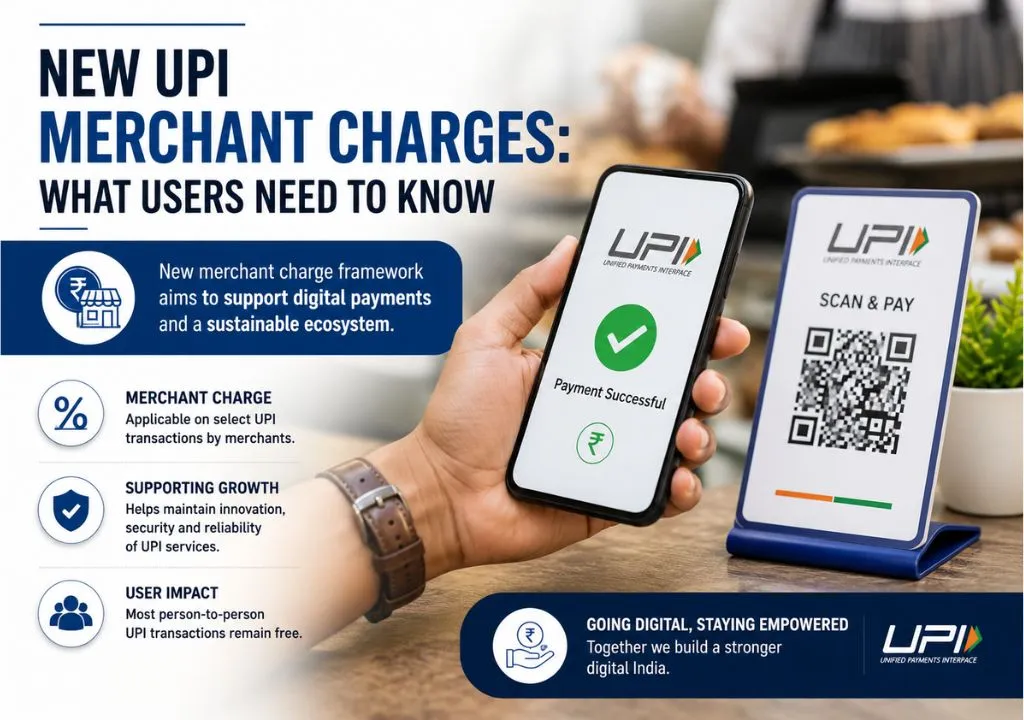
India’s Unified Payments Interface, better known as UPI, is entering a new phase as the National Payments Corporation of India (NPCI) introduces a Merchant Discount Rate (MDR) on certain high-value merchant transactions. Under the new framework, eligible UPI payments above ₹2,000 will attract an MDR of up to 0.4% from October 15, 2026.
The announcement has attracted attention because UPI has operated without a merchant discount rate for several years, helping digital payments become a major part of everyday transactions in India. However, the new framework does not mean that consumers will suddenly have to pay a 0.4% fee whenever they use UPI. The charge is designed primarily for eligible merchants, while person-to-person UPI transfers will continue to remain free.
What Is the New UPI Charge? (New UPI Merchant Charges: What Users Need to Know)
The new framework introduces a Merchant Discount Rate of up to 0.4% on specified person-to-merchant, or P2M, UPI transactions above ₹2,000.
MDR is a fee associated with accepting digital payments and is paid within the payment ecosystem rather than being collected as a government tax. The amount can be distributed among participants involved in processing the transaction, including banks and payment service providers.
The new system will begin on October 15, 2026, giving banks, payment companies and merchants time to adjust their payment and accounting systems.
The most important point for ordinary UPI users is that the new MDR does not create a general consumer charge for using UPI. Person-to-person transactions will remain free regardless of the amount transferred.
Will Customers Have to Pay the 0.4% Fee?
For eligible merchant payments, the announced MDR is intended to be paid by the merchant rather than directly by the customer.
For example, if a customer purchases a product worth ₹5,000 from an eligible merchant and pays through a direct UPI account-to-merchant transaction, the applicable MDR could be up to ₹20. The customer still pays ₹5,000 through UPI, while the merchant-side payment processing arrangement determines the MDR.
This distinction is important because the announcement has created confusion around whether UPI is becoming a paid service for consumers. According to the government’s clarification, MDR is neither a tax nor a charge collected by the government or NPCI.
Which UPI Transactions Will Remain Free? (New UPI Merchant Charges: What Users Need to Know)
A large portion of UPI activity will continue without the new MDR.
Person-to-person payments, such as sending money to a family member, friend or another personal bank account, will remain free regardless of the transaction amount. Payments to merchants up to ₹2,000 will also remain outside the new MDR framework.
Certain small merchants covered by the specified P2PM category will also continue to receive zero-MDR treatment. This category is intended to protect smaller businesses and local merchants from additional payment costs.
The government has said that approximately 96% of merchant UPI transactions will remain unaffected by the new framework, which means the change is focused on a narrower segment of the overall UPI ecosystem.
Why Has UPI Introduced MDR?
UPI has expanded rapidly across India and has become an important part of the country’s digital payments infrastructure. Millions of businesses now accept payments through QR codes, mobile applications and other UPI-enabled systems.
While the zero-MDR model helped encourage the adoption of digital payments, banks and payment companies still have costs related to maintaining payment infrastructure, cybersecurity, fraud prevention, technology upgrades and merchant acceptance networks.
The new MDR framework (New UPI Merchant Charges: What Users Need to Know) is intended to create a more sustainable financial model for parts of the payment ecosystem while keeping most everyday UPI transactions free.
The government has also emphasized that the new system is designed to protect consumers and smaller merchants while creating a revenue mechanism for eligible transactions.
What Happens to Payments Above ₹2,000? (New UPI Merchant Charges: What Users Need to Know)
The answer depends on the type of transaction and merchant category.
For standard eligible merchant payments above ₹2,000, the MDR can be up to 0.4%. The charge is capped at ₹300 for transactions of ₹75,000 or more, meaning the percentage-based calculation does not continue increasing indefinitely for very large transactions.
For example, a ₹10,000 eligible merchant payment could attract an MDR of up to ₹40, while a ₹50,000 transaction could attract up to ₹200. For a transaction of ₹75,000 or more, the applicable MDR is capped at ₹300 under the framework.
However, not every payment above ₹2,000 will automatically attract the standard 0.4% rate because several categories have separate pricing arrangements or exemptions.
Are There Exceptions to the 0.4% MDR?
Yes, the framework (New UPI Merchant Charges: What Users Need to Know) contains several important exceptions.
1.Certain essential-service categories, including some utility, fuel, insurance, telecom and railway payments, will follow separate pricing arrangements rather than the standard 0.4% rate. A flat fee of ₹5 applies to specified transactions in several of these categories when the payment exceeds ₹2,000.
2.Capital market transactions also have a separate MDR structure, with a lower percentage rate and a maximum cap.
3.UPI AutoPay and certain recurring payment mandates are also treated separately under the framework, meaning users should not assume that every recurring UPI transaction above ₹2,000 will attract the standard MDR.
These differences show why the new system cannot simply be described as a universal 0.4% UPI fee.
What Does This Mean for Small Businesses? (New UPI Merchant Charges: What Users Need to Know)
The impact on small businesses will depend largely on their category and the volume of UPI payments they receive.
Small merchants covered by the P2PM framework will continue to receive zero-MDR treatment under the specified conditions. This is important for street vendors, small shops and other businesses that depend heavily on QR-code payments.
For larger merchants, however, the new MDR could become an additional operating cost on eligible high-value transactions.
Businesses may therefore review their payment strategies, pricing structures and relationships with acquiring banks or payment service providers once the framework becomes operational.
At the same time, the relatively low MDR compared with some traditional card-payment costs could encourage businesses to continue accepting UPI for larger purchases.
Will UPI Become Less Attractive?
The new framework (New UPI Merchant Charges: What Users Need to Know) is unlikely to affect every UPI user in the same way because person-to-person payments and low-value merchant transactions remain free.
For consumers, the everyday experience of scanning a QR code and paying a small amount should largely remain unchanged. The greater impact is expected to be felt by merchants that process a significant number of eligible transactions above ₹2,000.
UPI’s popularity has been built around convenience, speed and widespread acceptance, so the introduction of MDR represents a change in how the payment ecosystem is funded rather than the end of free UPI payments for consumers.
The effect on merchants will become clearer after the new framework starts operating and businesses begin adjusting to the revised payment economics.
How Could the New MDR Affect India’s Digital Payments System?
The introduction of MDR could have broader implications for India’s digital payments ecosystem.
A sustainable revenue model could help payment companies and financial institutions continue investing in technology, cybersecurity, fraud detection and payment infrastructure. These investments are increasingly important as digital transactions become a larger part of India’s economy.
At the same time, the government has tried to limit the impact on smaller businesses and ordinary users by keeping person-to-person payments free and maintaining zero MDR for low-value merchant transactions.
The long-term effect will depend on how payment providers, banks and merchants respond to the new framework and whether the additional revenue leads to greater investment in the payment network.
What Should UPI Users Know?
For most consumers, there is no need to stop using UPI because of the new MDR framework.
The most important distinction is between paying another person and paying a merchant. Sending money to another individual will remain free, while eligible merchant payments above ₹2,000 will fall under the new MDR structure.
Consumers should also understand that the MDR is not the same as a government tax. It is a payment-processing charge within the merchant payment ecosystem.
If a merchant attempts to add an unexplained UPI surcharge directly to the customer’s bill, consumers should check the terms of the transaction and the payment provider involved rather than assuming that the new MDR automatically permits an additional customer fee.
Conclusion
The new 0.4% MDR framework marks an important change in India’s UPI payment system, but it does not mean that consumers will start paying a general fee for using UPI.
From October 15, 2026, eligible merchant transactions above ₹2,000 will attract an MDR of up to 0.4%, with a cap of ₹300 for transactions of ₹75,000 or more. Person-to-person transfers will remain free, while payments of up to ₹2,000 to merchants will also remain outside the standard MDR framework.
The government has also provided separate treatment for small merchants and several specific payment categories, meaning the new rules are more detailed than a simple “UPI charge” announcement.
For India, the change represents an attempt to balance two objectives: keeping digital payments affordable and widely accessible while creating a more sustainable financial structure for the institutions that maintain the UPI ecosystem.
As the new rules take effect, merchants and payment companies will have to adapt to the revised system, while consumers can continue using UPI for everyday payments without a general transaction fee.
If you find the information valuable, then you should visit Globaltides, and explore more articles in the blog section.
