RBI’s ₹1 Lakh Crore Bond Sale and Banking Liquidity
The Reserve Bank of India (RBI) has announced a major move to absorb excess money from India’s banking system by selling government securities worth ₹1 lakh crore through open market operations. The decision comes at a time when the banking system is holding a very large liquidity surplus, creating challenges for the central bank as it tries to keep short-term interest rates aligned with its monetary policy stance.
The RBI will conduct the bond sales in three stages during September, with ₹50,000 crore planned for September 17 and ₹25,000 crore each for September 21 and September 28. The central bank announced the move after reviewing current and expected liquidity conditions in the financial system.
The decision has attracted attention because the RBI is not trying to inject money into the economy at this point. Instead, it is doing the opposite by removing surplus funds from the banking system. The key question is why the RBI believes such a large liquidity drain is necessary and what this could mean for India’s economy.
What Is the RBI’s ₹1 Lakh Crore Bond Sale? (RBI’s ₹1 Lakh Crore Bond Sale and Banking Liquidity)
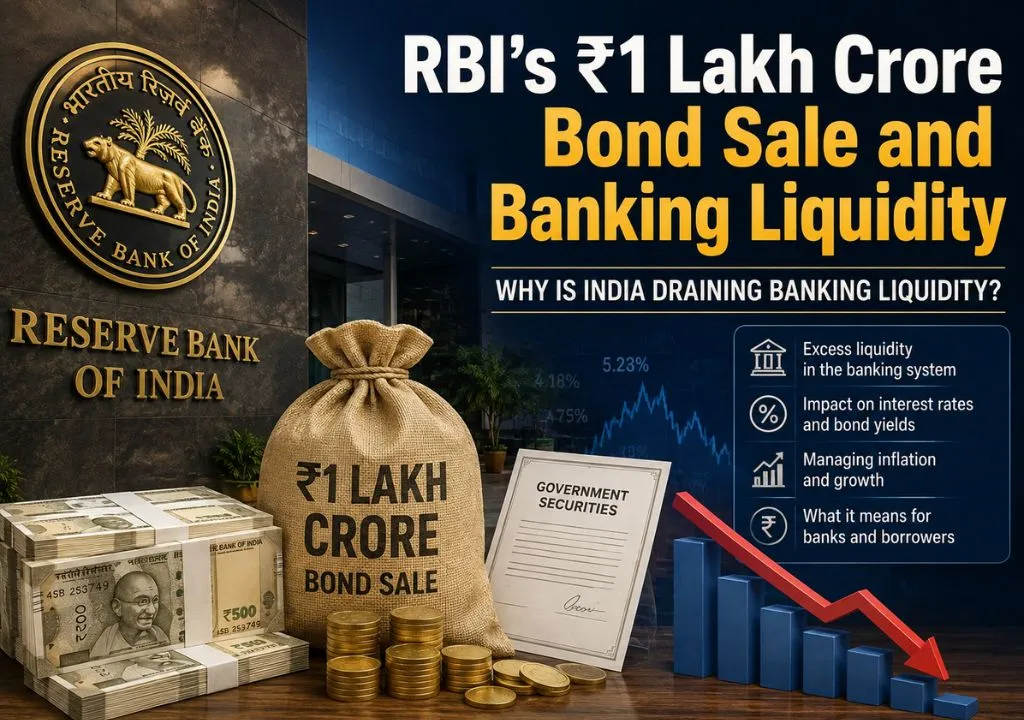
The RBI’s latest move is an Open Market Operation (OMO) in which the central bank will sell government securities to banks and other market participants. When the RBI sells these securities, buyers pay the central bank for them, which removes an equivalent amount of money from the financial system.
This is different from the RBI buying government bonds, which injects money into the banking system. In the current situation, the central bank is using bond sales as a way to reduce excess liquidity that has accumulated in recent months.
The ₹1 lakh crore operation is divided into three auctions so that the liquidity adjustment takes place in stages rather than through one very large transaction. The RBI has chosen several government securities across different maturities for the operation.
The move is particularly significant because the banking system had a liquidity surplus of more than ₹10 lakh crore in recent days, while estimates of core or durable liquidity were even higher.
Why Is There So Much Liquidity in the Banking System? (RBI’s ₹1 Lakh Crore Bond Sale and Banking Liquidity)
The current liquidity surplus has largely been linked to large foreign-currency inflows into India.
Indian banks raised substantial funds from overseas sources through a special mobilisation programme. These foreign-currency inflows were converted into rupees, increasing the amount of domestic currency available within the financial system.
The RBI used foreign-exchange operations, including dollar-rupee swaps, to manage these flows. While such operations can help address foreign-exchange and liquidity requirements, they can also create additional rupee liquidity in the domestic financial system.
According to recent reports, banks raised around $127 billion through the special foreign-exchange mobilisation drive, contributing significantly to the surplus liquidity that the RBI is now attempting to absorb.
This created a situation where banks had much more money available than they immediately needed for lending or other market activities.
Why Does Excess Liquidity Matter? (RBI’s ₹1 Lakh Crore Bond Sale and Banking Liquidity)
At first glance, having more money in the banking system may appear positive because banks can potentially lend more to businesses and households. However, an excessively large liquidity surplus can create problems for monetary policy and financial markets.
When banks have more funds than they need, they may be willing to lend those funds in the money market at very low interest rates. This can push short-term market rates below the level that the RBI wants to maintain.
Recent market data showed that surplus liquidity had pushed overnight rates lower, creating a gap between actual market conditions and the RBI’s desired monetary-policy stance.
This matters because the RBI uses interest rates to influence borrowing, spending, investment, inflation, and economic activity. If excess liquidity keeps short-term rates unusually low, changes in the RBI’s policy rate may not be transmitted effectively through the financial system.
In simple terms, the central bank wants to make sure (RBI’s ₹1 Lakh Crore Bond Sale and Banking Liquidity) that the amount of money available in the banking system does not become so large that it weakens the impact of its monetary policy.
Why Did the RBI Turn to Bond Sales? (RBI’s ₹1 Lakh Crore Bond Sale and Banking Liquidity)
The RBI had already been using other methods to absorb excess liquidity, including Variable Rate Reverse Repo (VRRR) auctions and dollar-rupee swaps.
However, the response from banks to some longer-duration VRRR auctions was weaker than expected. In one 26-day VRRR auction, banks placed bids for only ₹60,449 crore against a target of ₹5 lakh crore, showing that banks were not willing to lock away large amounts of their surplus funds for longer periods.
The RBI therefore needed another instrument that could absorb durable liquidity more directly (RBI’s ₹1 Lakh Crore Bond Sale and Banking Liquidity).
Open market bond sales provide such a mechanism because the central bank can permanently remove liquidity from the banking system through the sale of government securities rather than relying only on short-term operations.
The decision shows that the RBI is prepared to use multiple tools when one method is not sufficient to manage financial conditions.
Is the RBI Trying to Reduce Inflation? (RBI’s ₹1 Lakh Crore Bond Sale and Banking Liquidity)
Inflation is one of the important reasons behind the RBI’s focus on liquidity conditions.
Large amounts of surplus money can support stronger credit growth and spending if they remain in the financial system for an extended period. While liquidity alone does not automatically create inflation, an excessive surplus can add to demand pressures when other inflationary risks are already present.
India is currently facing additional uncertainty because global oil prices have risen sharply. Higher crude prices are particularly important for India because the country depends heavily on imported energy.
Recent data showed India’s August consumer inflation at 4.82%, while rising oil prices have increased concerns about future inflation.
By reducing surplus liquidity, the RBI can prevent financial conditions from becoming unnecessarily loose while it monitors these inflationary pressures.
The bond sale should therefore not be viewed as an isolated decision. It is part of a broader attempt to keep monetary conditions under control as the economic environment changes.
What Does the Bond Sale Mean for Government Bond Yields?
The RBI’s decision (RBI’s ₹1 Lakh Crore Bond Sale and Banking Liquidity) can also influence the government bond market.
When the central bank sells government securities, the market has to absorb additional bonds. If demand does not rise enough to match the additional supply, bond prices can come under pressure and yields can move higher.
This has already become visible in the government bond market. The benchmark 10-year government bond yield moved above 7% following the announcement, with market participants expecting further pressure on yields.
Higher bond yields can increase the cost of government borrowing because new government securities may need to offer more attractive returns to investors.
They can also influence other interest rates in the economy because government bond yields serve as an important reference point for financial markets.
For this reason, the RBI must balance the need to remove excess liquidity with the possibility that an aggressive liquidity drain could create additional pressure in the bond market.
What Could It Mean for Banks? (RBI’s ₹1 Lakh Crore Bond Sale and Banking Liquidity)
For banks, the impact is likely to be mixed.
On one hand, banks have recently had access to a very large pool of surplus funds. Removing some of this excess liquidity could reduce the availability of extremely cheap short-term money.
On the other hand, a controlled liquidity environment can help the RBI maintain more stable money-market conditions and make its monetary policy more effective.
Banks will also need to pay close attention to their deposit and lending strategies. If liquidity becomes tighter and market rates rise, the cost of raising funds could increase over time.
The effect on lending rates will depend on how persistent the liquidity adjustment becomes and how the RBI responds to inflation, economic growth, and financial-market conditions in the coming months.
Could Loans Become More Expensive?
The RBI’s ₹1 Lakh Crore Bond Sale and Banking Liquidity does not automatically mean that home loans, personal loans, or business loans will become more expensive immediately.
However, tighter liquidity can place upward pressure on market interest rates if it continues for a significant period. The effect will depend on several factors, including future RBI policy decisions, deposit growth, credit demand, inflation, and conditions in global financial markets.
The situation is particularly important because investors are already watching whether the RBI could change its policy stance in response to rising inflation risks.
Recent market expectations have included the possibility of an interest-rate increase at the RBI’s October policy meeting, although the final decision will depend on incoming economic data and the assessment of inflation and growth.
Therefore, the current bond sale should not be interpreted as a direct announcement of a rate hike.
What Does This Mean for the Indian Economy?
The RBI’s liquidity operation reflects a broader challenge for India’s monetary policy.
India’s economy needs enough liquidity to support productive lending, investment, businesses, and consumption. At the same time, too much surplus liquidity can make financial conditions excessively loose and weaken the transmission of monetary policy.
The central bank therefore has to find a balance between supporting economic activity and preventing financial conditions from becoming inconsistent with its inflation objectives.
The current situation is also unusual because the liquidity surplus has been influenced by large foreign-currency inflows rather than simply by strong domestic credit creation.
This means the RBI has to manage both domestic monetary conditions and developments in the foreign-exchange market.
Could the RBI Take More Steps?
The ₹1 lakh crore OMO sale may not be the only tool available to the RBI.
Governor Sanjay Malhotra has indicated that the central bank can use a combination of instruments to manage liquidity conditions. These include bond sales, VRRR operations, and foreign-exchange swaps.
The RBI’s choice of instrument will depend on how the liquidity situation develops.
If surplus funds remain extremely high, additional measures could become necessary. If liquidity normalises naturally, the central bank may not need to take equally strong action.
This flexibility is important because monetary conditions can change quickly when foreign capital flows, oil prices, exchange rates, and global interest rates are moving at the same time.
What Should Investors Watch Now?
Investors will closely monitor the three OMO auctions planned for September because their results could provide clues about market demand for government securities and the direction of bond yields.
The movement of the 10-year government bond yield will also remain important because it reflects investor expectations about inflation, government borrowing, interest rates, and monetary policy.
The rupee is another key factor. The Indian currency has recently faced pressure from higher oil prices and expectations of tighter global monetary policy. At the same time, India’s foreign-exchange reserves remain very strong, giving the RBI greater capacity to manage excessive currency volatility.
Investors will therefore be watching the interaction between liquidity, inflation, oil prices, bond yields, the rupee, and the RBI’s future policy decisions.
Conclusion
The RBI’s ₹1 lakh crore bond sale is a significant attempt to remove excess liquidity from India’s banking system and bring short-term financial conditions closer to the central bank’s desired policy environment.
The decision has come after a substantial increase in banking-system liquidity, partly linked to large foreign-currency inflows and the RBI’s own foreign-exchange operations. Earlier liquidity-absorption measures, particularly some longer-duration VRRR auctions, did not attract enough participation, making open market bond sales a more direct option.
The move could help the RBI maintain better control over monetary conditions and reduce the risk that excessive liquidity weakens policy transmission. At the same time, it can place upward pressure on government bond yields and potentially increase borrowing costs if tighter financial conditions persist.
For ordinary borrowers, the bond sale does not immediately mean higher loan rates. Its larger significance lies in what it says about the direction of India’s monetary environment.
The RBI is signalling that it does not want the banking system to remain flooded with surplus money while inflation risks, oil prices, currency pressures, and global interest-rate uncertainty are increasing.
The coming weeks will show whether the ₹1 lakh crore liquidity drain is enough to restore balance to the financial system or whether the RBI will need to use additional tools. For India’s economy, the central challenge will remain the same: maintaining enough liquidity to support growth while ensuring that excess money does not create new inflation and financial stability risks.
If you find this article informative, then you should visit Globaltides.in
