Russia’s Major Kyiv Strikes: What Happened and Why They Matter?
Russia’s major Kyiv strikes on September 8, 2026, using drones and missiles against Ukraine’s capital. The strikes came during a particularly sensitive period in the Russia-Ukraine war, shortly after U.S. envoys Steve Witkoff and Jared Kushner departed Kyiv following discussions about possible routes towards ending the conflict.
The attack caused civilian deaths and injuries and damaged several locations across the city. Residential buildings, a school, a medical facility and other sites were affected. Fires broke out, prompting emergency crews to work in multiple areas of Kyiv.
The timing drew international attention because it followed a brief lull in major attacks during the envoys’ visit. The renewed bombardment demonstrated how quickly conditions can deteriorate in Ukraine, even while diplomatic contacts are taking place.
It also raised a difficult question about the future of negotiations: Can meaningful diplomacy advance while large-scale attacks continue?
That question remains central to the Russia-Ukraine war (Russia’s major Kyiv strikes) and to Europe’s broader security concerns.
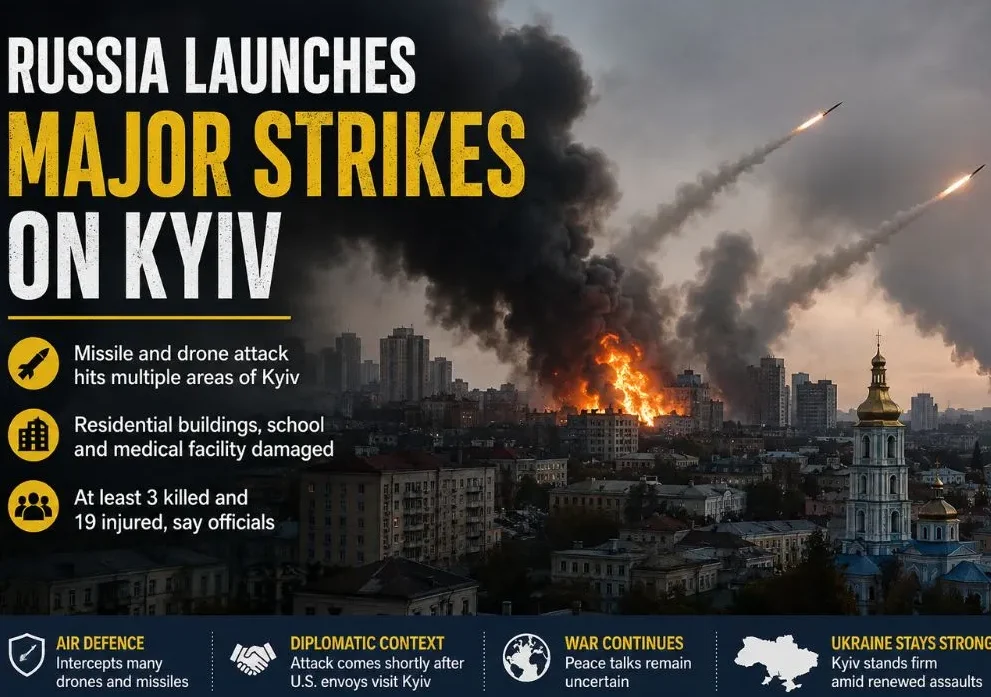
Russia’s major Kyiv strikes on large-scale
Kyiv has endured repeated Russian missile and drone attacks since Russia launched its full-scale invasion in 2022. The September 8 assault, however, followed a short period in which the capital experienced relative calm.
Reports indicated that Russian forces combined several kinds of weapons in the operation. Ukrainian air defence units intercepted many of them, but others struck targets and caused substantial damage.
Multiple parts of Kyiv were affected during Russia’s major Kyiv strikes. Civilian casualties were reported, buildings were damaged and fires required a coordinated response from emergency services.
Using drones alongside different missile systems can make an attack more difficult to counter. Ukrainian President Volodymyr Zelenskyy called the operation complex and again drew attention to the pressure placed on the country’s air defence network.
Ballistic missiles present a particular challenge because of their speed and trajectory. Ukraine has received air defence equipment from Western partners, yet Ukrainian officials continue to seek additional systems and interceptor missiles.
The attack reinforced the importance of air defence to Ukraine’s military planning and the protection of its population.
Why the Timing Matters
The timing of the Russia’s major Kyiv strikes was especially significant.
The attack ‘Russia’s major Kyiv strikes’ occurred soon after Witkoff and Kushner left Kyiv. Their visit formed part of diplomatic efforts focused on identifying possible ways to bring the war closer to an end.
Ukrainian officials used the visit to discuss the conflict and potential ideas for future negotiations. The subsequent Russian attack nevertheless showed that diplomatic engagement and military operations are proceeding simultaneously.
That creates a serious obstacle for negotiators.
Successful peace talks depend on communication, compromise and at least some degree of confidence between the parties. Continued attacks make that confidence difficult to establish, particularly when civilians remain exposed to danger.
Ukraine has consistently called for stronger international pressure on Russia to reduce or halt its attacks. Moscow, for its part, continues to advance its own demands and strategic aims.
Consequently, diplomatic activity has continued without producing a clear agreement capable of ending the war.
The Russia’s major Kyiv strikes exposed the sharp difference between discussions around a negotiating table and conditions faced by people on the ground.
Damage and the Civilian Toll
The consequences for civilians were among the most serious aspects of the attack.
The Russia’s major Kyiv strikes killed and injured people, and damaged homes and public facilities. Emergency responders dealt with fires, debris and other destruction caused by the incoming weapons.
For Kyiv residents, the threat of attack has become a recurring part of life during the war.
Air raid alerts can send families to shelters, sometimes in the middle of the night. Children, older adults and people with medical needs can be particularly affected by the repeated disruption and uncertainty.
When homes are damaged, families may lose access to safe accommodation. Damage to schools, clinics and other public buildings can create problems that continue well beyond the immediate attack.
The effects of the war therefore extend far beyond active front lines.
Long-range missiles and drones allow cities deep inside Ukraine to remain at risk. This has made air defence a central element of the country’s national security policy.
The latest strikes again demonstrated that civilians continue to bear a heavy burden as the conflict enters another uncertain stage.
Ukraine’s Air Defence Problem
Protecting Ukrainian cities depends largely on the country’s air defence capabilities.
Since the full-scale invasion, Russia has used drones, cruise missiles and ballistic missiles against urban areas and critical infrastructure.
Ukrainian forces have intercepted many incoming weapons, but even advanced air defence networks cannot guarantee that every threat will be stopped, particularly during coordinated attacks involving several weapon types.
Russian forces can launch weapons from different locations and vary their routes, speeds and attack patterns. Such tactics complicate detection and response.
Western countries have supplied Ukraine with air defence platforms and interceptor missiles. Even so, Ukrainian officials have repeatedly warned that existing resources are insufficient for the scale of the threat.
The September 8 attack brought that shortage back into focus.
Following the strikes, Ukrainian officials urged partner countries to provide more interceptors and stronger systems capable of defending populated areas.
The challenge is not limited to Kyiv.
Russian attacks have reached cities and regions throughout Ukraine, placing sustained demands on the country’s armed forces, rescue workers and local authorities.
The Conflict Extends Beyond the Capital
Although Russia’s major Kyiv strikes received much of the attention after the attack, fighting and bombardment continue in many other parts of Ukraine.
Ground combat remains active in eastern and southern areas. At the same time, long-range drone operations and attacks on infrastructure have expanded the conflict beyond conventional front lines.
Ukraine has also developed greater capacity to strike targets within Russia.
Ukrainian operations have reportedly focused on oil facilities, supply routes and other infrastructure associated with Russia’s military effort. These actions illustrate that the war is not simply a one-sided assault against a passive defender.
Both governments are attempting to damage the other’s military strength and economic capacity.
That dynamic has made the conflict more complicated and increased fears that it could escalate further.
Drones have become increasingly important to both sides. They can support reconnaissance, gather intelligence and carry out attacks, often at a lower cost than traditional aircraft or missiles.
Their expanding role is also influencing how governments and military planners view future warfare.
Implications for Peace Negotiations
The Kyiv attack occurred while diplomatic efforts were already facing major difficulties.
Several countries continue to support initiatives intended to identify a possible settlement. Yet the fundamental disagreements between Russia and Ukraine remain unresolved.
Ukraine seeks to preserve its sovereignty and protect its national security. It also wants firm guarantees that a future agreement would not merely pause the fighting before another war begins.
Russia continues to pursue its own demands and strategic objectives.
These conflicting positions leave little room for easy compromise.
The strikes could increase pressure on Western governments to determine how best to respond. Some may conclude that Ukraine requires greater military assistance, particularly additional air defence.
Others may argue that diplomacy and negotiations remain the most effective means of reducing violence.
The difficulty is that battlefield developments can shape the willingness of either side to negotiate.
If a government believes military action is improving its position, it may see fewer reasons to make concessions.
For that reason, military events and diplomatic discussions remain closely linked.
International Response and the United States
The attack has drawn renewed international attention to the war.
The United States remains influential because of its military resources, political weight and diplomatic role. The visit by U.S. envoys indicated that Washington is still exploring ways to support or encourage negotiations.
The renewed strikes, however, illustrated how difficult it may be to achieve tangible progress.
European governments are also monitoring developments closely. The war has affected European defence planning, energy markets and regional security.
Many European countries continue to provide Ukraine with military, financial and humanitarian assistance. At the same time, they are debating how such support can be maintained over the long term.
The latest attack may strengthen demands for more air defence aid and tougher measures against Russia.
Governments must also weigh the possibility that certain responses could contribute to a broader confrontation.
This balance helps explain why the Russia-Ukraine war remains one of the most serious security challenges facing the international community.
Why Kyiv Is a Significant Target
Kyiv is Ukraine’s capital, political centre and administrative heart.
An attack on the city therefore carries both practical and symbolic significance.
The capital contains government offices, national institutions and a large civilian population. Strikes there can disrupt public life, place pressure on national leadership and affect millions of residents.
Kyiv has also become a powerful symbol of Ukraine’s resistance since the full-scale invasion began.
Despite repeated attacks, the Ukrainian government has continued to function from the capital. The city’s ability to remain operational has become an important part of Ukraine’s message of resilience.
That resilience does not eliminate the strain caused by continued bombardment.
Each major attack creates additional work for emergency responders, hospitals, municipal authorities and families. Damage to infrastructure can also affect transport, utilities and essential services.
The latest assault showed that Kyiv remains exposed despite improvements to its air defence network.
Effects on Global Security
The Russia-Ukraine war has consequences far beyond the borders of the two countries.
It has influenced international relations, energy supplies, food markets and global security planning.
Relations between Russia and Western governments have deteriorated sharply. NATO members have increased their focus on defence, while European states have reconsidered their military readiness and security policies.
The conflict has also affected relationships among major powers outside Europe.
Governments have adopted different positions on sanctions, weapons assistance and negotiations. These differences have contributed to divisions within the international system.
The war has also raised questions about the effectiveness and future role of international institutions.
The United Nations and other organisations continue to address the conflict, but progress remains difficult because powerful states often hold competing interests and political priorities.
The Kyiv strikes were another reminder that the war’s consequences continue to influence the wider world.
What Could Happen Next?
The outlook remains unclear.
Russia may continue using drones and missiles as part of its military campaign. Ukraine is expected to keep strengthening its air defence while developing its ability to target military and strategic assets.
Diplomatic contacts may continue as well.
The prospects for a successful peace process, however, will depend on whether Russia and Ukraine can establish a foundation for serious and sustained negotiations.
That will be difficult.
Both countries have experienced extensive losses, and the political, territorial and security questions at the centre of the war remain highly contentious.
The latest attack demonstrated that military escalation can occur even during diplomatic engagement.
For Ukraine, expanding and improving air defence will remain a critical priority.
For its international partners, the challenge will be to provide meaningful support while also encouraging a credible and lasting route towards peace.
Conclusion
Russia’s large-scale attack on Kyiv once again demonstrated the continuing danger of the Russia-Ukraine war.
The strikes caused civilian casualties, damaged homes and public facilities and renewed concerns about Ukraine’s ability to defend its cities against complex missile and drone attacks.
Their timing was also notable. The assault followed a visit by U.S. envoys who had been discussing possible steps towards peace.
The contrast between diplomatic engagement and renewed violence illustrates why ending the conflict will be so difficult.
Negotiations may continue, but lasting progress will require difficult decisions and meaningful commitments from all sides.
The attack also highlighted Ukraine’s broader needs, including stronger air defence, sustained international assistance and improved protection for civilians.
As the war continues, Kyiv remains both a symbol of Ukrainian resistance and an important target in Russia’s military strategy.
The events of September 8, 2026, showed once again that the route to peace remains uncertain. Diplomatic efforts may persist, but conditions on the ground indicate that the Russia-Ukraine conflict is still far from a final settlement.
