Introduction to India and the Future of BRICS
India and the future of BRICS are important topics in global politics because the group has become a major platform for emerging economies. As BRICS expands its membership and influence, it is playing a larger role in discussions about international trade, development, technology, energy and global governance.
India is one of the most important members of BRICS. In 2026, India holds the BRICS presidency and will host the 18th BRICS Summit in New Delhi on September 12 and 13. The summit will take place at a time when the world is dealing with wars, trade tensions, climate change, economic uncertainty and changes in global power.
India can use its presidency to bring attention to these challenges while also encouraging stronger cooperation among BRICS members. Its leadership will be important in deciding whether BRICS can move beyond political discussions and produce practical results.
What Is BRICS?
BRICS is a group of major emerging economies that cooperate on economic, political and development-related issues. The group began as BRIC in 2009, with Brazil, Russia, India and China as its original members. South Africa joined in 2010, which led to the group being renamed BRICS.
In recent years, BRICS has expanded further. New members include Egypt, Ethiopia, Iran, Saudi Arabia, the United Arab Emirates and Indonesia. This expansion has increased the group’s global importance because BRICS now represents a large share of the world’s population, natural resources and economic activity.
BRICS is not a military alliance, and it does not function like a traditional political organisation. Instead, it provides a platform where member countries can discuss shared concerns and explore areas of cooperation. These areas include economic growth, trade, development, technology, energy, climate change and reform of global institutions.
The group brings together countries with different political systems, economic conditions and foreign policy goals. This diversity gives BRICS a broad international reach, but it can also make agreement more difficult.
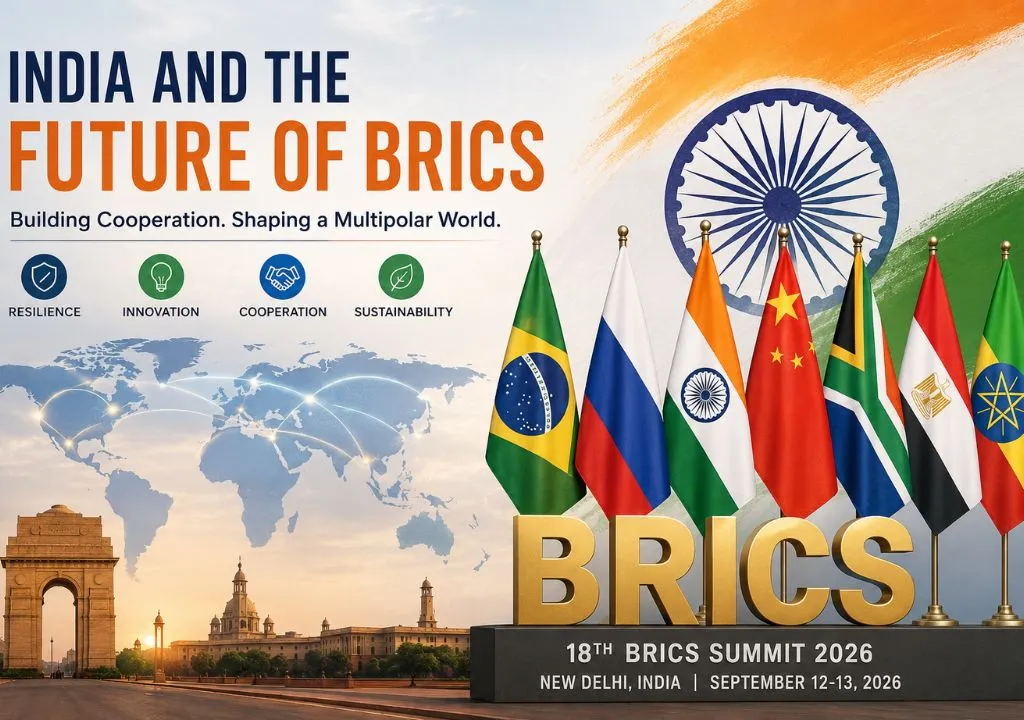
India’s BRICS Presidency in 2026
India took over the BRICS presidency in January 2026, giving it an important opportunity to influence the group’s priorities and working methods. India has identified four broad themes for its presidency: resilience, innovation, cooperation and sustainability.
These themes reflect the challenges facing both BRICS members and the wider developing world. Resilience is important because countries must prepare for economic shocks, health emergencies, supply-chain disruptions and natural disasters. Innovation is necessary for improving productivity, digital services and access to modern technology.
Cooperation remains central to the purpose of BRICS, especially as members face common problems that cannot be solved by one country alone. Sustainability is also becoming more important as countries try to balance economic development with the need to protect the environment.
India wants BRICS to focus on practical issues and produce results that can benefit member countries. It also wants the group to give greater attention to developing countries, which is connected to India’s growing role as a voice for the Global South.
The Global South includes many developing and emerging countries that want a stronger role in global decision-making. These countries often seek better access to finance, technology, markets and development opportunities. India wants BRICS to help represent these concerns more effectively.
Why Is BRICS Important for India? (India and the future of BRICS)
BRICS is important for India because it gives the country a platform to work with several major economies at the same time. These include China, Russia and Brazil, as well as important countries in the Middle East and Africa.
The group also helps India build stronger relationships across Asia, Africa, the Middle East and Latin America. These relationships can support India’s economic interests and strengthen its diplomatic influence.
BRICS gives India an opportunity to discuss global economic issues, including trade, development finance, energy security and international financial reform. India can use these discussions to promote policies that support developing economies.
India can also use BRICS to support reforms in global institutions. For example, India has long called for changes to the United Nations Security Council so that developing countries receive better representation. BRICS provides another platform for India to raise this issue and build support for a more balanced international system.
The group also supports India’s broader foreign policy approach. India wants to maintain strong relationships with different major powers instead of depending too heavily on one country or one political bloc.
India’s Vision for the Future of BRICS
India and the future of BRICS where India wants BRICS to remain focused on cooperation rather than becoming only an anti-Western organisation. Although some members are critical of the existing global order, India believes that BRICS should concentrate on common interests instead of creating unnecessary divisions.
These common interests include economic growth, technology, energy security, sustainable development and greater representation for developing countries. By focusing on these areas, BRICS can remain useful to members with different political views and international partnerships.
This approach may also help BRICS cooperate with countries outside the group. India has relationships with the United States, Europe, Russia, China and many countries in the Global South. Its experience in managing these different relationships can help it find common ground within BRICS.
However, this task will not be easy. BRICS members have different national interests and foreign policies, and they do not always agree on international conflicts. India will therefore need to use careful diplomacy to keep the group focused on areas where cooperation is possible.
BRICS and the Global South
The Global South is an important part of India’s foreign policy, and BRICS can help India strengthen its leadership among developing countries. Many countries in the Global South want more influence in global affairs, along with better access to finance, technology, investment and development opportunities.
India has often presented itself as a voice for these countries. BRICS supports this role by providing a forum where members can discuss issues that affect developing economies.
These issues include food security, energy access, climate change, public health, infrastructure and development finance. BRICS can also help countries share knowledge, technology and successful development experiences.
If BRICS becomes more responsive to the needs of developing countries, it could become a more valuable institution for the Global South. India can support this goal by encouraging wider cooperation and by ensuring that the group’s agenda includes practical development concerns.
India and China: A Major Challenge
India’s relationship with China is one of the most important challenges facing BRICS. Both countries are major members of the group and have strong economic links, but they also have serious differences.
India and China have experienced tensions along their border, and they compete in several economic, technological and strategic areas. Their different views on regional security and global politics can also affect cooperation within BRICS.
At the same time, both countries need to work together in the group. This creates a difficult situation for India, which must protect its national interests while cooperating with China on issues that benefit both countries.
The future of BRICS will partly depend on how India and China manage their differences. If they can separate areas of disagreement from areas of shared interest, BRICS may continue to make progress. If their tensions dominate the group’s discussions, decision-making could become more difficult.
BRICS and the Global Economy
Economic cooperation is one of the main purposes of BRICS. Its members have large consumer markets, major natural resources and rapidly developing economies. These conditions create opportunities for increased trade, investment and joint development projects.
BRICS countries can benefit by reducing barriers to trade and improving business connections. They can also cooperate on infrastructure, agriculture, manufacturing and supply chains.
Financial cooperation is another important issue. Some BRICS members want to reduce their dependence on existing international financial systems and increase the use of national currencies in trade.
There has also been discussion about creating a common BRICS currency. However, this would be extremely difficult because member countries have different economies, financial systems, inflation rates and national priorities.
For this reason, greater financial cooperation may be more realistic than creating a single currency. Members could focus on improving payment systems, expanding development finance and making trade settlements easier without immediately attempting to establish a common currency.
Technology and Innovation
Technology will strongly influence the future of BRICS. Artificial intelligence, digital payments, cybersecurity and digital public services are becoming increasingly important for economic growth and national security.
India has developed strong digital systems, including digital payment networks and digital public infrastructure. Its experience can be useful for other developing countries that want to expand access to financial and government services.
India can share knowledge in areas such as digital payments, online public services and technology-based development. BRICS countries can also cooperate on artificial intelligence by discussing how to use it safely, fairly and responsibly.
Technology cooperation can create new opportunities for businesses, governments and educational institutions. It can also help developing countries improve their digital infrastructure and reduce the technology gap between richer and poorer nations.
Energy and Climate Change
Energy security is another major issue for BRICS. Some members are leading energy producers, while others are among the world’s largest energy consumers. This difference creates opportunities for cooperation in energy trade, infrastructure and technology.
In India and the future of BRICS where India wants BRICS to focus on reliable and affordable energy supplies while also supporting the transition towards cleaner energy. This balance is important because developing countries need economic growth, but they must also respond to climate change.
India supports greater cooperation in renewable energy, energy efficiency and new technologies. At the same time, it believes that developing countries should have access to affordable and dependable energy as they expand their economies.
BRICS can help members share technology, investment and experience in this area. Cooperation could support both energy security and long-term environmental goals.
Challenges Facing BRICS
BRICS has many opportunities, but it also faces serious challenges. One of the main challenges is the growing number of members. Expansion gives the group a wider global reach, but it also makes decision-making more complicated.
Each member has its own national interests, economic priorities and foreign policy goals. Members also have different views on international conflicts and different relationships with the United States and European countries.
These differences can make it difficult for BRICS to reach a common position on sensitive political issues. The group must therefore focus on practical areas where cooperation is possible.
Another challenge is maintaining the group’s main purpose. BRICS needs to show that it can deliver useful results rather than producing only political statements. If disagreements dominate its meetings, cooperation may become weaker.
Within (India and the future of BRICS) India will need strong diplomatic skills during its presidency to manage these differences and keep members focused on shared goals.
The 2026 BRICS Summit in New Delhi (India and the future of BRICS)
India will host the 18th BRICS Summit in New Delhi on September 12 and 13, 2026. The summit will be an important event for India’s foreign policy and diplomatic leadership.
It will bring together leaders and representatives from BRICS countries to discuss major global issues. These may include trade, energy, technology, climate change, development finance and reform of global institutions.
The summit will give India an opportunity to present its vision for the future of BRICS. It will also allow India to demonstrate that the group can support practical cooperation among countries with different political and economic systems.
The success of the summit will depend on the results it produces. Strong statements alone will not be enough. Members will need to agree on practical areas of cooperation and establish clear plans for future action.
What Does the Future Hold for BRICS?
The future of BRICS could develop in several important ways.
First, it could become a stronger economic platform by increasing trade, investment and financial cooperation among its members.
Second, BRICS could become a more influential voice for the Global South. Members could work together to demand better representation for developing countries in global institutions and greater access to development finance.
Third, BRICS could become an important platform for technology cooperation. Members could work together on artificial intelligence, digital systems, cybersecurity and technology education.
Energy and climate cooperation could also expand as countries share resources, investment and technical knowledge. However, disagreements between members could slow this progress.
India (India and the future of BRICS) will have an important role in managing these differences and encouraging cooperation. Its success will depend on whether it can balance national interests with the wider goals of the group.
India’s Role in a Changing World (India and the future of BRICS)
India’s role in BRICS is closely connected to its wider foreign policy that can be figured out through the title of this article (India and the future of BRICS). India wants strong relationships with different parts of the world, including the United States, Europe, Russia, China and countries in the Global South.
Rather than depending on one major power, India wants to maintain strategic flexibility. This means working with different countries according to the issue involved and India’s national interests.
BRICS supports this approach by giving India another platform to cooperate with major emerging economies. At the same time, India can continue its partnerships with Western countries and other international organisations.
This makes India’s role in BRICS (India and the future of BRICS) different from simply supporting one side of global politics. India is trying to build a flexible and balanced foreign policy that allows it to participate in several international partnerships.
Conclusion
India and the future of BRICS are closely connected. India’s BRICS presidency in 2026 gives it an important opportunity to influence the group’s future direction and strengthen its role in global affairs.
India can focus on economic cooperation, technology, energy security, sustainable development and the interests of developing countries. It can also encourage BRICS to become a more practical and effective platform for the Global South.
However, India will face several challenges. Differences between BRICS members can make cooperation difficult, while the relationship between India and China will remain especially important.
India will need to use diplomacy to manage these differences and keep the group focused on shared interests. The future of BRICS will depend on its ability to find common ground and produce meaningful results.
BRICS may not replace existing global institutions, but it can become an important platform for emerging economies. For India, the group is more than an economic partnership. It is also a way to increase India’s influence in global affairs and support a more balanced international system.
As the world becomes more multipolar, India’s diplomatic role is likely to become even more important. (India and the future of BRICS)
If you find this article informational, then visit Globaltides.
